
Putting a scientific equation on a watch dial is not mainly a question of decoration. It is a problem of information design at a very small scale. The notation must remain recognisable, the time display must remain usable, and every element has to survive the transition from a flat dial to an assembled watch.
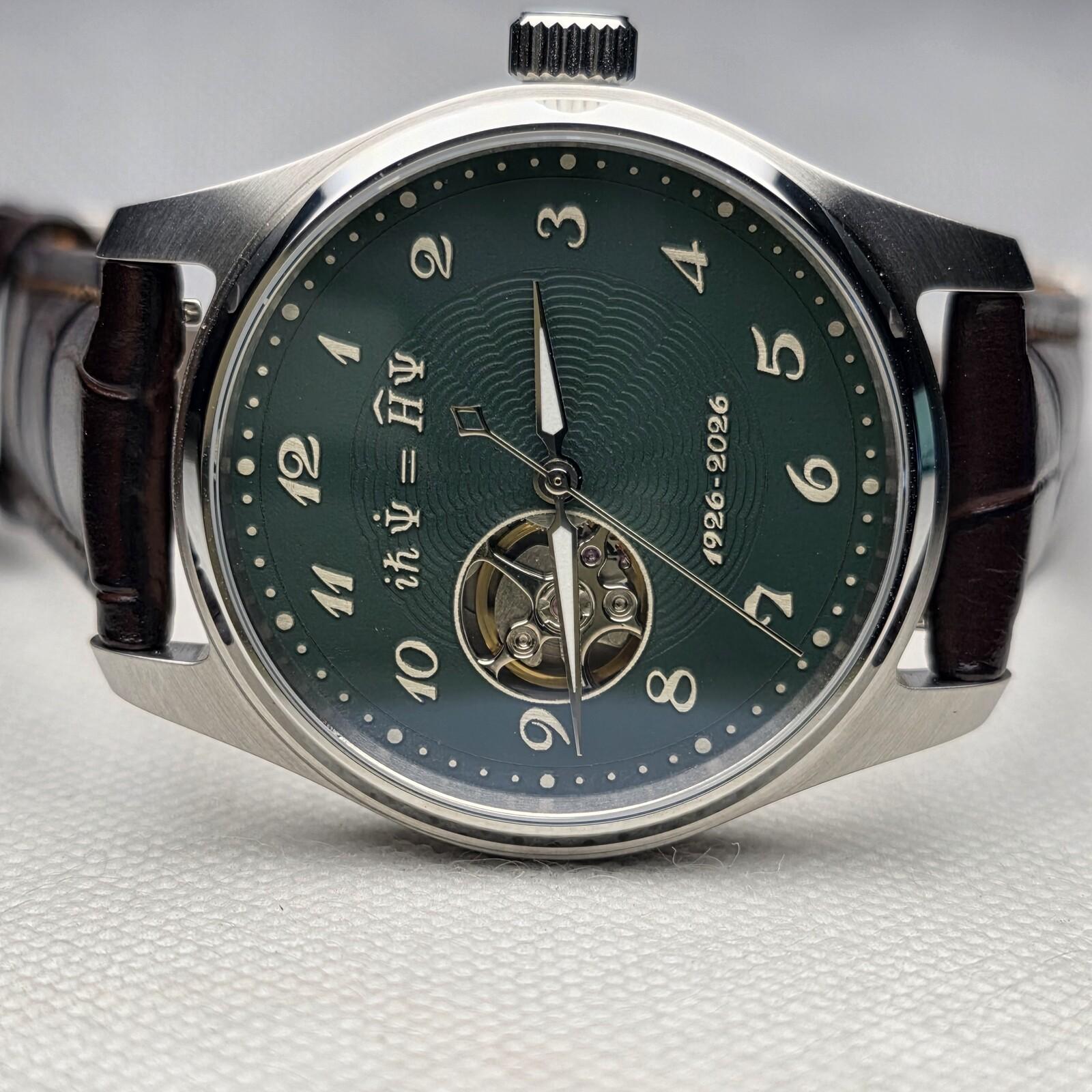
This Rexx Timepieces project makes the design problem unusually clear. Its green dial carries the time-dependent Schrodinger equation, iℏ∂ψ/∂t = Hψ, the dates 1926-2026, a full Arabic numeral track and an open-heart aperture. Each part has meaning, but meaning alone does not make the layout work.
What the Equation Means on the Dial
The time-dependent Schrodinger equation is one of the central equations of quantum mechanics. In simplified terms, it describes how a quantum state changes over time. On this dial, the equation is not used as a technical measurement or a claim about the movement. It is the subject of the design.
That distinction matters. A watch can reference science without pretending that the mechanism performs a scientific function. The equation provides identity and context; the hands and movement still perform the horological work.
Equation Placement Is a Legibility Decision
Long inscriptions are difficult on a watch because the centre is occupied by the hand stack and the perimeter is needed for timekeeping. The equation sits above the centre, while the centenary dates occupy the lower field. This lets the two text elements balance one another without turning the whole dial into a block of copy.
The hands will cross the equation many times each day. That is unavoidable. The useful question is whether the notation remains identifiable when partially covered, and whether the hands remain distinct when they pass over it. Contrast, spacing and line weight matter more here than they do in a static graphic.
An Aperture Creates a Second Centre
An open-heart display pulls attention away from the central pinion because it reveals visible movement activity. Once the aperture is placed off-axis, the rest of the dial has to respond. Numerals may need to move, disappear or change scale. Text must avoid the opening. Empty space becomes active rather than incidental.
In this watch, the aperture, equation and date line create a triangular distribution of visual weight. The design is asymmetrical, but the information remains ordered. That is a better test of success than simple geometric symmetry.
Why the Finished Watch Is the Real Proof
A dial can look controlled under flat workshop lighting and behave differently behind a crystal. Reflections reduce contrast. The rehaut and case make the dial opening feel smaller. Hands obscure details. The strap and case introduce colours and textures that were absent from the isolated component.
For that reason, a credible custom-dial story should show both the component and the assembled watch. The dial photograph proves the detail. The finished-watch photograph proves that the design still works as a wearable object.
Three Rules for Symbolic Watch Dials
- Protect time reading first. Meaningful text should not erase the hour structure or make the hands disappear.
- Design around fixed geometry. Hand clearance, date windows, apertures and dial feet are constraints, not optional graphic elements.
- Approve the assembled result. A component photo cannot reveal every reflection, overlap or scale problem that appears inside the case.
The Watcher HQ View
The strongest symbolic watches do not paste a subject onto an existing dial. They translate it into the visual grammar of a watch. This project succeeds as an instructive example because the equation, open-heart display and centenary dates are visibly part of one composition, while the time display remains present and legible.
The images in this article are owner-supplied workshop evidence from Rexx Timepieces, part of the same watch ecosystem as The Watcher HQ. Read Rexx’s workshop story for the project-specific build context, or watch the verified workshop Short. This article focuses on the broader design lesson.