Beginner Guide to Mechanical Watches
Mechanical watches are small machines worn on the wrist. They do not need a battery to keep time. Instead, they use a wound mainspring, gears, an escapement, and a balance wheel to release energy in a controlled rhythm.
That mechanical system is the reason many people fall in love with watches. A mechanical watch is not only a time display. It is a physical object with movement, sound, friction, adjustment, wear, servicing, and personality.
This guide explains how mechanical watches work, how they differ from quartz and automatic watches, what to expect from accuracy and maintenance, and whether a mechanical watch makes sense for you.
What Is a Mechanical Watch?
A mechanical watch is powered by stored mechanical energy. When the mainspring is wound, it stores energy. That energy slowly releases through the movement, turning the gears and moving the hands.
There are two main types of mechanical watches:
- Manual-wind mechanical watches, which you wind by turning the crown.
- Automatic mechanical watches, which use wrist movement to wind the mainspring through a rotor.
Both are mechanical. The difference is how the mainspring gets wound.
How Mechanical Watches Work
The basic sequence is easier to understand than it looks:
- The mainspring stores energy.
- The gear train transfers that energy.
- The escapement releases energy in controlled steps.
- The balance wheel oscillates back and forth.
- The hands move across the dial.
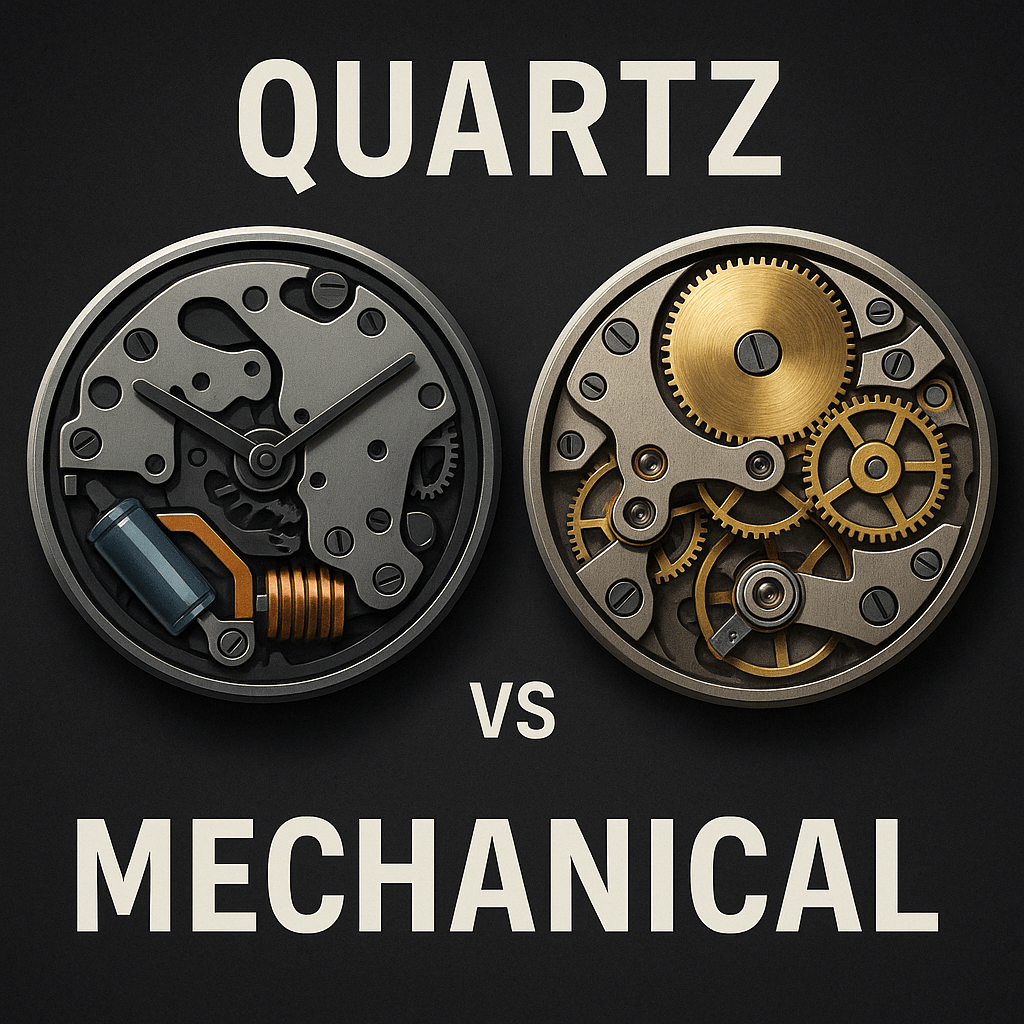
This is why mechanical watches feel different from quartz watches. They are not electronically counting time with a crystal and circuit. They are physically regulating energy through a tiny machine.
For a direct comparison, read Automatic vs Quartz vs Mechanical Watches.
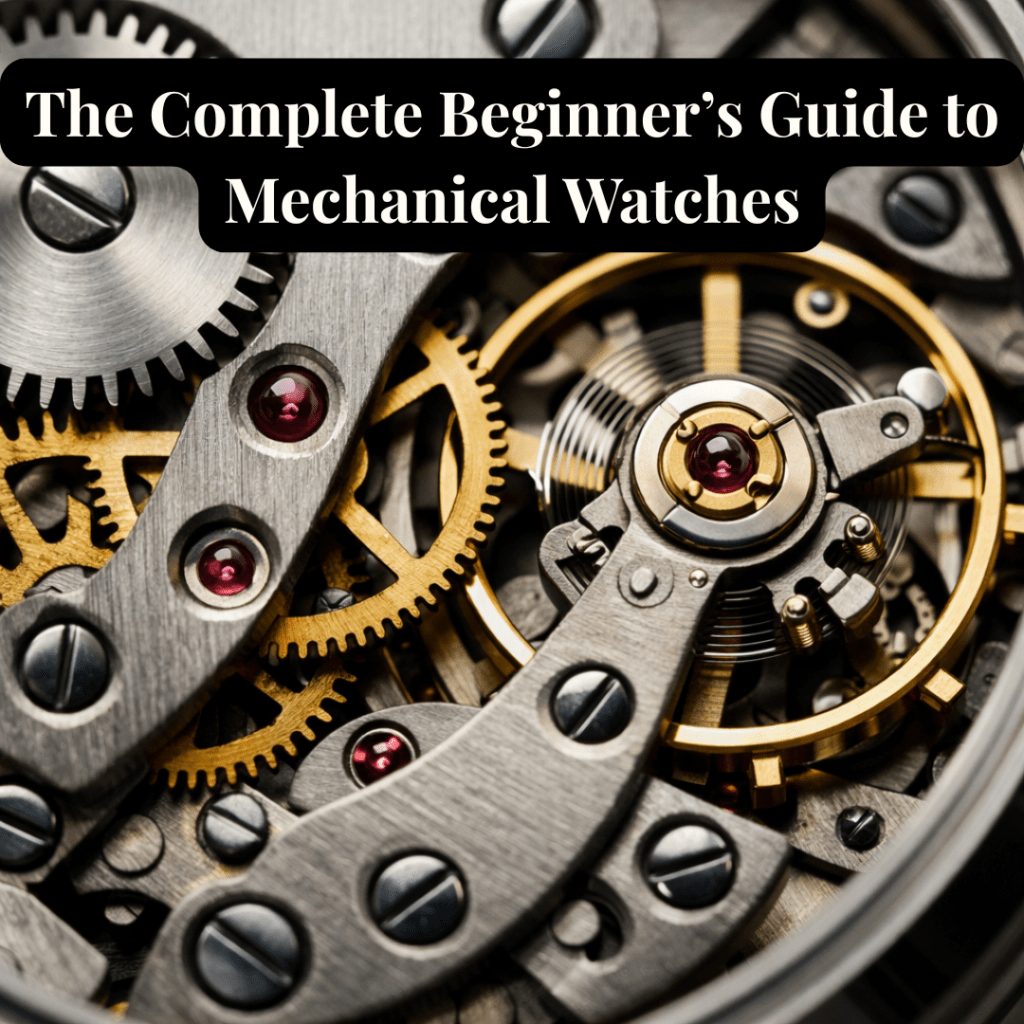
The Main Parts of a Mechanical Movement
You do not need to become a watchmaker to enjoy mechanical watches, but knowing the main parts helps everything make more sense.
- Mainspring: stores the energy that powers the watch.
- Barrel: holds the mainspring.
- Gear train: transfers energy through the movement.
- Escapement: releases energy in controlled impulses.
- Balance wheel: oscillates back and forth to regulate time.
- Jewels: synthetic rubies used as low-friction bearings.
- Rotor: the winding weight found in automatic movements.
Once you understand these parts, a mechanical watch stops feeling mysterious. It becomes a system of energy storage, control, and display.
Manual vs Automatic Mechanical Watches
A manual mechanical watch needs to be wound by hand. For some people, that daily ritual is part of the charm. It creates a small connection between the owner and the watch.
An automatic mechanical watch winds itself while you wear it. The rotor inside the movement turns with wrist motion and winds the mainspring. If you wear the watch regularly, it can keep running without daily hand-winding.
Automatic watches are popular because they give you mechanical character with more convenience. That is why they are common in everyday watches, Seiko mods, custom builds, and small independent watches.
The important beginner lesson is simple: automatic watches are mechanical watches. They are not a third category separate from mechanical. They are mechanical watches with self-winding.
Are Mechanical Watches Accurate?
Mechanical watches are not usually as accurate as quartz watches. That is normal. Even a good mechanical watch can gain or lose seconds per day depending on movement quality, regulation, position, temperature, magnetism, shock, and wear.
For most enthusiasts, that is part of the deal. You do not buy a mechanical watch because it is the most accurate object available. You buy it because it is a tiny mechanical system with character and craft.
If pure accuracy matters most, quartz is usually the better choice. If mechanical charm matters more, a few seconds a day may not bother you.
For a practical way to judge mechanical timekeeping over several days, read Watch Accuracy Explained.
Power Reserve
Power reserve means how long a mechanical watch can run after it is fully wound. Many automatic watches offer around 40 hours, though some movements offer more.
If a watch stops after sitting for a day or two, that does not mean it is broken. It may simply have used its stored energy. You reset the time, wind it, and wear it again.
Power reserve becomes more important if you rotate between several watches. A longer reserve means the watch can sit longer before stopping. A shorter reserve means you may reset it more often.
For a short explanation, read What Is Power Reserve?.
Servicing and Maintenance
Mechanical watches contain moving parts. Over time, oils age, friction changes, seals dry, and parts can wear. That is why mechanical watches may need servicing after years of use.
This is especially important if the watch is opened, modified, or exposed to water. Water resistance should not be assumed after a case has been opened unless the watch has been properly tested.
Mechanical ownership is not difficult, but it is not zero-maintenance. Treat the watch like a small machine, because that is exactly what it is.
Common Beginner Misunderstandings
- Mechanical does not mean more accurate. Quartz usually wins on accuracy.
- Automatic does not mean battery-powered. Automatic watches are mechanical.
- A stopped automatic watch is not usually broken. It may simply be out of power.
- Water resistance is not permanent. Gaskets age and should be tested when needed.
- More jewels do not automatically mean better quality. Jewel count depends on movement design.
- A display caseback does not guarantee a beautiful movement. It only means you can see it.
Why Mechanical Watches Still Matter
Mechanical watches still matter because they offer a type of connection that digital devices and quartz watches do not. They are slower, less convenient, and less accurate, but they are also more tactile and alive.
You can see the movement. You can feel the winding. You can hear the beat. You can understand that the watch is running because energy is being stored and released through a physical mechanism.
That is the appeal. Mechanical watches turn timekeeping from a background function into a small daily relationship with an object.
Who Should Buy a Mechanical Watch?
A mechanical watch makes sense if you enjoy objects with craft, history, and physical function. It also makes sense if you want to understand watches more deeply or eventually explore modding, custom builds, or independent watchmaking.
It may not make sense if you only want perfect accuracy, zero maintenance, and the lowest possible cost. There is nothing wrong with that. Quartz watches are excellent for practical timekeeping.
A good first mechanical watch should be something you will actually wear, not something you bought only because the movement sounded impressive.
Mechanical Watches and Collecting
Mechanical watches often become the point where casual interest turns into collecting. Once you start noticing movement feel, winding, power reserve, caseback design, servicing, and accuracy behavior, watches become more than style objects.
That does not mean every collection needs to be mechanical. A balanced collection can include quartz, mechanical, automatic, vintage, custom, and independent watches. The point is to understand why each one belongs.
For a practical path into collecting, read How to Start a Watch Collection Without Wasting Money.
How Mechanical Watches Connect to Modding
Many Seiko mods and custom watches use automatic mechanical movements because they are reliable, accessible, and easy to build around. The NH35 movement, for example, has become a common foundation for custom builds.
Once you understand mechanical watches, modding becomes easier to understand too. You are no longer only looking at a dial and case. You are thinking about the movement, stem, hands, dial feet, case fit, crown position, and how the whole watch functions.
Continue with What Is Watch Modding? and Best Seiko Mod Parts.
Rexx Timepieces and Mechanical Custom Builds
For Rexx Timepieces, mechanical watch knowledge matters because custom builds are not only visual. Movement choice affects dial compatibility, hand height, stem position, case fit, thickness, crown feel, and long-term reliability.
A custom mechanical watch works best when the design and movement are chosen together. A beautiful dial can still fail as a build if the movement, hands, case, and clearance do not agree.
If you want a workshop-led custom mechanical watch, start with Rexx custom watches. For a dial-first idea, use the Rexx custom dial designer.
Meshberg and the Quiet Automatic Watch
Meshberg Watches represents the quieter independent side of mechanical watchmaking. The Meshberg 37 Automatic is not about showing off a movement spec for its own sake. It is about proportion, dial character, small-batch identity, and a compact automatic watch that feels deliberate.
That is a useful reminder for beginners. A mechanical or automatic movement is only part of the watch. The case, dial, strap, proportions, and finishing decide whether the finished object feels resolved.
Explore the Meshberg 37 Automatic as a restrained independent example.
Final Thoughts
Mechanical watches are not the most convenient way to tell time. That is exactly why they remain interesting. They turn timekeeping into something physical, visible, and personal.
For beginners, the best approach is simple: understand the tradeoffs, buy something you will actually wear, and do not confuse mechanical charm with perfection.
A mechanical watch is a machine. That is the whole point.