New vs pre-owned watches is not simply a choice between paying more for something untouched and paying less for something worn. The real decision is how much certainty you want, what evidence comes with the watch, and which future costs you are willing to accept.
A pre-owned watch can be the smarter purchase. It may offer a discontinued design, a better specification for the money, or a price that has already absorbed the first owner’s depreciation. It can also arrive with an unknown service history, altered parts, weak water resistance, or a return policy that leaves little room to discover those problems.
A new watch usually offers a cleaner ownership trail, a manufacturer or retailer warranty, and fewer questions about condition. But new does not automatically mean better value. Current retail pricing can move with currencies, supply, tariffs, and brand strategy. In July 2026, Watches of Switzerland Group specifically described navigating tariff-driven price and margin changes in the United States while also reporting that certified pre-owned continued to gain traction.
The useful question is therefore not “Which is always better?” It is “What exactly am I receiving for the total price?” These nine checks make that answer much clearer.
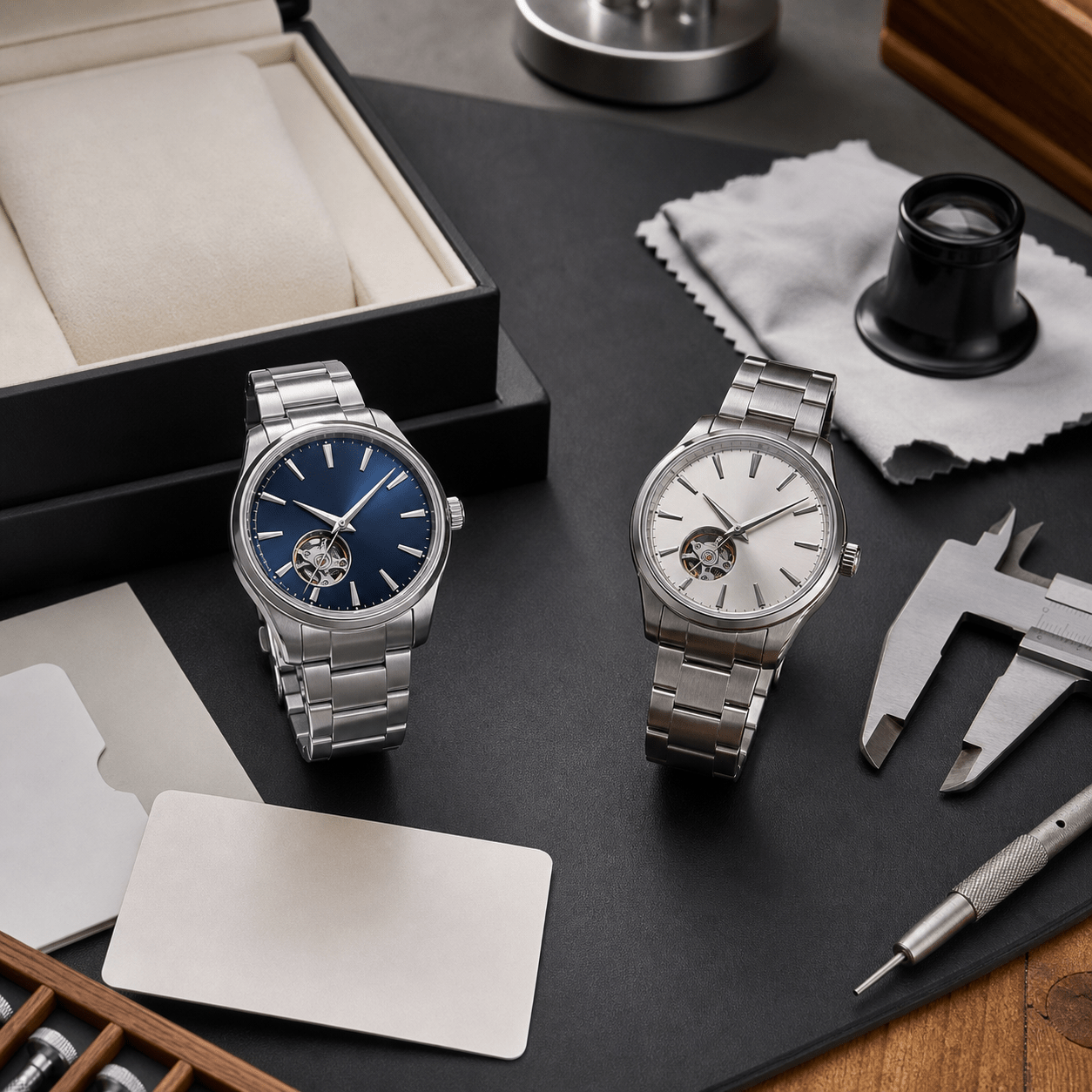
New vs Pre-Owned Watches at a Glance
Buying New Usually Gives You
- A clear ownership and warranty start date
- Known factory configuration
- Full retailer return terms where offered
- No prior wear, polishing, or hidden service history
- The current model, packaging, and supplied accessories
Buying Pre-Owned Can Give You
- A lower price or more watch for the same budget
- Access to discontinued and vintage references
- Less exposure to first-owner depreciation
- Real photographs of the exact watch
- Character, patina, or a configuration no longer sold new
Neither column is a guarantee. A grey-market “new” watch may have a seller warranty rather than a manufacturer warranty. A carefully documented pre-owned watch may be mechanically better prepared than an old unsold watch that has sat for years. When comparing new vs pre-owned watches, labels matter less than the evidence behind them.
1. Compare the Total Cost, Not Only the Listing Price
The visible discount is only the beginning. Add sales tax or import charges, insured shipping, bracelet links, a missing strap or clasp, and any service the watch may need soon after purchase. A pre-owned mechanical watch that appears $700 cheaper can lose most of that advantage if it immediately needs a full service, crown work, a crystal, or a pressure test.
For a new watch, ask whether the retailer is discounting an outgoing reference, selling through an authorized channel, or providing its own warranty. For a pre-owned watch, create a service reserve before deciding what you can afford. The older, more complicated, or less documented the watch is, the larger that reserve should be.
This is the same discipline that matters when you start a watch collection without wasting money: protect room in the budget for ownership, not only acquisition. Buyers comparing lower-priced current models can also use our guides to automatic watches under $500 and watches under $1,000 as a reality check against the pre-owned alternative.
2. Identify Who Actually Provides the Warranty
“Warranty included” is incomplete information. Find out who stands behind it, when it begins, how long it lasts, which countries it covers, whether it transfers to another owner, and what exclusions apply. A manufacturer warranty, a retailer warranty, and a marketplace protection program are not interchangeable.
Certified pre-owned programs can narrow the gap. Rolex says its Certified Pre-Owned watches are authenticated in Rolex workshops, fully serviced, tested, and supplied with a two-year international guarantee. That is a specific brand-backed program, not a description of the ordinary second-hand market.
For any purchase, save the listing, invoice, warranty terms, serial information, and the seller’s written answers. If the warranty depends on returning the watch to one overseas dealer, include that shipping risk and delay in your decision.
3. Separate Authentication from Mechanical Condition
An authentic watch can still run poorly. It can be overdue for service, lose amplitude, have a damaged automatic winding system, show moisture damage, or fail a pressure test. Authentication answers whether the watch and its components meet a stated authenticity standard. It does not automatically prove that the watch is accurate, recently serviced, or water resistant.
eBay’s official watch authentication terms illustrate the distinction. They say eligible watches are physically inspected for authenticity and consistency with the listing. The same guidance warns that many vintage and used watches may not retain their original water resistance. That means the blue authentication badge is useful, but it is not a substitute for a mechanical inspection.
Ask for a recent timegrapher result where relevant, but interpret it carefully. One reading in one position is not a complete diagnosis. Our guide to watch accuracy and seconds per day explains why position, power reserve, beat error, amplitude, movement condition, and real wrist use all matter.
4. Ask What Is Original, Replaced, or Modified
Originality is not a simple moral score. Gaskets, crystals, crowns, hands, bracelets, movement components, and even dials may be replaced during decades of maintenance. A correct service part can make a watch more usable. A poorly disclosed aftermarket dial can materially change its identity and value.
The important standard is disclosure. Ask which parts are original to the watch, which are genuine service replacements, which are aftermarket, and whether the seller has evidence for those claims. Chrono24 notes in its Buyer Protection guidance that authentic watches may contain replacement parts and that non-original components are especially common in vintage watches; it requires known replacement parts to be disclosed in dealer listings.
Do not treat “all original” as proven because it appears in a title. Compare fonts, lume color, hand length, case reference, movement caliber, clasp codes, and period-correct details with reliable references. If branding itself is questionable, our guide to homage versus replica watches explains the more fundamental identity problem.
5. Verify the Service History
“Recently serviced” should lead to four questions: serviced when, by whom, what work was done, and is there an invoice? A pressure test alone is not a movement service. Regulation alone is not a service. A seller opening the case and describing the movement as clean is not a service.
A useful invoice should identify the watch and describe at least the major work performed. For vintage watches, the identity of the watchmaker and the parts policy can matter as much as the date. Some owners prioritize cosmetic originality; others prioritize reliable daily wear. The right service approach depends on which outcome the buyer values.
No paperwork does not prove neglect, but it increases uncertainty. Price that uncertainty honestly. If the seller cannot document the service, assume you may need one rather than building your budget around an unverified claim.
6. Inspect Condition Beyond the Obvious Scratches
Hairline scratches are often less important than altered geometry. Look at the lugs, bezel edges, case transitions, crown guards, and brushing direction. Heavy polishing can soften edges, create uneven lugs, remove metal around spring-bar holes, and change how the bracelet meets the case.
Check the bracelet for stretch, missing links, damaged screws or pins, and clasp wear. Inspect the crystal for chips near the edge, the crown for rough operation, and the caseback for signs of careless opening. On the dial, look for moisture marks, flaking lume, shifted markers, scratches around the hand stack, or hands that do not match the reference.
Material changes how wear appears. Titanium picks up marks differently from polished steel, gold is easier to reshape through polishing, and coated cases can expose the underlying metal at high-contact points. The Watcher HQ guide to watch case materials helps translate those marks into practical ownership consequences.
7. Treat Water Resistance as a Current Test Result
A depth rating engraved on an old caseback describes the watch when it met the manufacturer’s specification, not necessarily its condition today. Gaskets age. Crowns wear. Crystals and casebacks are opened. Previous repairs can alter sealing surfaces.
If water resistance matters, ask for a recent pressure-test result from a qualified watchmaker and confirm what was tested. For a newly purchased used watch, it is sensible to avoid swimming until the watch has been checked. Even Rolex notes that exceptions may apply to the waterproofness and original precision of some of the oldest watches in its own rigorously serviced Certified Pre-Owned program.
“It was fine in the sink” is not evidence. Neither is condensation-free shipping. Water resistance is a condition to verify, not a permanent personality trait.
8. Judge the Seller and the Transaction Structure
A good watch sold through a weak transaction can still become a bad purchase. Check how long the seller has operated, whether reviews describe similar watches, how disputes are handled, and whether the seller answers specific questions with specific evidence.
Use a payment method and platform process that preserve recourse. Chrono24 says its Buyer Protection can hold payment in escrow after delivery, giving the buyer time to inspect the watch before funds are released. Its terms differ between dealer and private-seller purchases, so read the exact return and escrow conditions for the listing rather than assuming every transaction has the same protection.
Keep communication on the platform when possible. Do not move to an irreversible payment method because the seller offers a small discount. Confirm the return window, who pays insured return shipping, what condition the watch must remain in, and whether removing a security tag ends your return rights.
9. Understand How Modifications Change the Purchase
A modified or custom watch is not automatically inferior. It can contain excellent components, thoughtful design, and real workshop skill. But it belongs to a different buying category from an original factory watch, and the seller should describe it that way.
Platform protection may also change. eBay currently excludes watches it defines as customized from its watch Authenticity Guarantee. That includes configurations where original brand parts have been replaced with non-brand parts, parts do not match the model or era, or components have been modified from the original design.
For a modified watch, ask who built it, which base watch or movement was used, which parts are aftermarket, whether any protected branding appears on non-original components, and who will service it. Transparent custom work can be an honest purchase. A mod presented as an untouched factory reference is not.
The Watcher HQ view: the best pre-owned purchase is not the watch with the largest discount. It is the watch whose identity, condition, service needs, seller, and transaction risk are understood well enough that the remaining uncertainty is reflected in the price.
When Buying New Makes More Sense
Buy new when certainty is worth more to you than the discount. That is especially reasonable for a first mechanical watch, a gift, a watch intended for frequent water use, a complicated movement, or a model where the used-price difference is small.
New can also be the cleaner choice when you strongly care about an untouched case, current factory specification, a complete set, or a straightforward warranty relationship. If the watch will mark an important event, the ownership history beginning with you may have value that does not appear in a spreadsheet.
When Buying Pre-Owned Makes More Sense
Buy pre-owned when the evidence is strong and the price leaves room for realistic ownership costs. In the new vs pre-owned watches decision, the used option is often compelling for discontinued references, watches with stable service support, models whose initial depreciation has already occurred, and designs you can inspect through detailed photographs of the exact example.
Pre-owned also lets a fixed budget reach a higher level of finishing, movement, or case construction. But the jump is only real if the watch is healthy. A bargain that requires immediate expensive work is simply a deferred invoice.
Pre-Owned Watch Buyer Checklist
- Confirm the exact reference, serial-range logic, size, movement, and configuration.
- Save the full listing, photographs, seller answers, invoice, and warranty terms.
- Ask what is original, serviced, replaced, refinished, polished, or modified.
- Request service documentation and recent performance evidence where practical.
- Inspect dial, hands, crystal, crown, case geometry, bracelet, clasp, and accessories.
- Do not rely on the original water-resistance rating without a current test.
- Calculate tax, import, shipping, missing parts, and a realistic service reserve.
- Read the exact authentication, escrow, return, and final-sale rules.
- Walk away when the seller’s certainty is greater than the evidence.
Frequently Asked Questions
Are pre-owned watches always cheaper than new watches?
No. Discontinued, scarce, or highly demanded watches can trade above their original retail price. Even when the listing price is lower, service, tax, shipping, missing accessories, and repairs can make the total cost higher than expected.
Does authentication mean a used watch has been serviced?
Not unless the program explicitly says so. Authentication establishes identity under a defined standard. Mechanical condition, accuracy, service history, and water resistance require separate evidence. Some brand-run certified programs include service; many marketplace authentication checks do not.
Are replacement parts bad in a pre-owned watch?
Not automatically. Gaskets and movement components are normal service items, and genuine replacement parts can keep a watch reliable. The concern is whether parts are correct, whether changes affect originality or value, and whether the seller discloses them accurately.
Can you swim with a pre-owned watch?
Only after its current water resistance has been properly tested and its crown, crystal, caseback, and seals are known to be suitable. Do not rely only on the depth rating printed on an older watch.
Is certified pre-owned worth the premium?
It can be when the certification includes meaningful authentication, inspection, service, warranty, and return support. Compare the actual program terms with the price difference. A certificate is valuable only to the extent that it reduces a risk you care about.