Watch dial materials are becoming one of the clearest dividing lines between a watch with a real point of view and one that merely looks busy. Engraving, paper, stone, enamel, forged composites, chemical darkening, and laser texture can all create a strong first impression. None of them guarantees a good dial.
The best material-led dials do more than add surface interest. They change how light moves across the watch, how the markers sit in the composition, how legibility holds up at different angles, and how convincingly the finished object reflects the process used to make it.
That distinction matters in 2026 because texture is everywhere. Some of it is genuine craft. Some is industrial technique used intelligently. Some is decoration searching for a story after the fact. The useful question is not whether a dial is handmade or unusual. It is whether the material and process make the watch better.
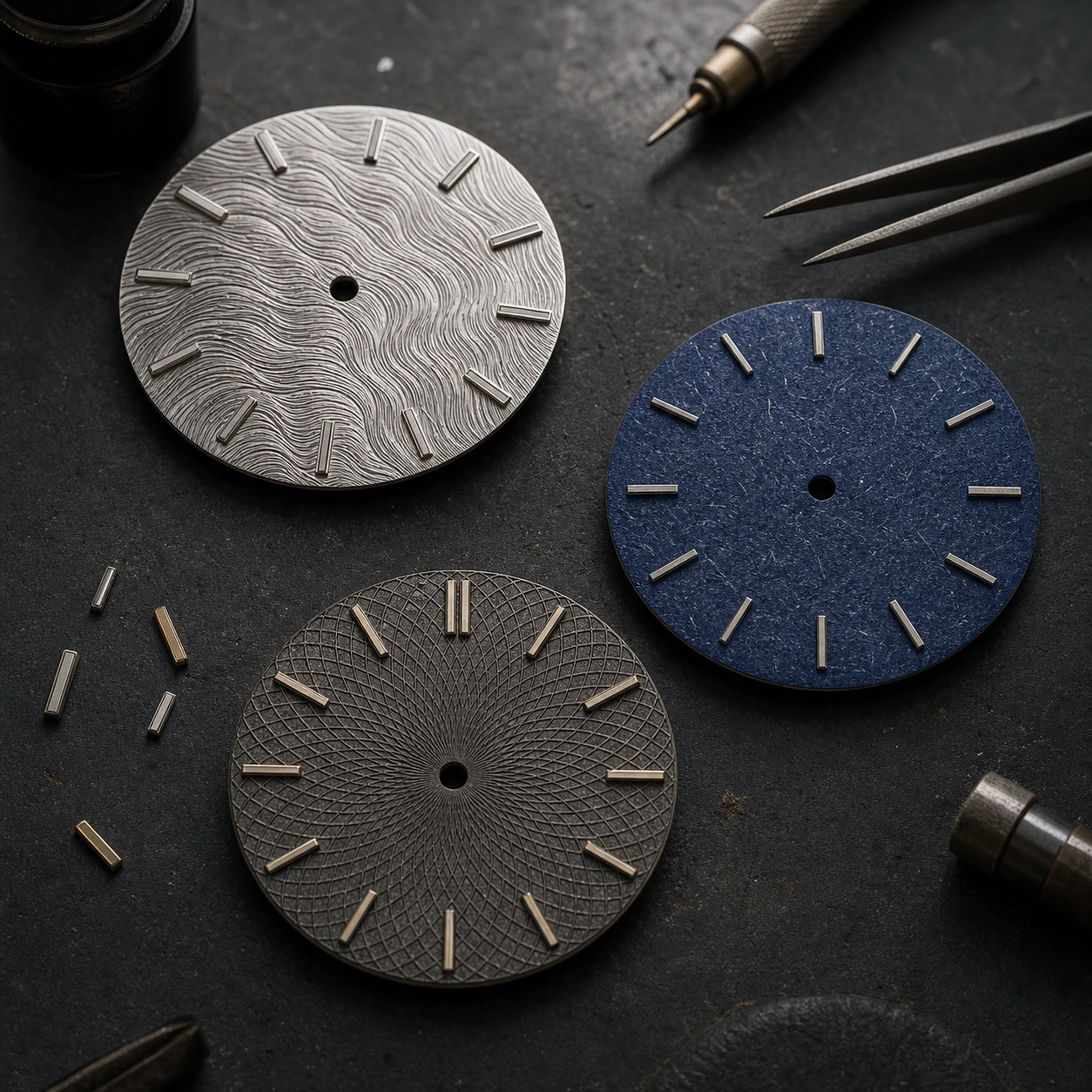
The Dial Is Becoming Evidence, Not Just Decoration
A conventional dial can be excellent. Clear printing, controlled color, well-proportioned markers, and correctly sized hands often produce a better watch than an expensive material used without discipline. Material is not a substitute for design.
What has changed is the way collectors read a dial. A surface can now serve as evidence: evidence of engraving, dyeing, firing, hammering, oxidation, brushing, or another process that leaves a visible result. That evidence makes the watch feel more specific because the dial is no longer only carrying graphics. It is carrying traces of how it was made.
This is the stronger side of the movement explored in our guide to art dials and independent dial makers. A successful art dial is not simply decorative. It makes technique part of the identity of the watch without forgetting that the owner still needs to read the time.
Grand Seiko: Engraving That Continues Across the Whole Watch
The Grand Seiko SBGZ011, announced for July 2026 in a limited edition of 50, is a useful high-end example because its dial does not operate as an isolated visual trick. Grand Seiko says the dial is hand-engraved with lines moving in multiple directions, while the lettering and minute markers are carved directly into the surface. The platinum case is hand-engraved as well.
That continuity is the important part. The dial, case, hand-finished details, and manually wound Spring Drive calibre 9R02 all belong to the same idea of controlled craft. The texture is not pasted onto an otherwise unrelated watch. It continues through the object.
There is also restraint inside the complexity. Applied 14-karat white-gold markers and hand-curved hands give the dial structure. The engraving creates movement, but the time display still has hierarchy. This is where elaborate texture earns its place: the surface changes constantly in the light, yet the watch does not abandon its primary function.
The lesson is not that a dial needs this level of labor or price to be legitimate. It is that material should be coherent with the case, hands, movement, and intent of the watch. A less expensive watch can follow the same principle even when the manufacturing method is completely different.
Citizen: When the Dial Material Has a Technical Job
Citizen offers a different answer. The 2026 The CITIZEN AQ4094-58L uses hand-dyed indigo Tosa washi paper. The paper has a visible fiber structure and is colored through a traditional natural lye fermentation dyeing process, but its value is not only cultural or visual.
Washi is also suitable for a light-permeable Eco-Drive dial. Citizen explains that light passes through the dial to power the movement, which means the material has to support the function of the watch. The company also notes that the dyeing process must preserve the right balance of color and light permeability.
This is an excellent example of material doing more than telling a story. The irregular fibers alter the texture. The indigo changes in different light. The paper contributes individual variation. At the same time, the dial is part of the energy system of the watch.
Traditional craft and industrial watchmaking are often described as opposites. This dial shows why that division can be too simple. A natural material, hand-dyeing process, solar technology, high-accuracy quartz calibre, and Super Titanium case can coexist when each choice has a clear job.
Material Alone Does Not Make a Good Dial
The rise of unusual watch dial materials creates an obvious risk: novelty can become the whole design. A dramatic surface photographs well, but a watch is viewed in motion, at arm’s length, under bad indoor lighting, and from angles that marketing images rarely show.
A convincing material-led dial still has to solve ordinary problems:
- Legibility: the hands and markers need enough contrast against the changing surface.
- Hierarchy: texture should support the time display instead of turning every part of the dial into the loudest part.
- Scale: a pattern that looks impressive in a macro photograph may become visual noise on a 36mm or 37mm watch.
- Clearance: applied texture, markers, date frames, and hand stacks must work within the available space.
- Consistency: natural variation can be desirable, but uncontrolled defects should not be excused as character.
- Honest claims: brands should explain what is handmade, what is machine-made, what is finished by hand, and what the material actually is.
These checks are closely related to the practical reasons a dial can look cheap. Our short guide to what makes a watch dial look cheap focuses on alignment, proportion, printing, markers, hands, and finishing because unusual material cannot rescue weak fundamentals.
Strata: Workshop Process at a Different Scale
Meshberg Strata belongs in this conversation for a different reason and at a different scale. It is not being presented as an equivalent to the Grand Seiko or Citizen projects. It is evidence of how material-led thinking can work inside a small independent workshop ecosystem.
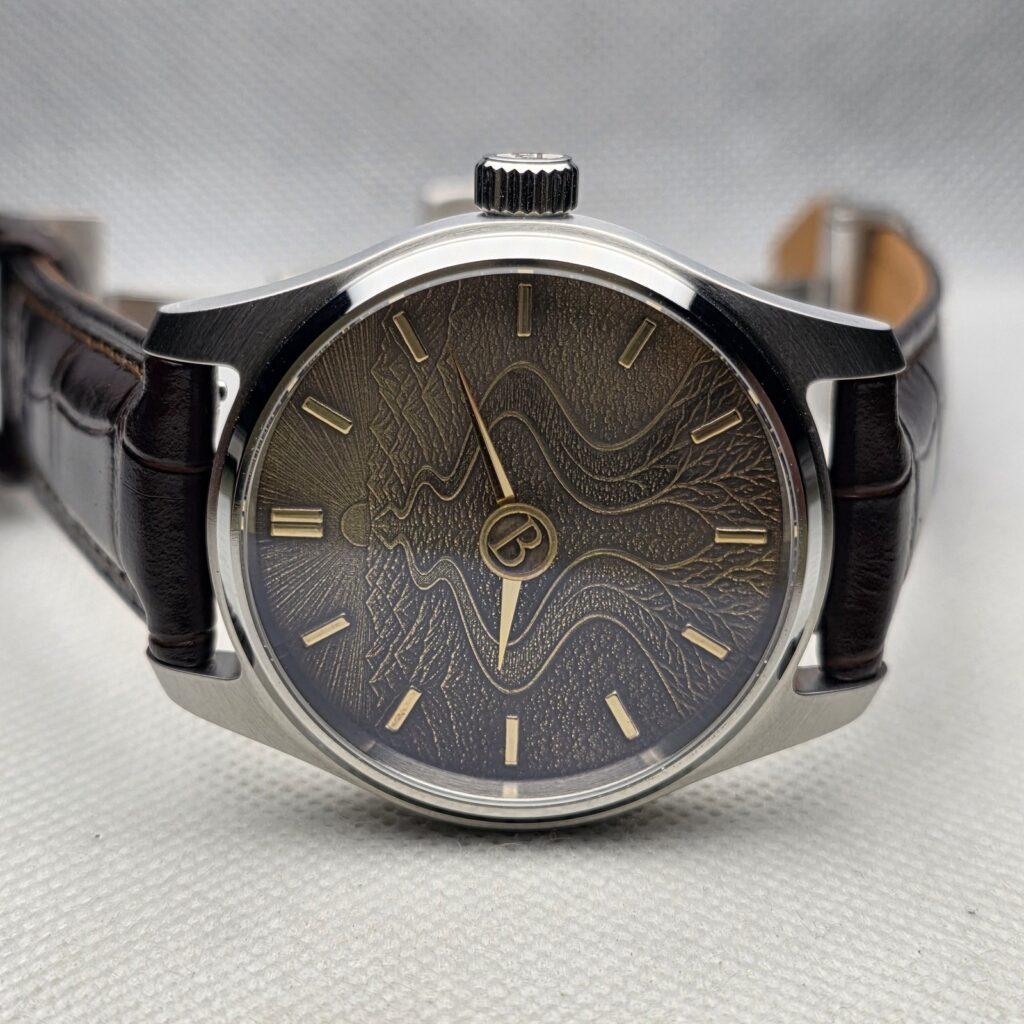
Strata is a 36.5mm automatic watch powered by a Sellita SW200-1 movement. Its dial is laser-made, hand-finished, and chemically darkened. The project was developed as a collaboration between Meshberg Watches and the workshop side of Rexx Timepieces and Rexx StudioWorks.
The darkened surface is not perfectly flat or anonymous. The process creates depth that appears and recedes as the angle changes. Gold-tone markers give the composition structure, while the compact steel case and bracelet keep the dial from becoming detached from the rest of the watch.
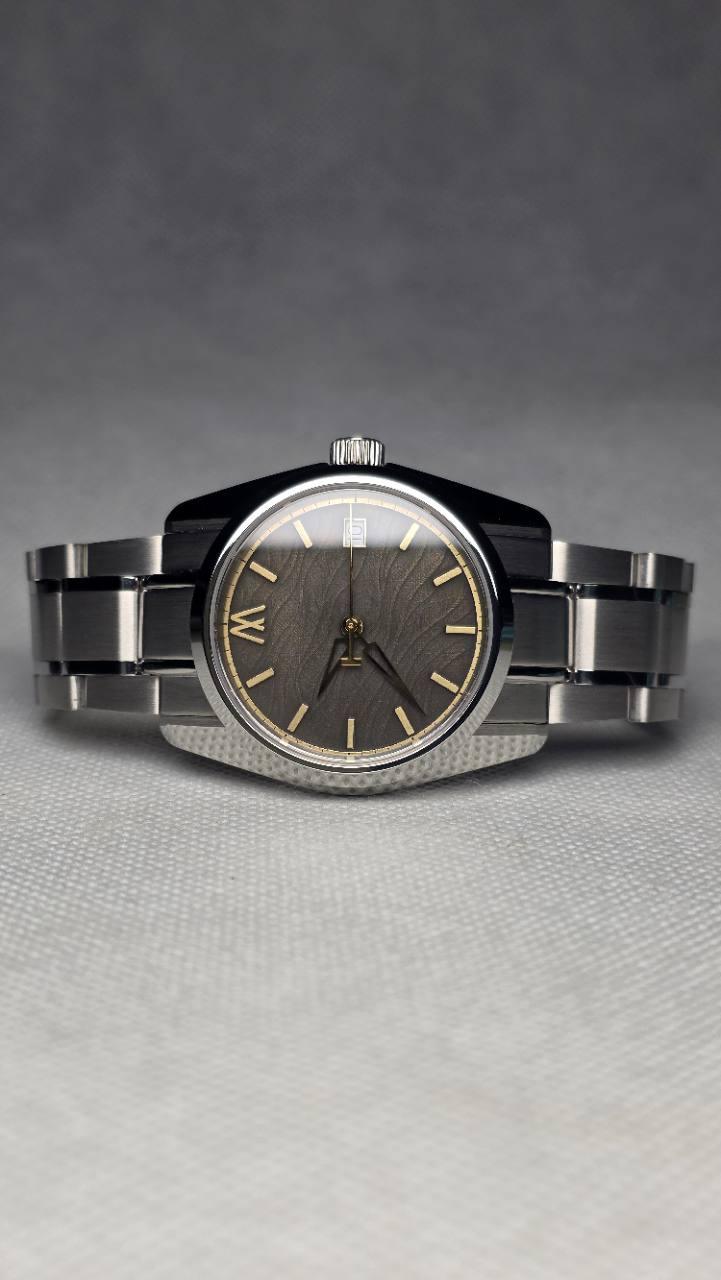
The process is visible, not merely claimed. The Rexx Timepieces Short Handcrafting a Watch Dial for MESHBERG Watches | Rexx StudioWorks shows the dial being developed and finished in the workshop.
This is the useful advantage of a connected ecosystem. Meshberg can remain quiet and product-focused, while Rexx provides workshop proof and Rexx StudioWorks represents the small-batch craft layer. The process is available for inspection instead of being hidden behind generic luxury language.
Engraved Metal and Hand-Poured Resin: When Mixed Media Earns Its Place
The Rexx Timepieces Short Laser Engraving Meets Hand-Poured Resin | A One-of-One Watch Dial documents a different material route. The dial begins as engraved metal. Hand-mixed resin, pigments, and shimmering mica are then added, with the small sections filled individually by hand.
The useful point is not simply that several materials appear on one dial. Engraving creates boundaries and depth; the filled sections introduce color and reflected light. The result still has to be judged as a watch dial: the composition needs hierarchy, the hands need contrast, and the surface must not overwhelm the time display. Mixed media earns its place when every process has a visual job.
A Material Name and a Making Method Answer Different Questions
A precise description should help you separate the dial’s material from the treatment that gives it texture. Zelos’s Helmsman variants provide three useful examples:
A pale, glossy dial does not reveal how it was made. Glashütte Original describes the 2026 Senator Meissen Cherry Blossom as hand-painted porcelain made by Meissen. anOrdain’s porcelain uses a glazed clay body, while its vitreous enamel is glass fused to a metal base. Both can involve kiln firing, but that shared step does not make them the same construction. Read the maker’s description of the exact dial before using either term.
| Version | What the maker identifies | What to avoid assuming |
|---|---|---|
| Aventurine | Aventurine glass dial | A natural-stone slice simply because the name sounds mineral |
| Garnet | Crushed red garnet dial | A single uninterrupted slice, or an undisclosed bonding method |
| Teal MOP | Mother-of-pearl with a fumé treatment and a wave pattern made by CNC | Traditional engine turning or hand engraving from the pattern alone |
These descriptions explain different choices; they do not establish a quality ranking. Read the maker’s exact wording, then use the ordinary-light, legibility and variation checks below. A photograph can help you assess appearance, but it cannot independently identify every material or manufacturing step.
A visible example of a making method is Rexx’s aviation dial. In the maker’s discussion of its laser and finishing process, Meidan explains how background removal, blue lacquer and hand finishing produce raised metal artwork. It is an engraved and painted metal dial: its colour and relief come from different stages of the process.
What Buyers Should Look for in a Material-Led Dial
When a brand promotes a special dial material, look beyond the first macro photograph. The following questions reveal whether the material is doing real work:
- Can you identify the actual material and process? Terms such as handmade, artisan, textured, and inspired are not enough on their own.
- Does the dial look good in ordinary light? Search for wrist photographs, side angles, video, and unfiltered workshop images.
- Are the hands still readable? A dark hand over a dark textured surface may disappear even when the dial looks impressive in a studio image.
- Does the process fit the whole watch? The case, hands, markers, movement, and strap or bracelet should support the same design direction.
- Is variation explained honestly? Natural paper, oxidation, stone, patina, and hand finishing can create differences. Buyers should know which differences are expected.
- Is there proof? Process photographs, workshop video, maker attribution, and precise descriptions are more useful than vague claims.
- Would the watch still work without the story? The strongest material-led dial remains legible, proportionate, and wearable after the marketing language is removed.
For a deeper look at the physical stages behind workshop dial work, read how custom watch dials are made. It covers design preparation, material selection, engraving, surface finishing, printing or marker application, fit, and final inspection.
What This Means for Microbrands and Custom Watches
Large manufacturers can invest in specialist crafts, proprietary materials, and long development programs. Small brands and custom workshops have a different advantage: they can work directly, experiment in smaller quantities, and let the identity of a specific dial lead the project.
That freedom is valuable, but it needs discipline. A microbrand should not use a dramatic dial to disguise an unresolved case, poor hand proportions, or generic product development. A custom watch should not promise that every visual idea is mechanically practical. The material has to survive contact with the actual case, movement, hands, crystal, and wearer.
This is why the most credible small-scale work is usually close to the bench. Rexx custom watch dials can be discussed in relation to a real build, while Meshberg can use experimental dials inside a more restrained small-batch brand language. One side proves the process; the other edits the result.
For collectors, this makes workshop proximity a useful trust signal. It does not guarantee quality, but it makes the design decisions easier to question, document, and understand.
Final Take: Texture Should Leave a Reason, Not Just a Pattern
The strongest dial trend in 2026 is not simply more texture. It is the growing expectation that a dial should explain itself through material, process, and performance.
Grand Seiko uses engraving as part of a coherent hand-finished object. Citizen gives indigo-dyed washi both visual and technical work. Strata shows how a laser-made, hand-finished, chemically darkened surface can give a compact independent watch a specific identity when the process is visible and the surrounding design remains controlled.
These watches are not comparable in price, scale, or manufacturing structure, and they do not need to be. Together they point to the same standard: unusual watch dial materials matter when they improve the relationship between the watch, the light, the maker, and the person reading the time.
Decoration can catch the eye. Material used with purpose gives the eye a reason to return.