
How to inspect watch finishing without being misled by price, branding, fingerprints, or dramatic macro photography comes down to one discipline: inspect the watch as a complete object before hunting for microscopic faults. Start with clean surfaces, neutral light, and the correct comparison. Then examine geometry, transitions, dial alignment, hands, crystal, bracelet, and visible movement work in a repeatable order.
Finishing is not the same thing as decoration. A watch can have mirror polishing, a textured dial, and an exhibition caseback yet still feel unresolved. Another watch may look simple but show excellent control in its case lines, brushing direction, marker placement, hand finish, and bracelet fit. The useful question is not how many finishes a watch has. It is how consistently those finishes serve the design.
The short answer: good watch finishing preserves intended geometry, applies each surface treatment consistently, keeps transitions controlled, and supports legibility and wear. A scratch is not automatically poor manufacturing. A polished surface is not automatically high quality. Judge execution against the material, design, price, age, and stated purpose of the watch.
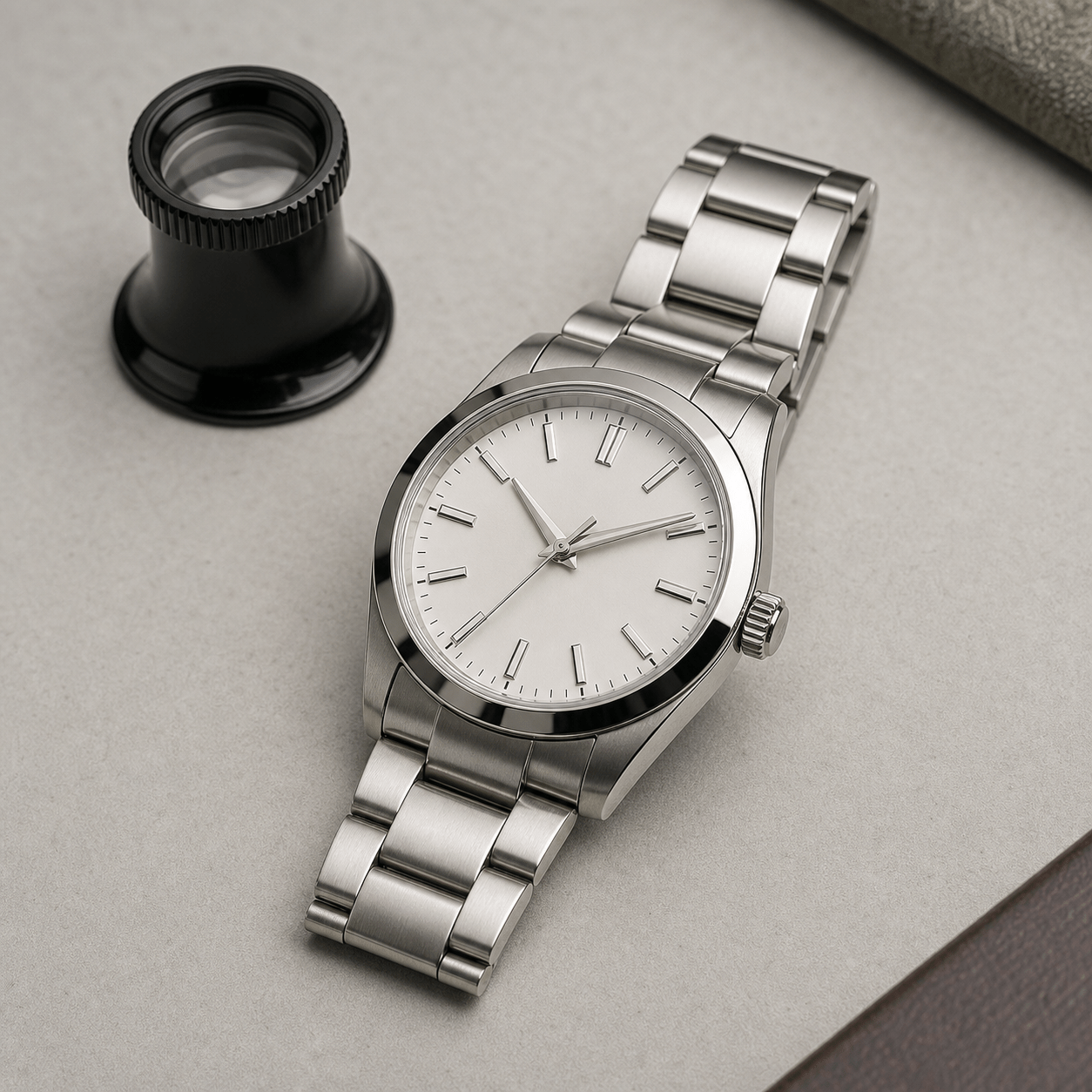
How to Inspect Watch Finishing: Set Up the Test First
Do not begin under a jewelry-store spotlight. Hard point light creates dazzling reflections that can hide shallow distortion while making every dust particle look catastrophic. Start in diffuse daylight near a window or under a broad neutral lamp. Rotate the watch slowly rather than moving it randomly. A controlled change in angle tells you how one plane meets the next.
Clean the watch with an appropriate dry microfiber cloth before judging it. Fingerprints make polished steel look cloudy, and skin oil can exaggerate marks on anti-reflective coatings. Do not wash an unfamiliar watch until you know its water-resistance condition, crown design, and strap requirements. Rolex, for example, advises confirming that the crown is fully screwed down before washing a suitable watch and reserves professional polishing for trained service work in its official watch-care guidance.
Use the naked eye first, then modest magnification. A loupe is useful for understanding how something was made, but a flaw visible only at extreme magnification may have little effect on daily ownership. The order matters: wrist, hand, close view, then magnification.
Compare Like with Like
A fair inspection needs context. Stainless steel, titanium, bronze, ceramic, coated metal, and precious metals do not behave identically. A tool watch intended to tolerate hard use should not be judged by the same decorative priorities as a polished dress watch. A handmade dial may show controlled variation that would be unacceptable in a mass-printed minute track, while a deliberately rough surface should still look intentional.
Price matters, but not as a permission slip. Higher prices can support more hand work, more finishing stages, tighter component selection, and more inspection time. They do not guarantee those things. At lower prices, evaluate whether the manufacturer spent its limited budget intelligently: clean brushing, readable hands, aligned markers, and a stable bracelet often matter more than an extra polished bevel.
| Do compare | Do not assume |
|---|---|
| Watches with similar materials, purpose, and price | Every polished surface represents more skill than a brushed one |
| The left and right sides of the same case | Every visible mark was created at the factory |
| Repeated markers, numerals, and bracelet links | Macro photography represents normal viewing distance |
| Transitions under several angles of diffuse light | Handmade means inconsistent, or that inconsistency proves hand work |
| The actual watch against its stated design intent | A famous logo makes execution beyond criticism |
Case Geometry Comes Before Shine
Look at the case silhouette before focusing on surface gloss. Are the lugs symmetrical? Do the case flanks follow the intended curve? Are bevels similar in width from side to side? Does a sharp design retain clear ridgelines, or have the edges become soft and uneven?
This is why polishing quality cannot be reduced to brightness. Grand Seiko describes Zaratsu polishing as a way to create smooth, distortion-free planes while preserving sharp ridges. Its official explanation of case polishing and ridge lines is useful even when inspecting other brands: watch the reflected line travel across the surface. If the line bends or ripples on what should be a flat plane, the surface may be distorted.
On a used watch, softened edges may come from later refinishing rather than original production. Rolex states that proper service refinishing requires the case to be disassembled and its parts restored to their original polished or satin finish. That official servicing sequence is a reminder that refinishing is geometry work, not simply removing scratches.
Read Brushing Direction and Consistency
Brushing should have a deliberate direction and density. On a flat lug, the lines may run lengthwise; on a circular bezel, they may follow the circumference; on a bracelet, each link may use a grain chosen to reinforce its shape. The exact choice is design-dependent, but the execution should be coherent.
Rotate the watch until light travels across the grain. Look for areas where lines suddenly change direction, become much deeper, or fade near an edge. Compare corresponding lugs and repeated bracelet links. A tiny variation can be normal. A patch that looks cross-hatched, cloudy, or rubbed in several directions may indicate inconsistent manufacture or later refinishing.
Grand Seiko explains that even its hairline finish depends on uniform pressure and surface preparation; distortion beneath the grain makes the lines irregular. Its account of hairline finishing and polished transitions shows why the boundary between finishes can reveal more than either surface viewed alone.
Inspect Polished Surfaces for Shape, Not Scratches
Fresh mirror polishing will show handling marks quickly. Those marks may be annoying, but they are not the same as poor finishing. Instead, use reflected straight lines from a window frame, phone screen, or white card. Move the reflection across the bezel, case flank, and bevel. A well-controlled flat surface carries the line smoothly. A complex curved surface should bend it predictably rather than breaking into random waves.
Pay special attention to the border between polished and brushed areas. The line should fit the design and remain consistent. On inexpensive watches, slight overshoot may be understandable. On watches sold on elaborate finishing claims, vague transitions deserve more scrutiny.
Never try to correct a suspected flaw with home polishing while evaluating the watch. Abrasive cloths and compounds remove material. They can erase brushing, round edges, alter dimensions, and complicate a return or warranty claim. The American Watchmakers-Clockmakers Institute treats case and bracelet refinishing as a trained discipline involving metallurgy, machinery, and methods intended to preserve case shape.
Examine the Dial as a System
The dial should be judged at normal distance first. Is the time easy to read? Do the hands separate from the background? Does the text hierarchy make sense? Does the dial look balanced when the date window, subdials, logo, and markers are considered together?
Then move closer. Compare repeated markers for position and angle. Check whether printed minute tracks remain concentric, whether text follows a clean baseline, and whether applied elements sit flat. On an engraved or filled dial, inspect whether recesses, exposed material, color, and texture create an intentional pattern. Keep the judgment proportional: first decide whether the dial works as a complete composition at normal distance, then use a closer view to understand how the details support it.
Do not expect every textured or handmade surface to look sterile. Controlled variation can be part of the object. But “handmade” should not excuse loose components, unreadable text, contamination under the crystal, or alignment that contradicts the intended design. Our guide to watch dial materials and texture explains why the process has to support legibility, while what makes a watch dial look cheap isolates the fastest warning signs.
Check the Hands, Markers, and Clearances
Set the watch to a time that makes alignment easy to read. At 12:00, the hour and minute hands should agree with the marker unless the movement or hand-setting system introduces a known tolerance. Move the hands through a full cycle and watch their relationship to each other, the dial, applied markers, date frame, and crystal.
Look along the dial at a shallow angle. Hands should sit in parallel planes and remain clear of one another. A seconds hand that rises, dips, or catches may indicate poor seating or deformation. Dust, fibers, scratches, and fingerprints under the crystal are assembly issues rather than finishing style.
The hand surfaces themselves matter too. Flat or faceted hands should reflect light consistently. Painted or luminous areas should appear deliberate at normal viewing distance. Our short guide to watch hand clearance covers the mechanical reason these visual checks matter.
Do Not Let the Crystal Fool You
A domed crystal can bend the dial at an angle by design. Strong anti-reflective coating can show blue, purple, or green reflections. A highly curved crystal can also make marker alignment appear different from one side to the other. Before blaming the dial, move your eye directly above the watch and compare the same detail from opposite angles.
Inspect the outer and inner surfaces separately where possible. A mark that changes position relative to the dial as you move is likely on the crystal. A speck that remains fixed over one marker may sit beneath it. Bright phone flash is useful for locating contamination, but it is poor for judging overall appearance because it amplifies every reflective artifact.
Bracelet and Clasp Finishing Should Work in Motion
A bracelet is not a static sculpture. Flex it gently and watch how the links articulate. Look for consistent brushing, clean polished accents, and end links that meet the case without obvious gaps or height differences. Check that sharp decorative lines are not actually uncomfortable burrs.
Open and close the clasp several times. The action should feel deliberate, and safety locks or pushers should engage correctly. Some play is necessary for articulation; uncontrolled lateral movement, rattling caused by poor fit, or a clasp that binds is a different matter. Compare the bracelet to the design and price rather than expecting every construction to feel like a solid-link luxury bracelet.
Straps deserve inspection too. Check stitching rhythm, edge paint, keeper alignment, buckle finish, spring-bar fit, and whether the strap sits naturally between the lugs. A beautifully finished case paired with a poorly fitted strap can make the whole watch feel unfinished.
Movement Finishing: Separate Decoration from Function
An exhibition caseback invites inspection, but visible decoration does not prove movement quality or regulation. Stripes, perlage, blued screws, engraving, and a customized rotor can be attractive. They should be identified accurately: stamped texture, machine-applied decoration, coating, and hand-finished bevels are not interchangeable.
Look for clean screw heads, appropriate component seating, dust or fingerprints, consistent plating, and obvious tool marks. Then remember that many functional qualities cannot be seen through the glass. Timekeeping in several positions, amplitude, beat error, power reserve, winding efficiency, and shock performance require testing. See watch accuracy explained for why one attractive timing result or one decorative surface does not tell the whole story.
Design Choice, Wear, or Manufacturing Defect?
Likely Design Choice
Deliberate asymmetry, a visibly textured handmade surface, domed-crystal distortion, mixed brushing directions that follow separate planes, or a darker edge created by a documented finishing process.
Likely Wear or Handling
Fine hairlines on polished metal, clasp marks, strap creasing, coating marks that match contact points, or dust and fingerprints on the outside of the crystal.
Possible Assembly Issue
Dust under the crystal, hands touching, a rotated dial or chapter ring, loose markers, a pinched gasket, a crown that does not engage correctly, or an end link installed at the wrong height.
Possible Finishing Issue
Asymmetric bevels, rippled flat planes, random cross-grain brushing, uncontrolled transition lines, plating gaps, burrs, or repeated elements that visibly disagree at normal distance.
If a new watch may have a defect, document it before wearing, polishing, opening, or altering the watch. Photograph the whole object, then the relevant area in diffuse light, and contact the seller within the stated return period. Our new vs pre-owned watch checklist adds the condition, seller, warranty, and return questions that finishing alone cannot answer.
Why Macro Photos Can Make Every Watch Look Bad
Macro photography changes scale. A one-millimeter mark can fill a screen. Focus stacking can make a surface appear flatter and harsher than the eye sees, while sharpening can exaggerate grain and dust. Conversely, carefully placed light can hide distortion, soften edges, and make inexpensive finishing look exceptional.
Use macro photographs as evidence, not as the verdict. Ask whether the issue is visible at normal distance, whether it affects function, whether it repeats across corresponding parts, and whether the photograph was made under fair light. The same caution applies to renders. Our guide to watch renders versus real watches explains why controlled digital surfaces cannot prove the physical result.
A Five-Minute Watch Finishing Inspection
Use This Order
- Clean and contextualize: confirm condition, material, age, price, and intended use.
- View at wrist distance: judge balance, legibility, proportion, and whether the watch feels coherent.
- Rotate under diffuse light: follow case planes, ridges, brushing, polishing, and finish transitions.
- Inspect the dial head-on: compare markers, printing, texture, date placement, and hand alignment.
- Check the side view: verify hand clearance, crystal behavior, crown fit, and case symmetry.
- Move the bracelet or strap: test articulation, clasp action, end-link fit, stitching, and comfort.
- Use modest magnification: confirm what you already noticed; do not invent a new standard based on microscope scale.
- Document before acting: photograph possible defects and contact the seller before polishing, opening, or modifying anything.
What Good Watch Finishing Really Proves
Good finishing proves control. The maker understood the geometry, material, process, and visual hierarchy well enough to produce a coherent object. That may appear as distortion-free polished planes, uniform brushing, crisp dial work, clean assembly, comfortable bracelet edges, or a handmade surface whose variation remains intentional.
It does not prove that the movement is accurate, the watch is water resistant, the brand offers good service, or the price is fair. Those require separate evidence. It also does not mean the watch must look flawless under unlimited magnification.
The best inspection is demanding but proportionate. Look closely enough to understand the work, then step back far enough to remember what the watch is for. If you want to understand where assembly, finishing, diagnosis, and repair separate, continue with watch building vs watchmaking. For the practical workshop side of custom dials, see how custom watch dials are made and the hands-on evidence from Rexx Timepieces on YouTube.