Dive watch specs are easy to compare and surprisingly easy to misunderstand. A product page may lead with 200 metres of water resistance, sapphire crystal, a ceramic bezel, and powerful lume. Those details sound reassuring, but none of them tells the whole story on its own.
A useful dive watch is a system. The case, crown, gaskets, crystal, bezel, dial, hands, strap, and testing standard all have to work together. A large depth rating cannot rescue a difficult bezel. Sapphire does not guarantee good legibility. A screw-down crown helps protect the seal, but only when it is closed correctly and the watch remains in good condition.
This guide explains the nine dive watch specs and checks that actually matter, how to read them, and where spec-sheet language becomes less useful than real construction and maintenance.
1. Start With the Rating, Then Ask What Was Tested
Water resistance is the obvious starting point, but a number such as 100m, 200m, or 20 ATM is not a promise that the watch has lived at that depth. It is a pressure-resistance rating established under controlled test conditions. Real use adds movement, temperature changes, impacts, ageing seals, and the possibility of an open crown.
That distinction is why two watches with similar-looking depth ratings may be intended for different jobs. Citizen’s official water-resistance guidance separates ordinary water-resistant watches from watches specifically classified as divers’ watches. It also notes that water resistance can decline as gaskets age or components are damaged.
Read the complete marking and the manufacturer’s usage guidance, not just the largest number. Our short lesson on what a 200m water-resistance rating means is a useful companion to this section.
2. “Diver’s Watch” and “Dive-Inspired” Are Not the Same Claim
The current international reference is ISO 6425:2018. ISO describes the standard as covering requirements and test methods for divers’ watches and saturation divers’ watches. Its public abstract says it applies to watches designed for at least 100 metres, fitted with a secured system for measuring dive time, and able to show that information in darkness.
That does not mean every watch with a rotating bezel and 200m text is ISO-certified. Some brands state compliance clearly. Others sell capable sports watches with dive-watch styling and a stated water-resistance rating without making an ISO claim. Those are different propositions, and honest product copy should keep them separate.
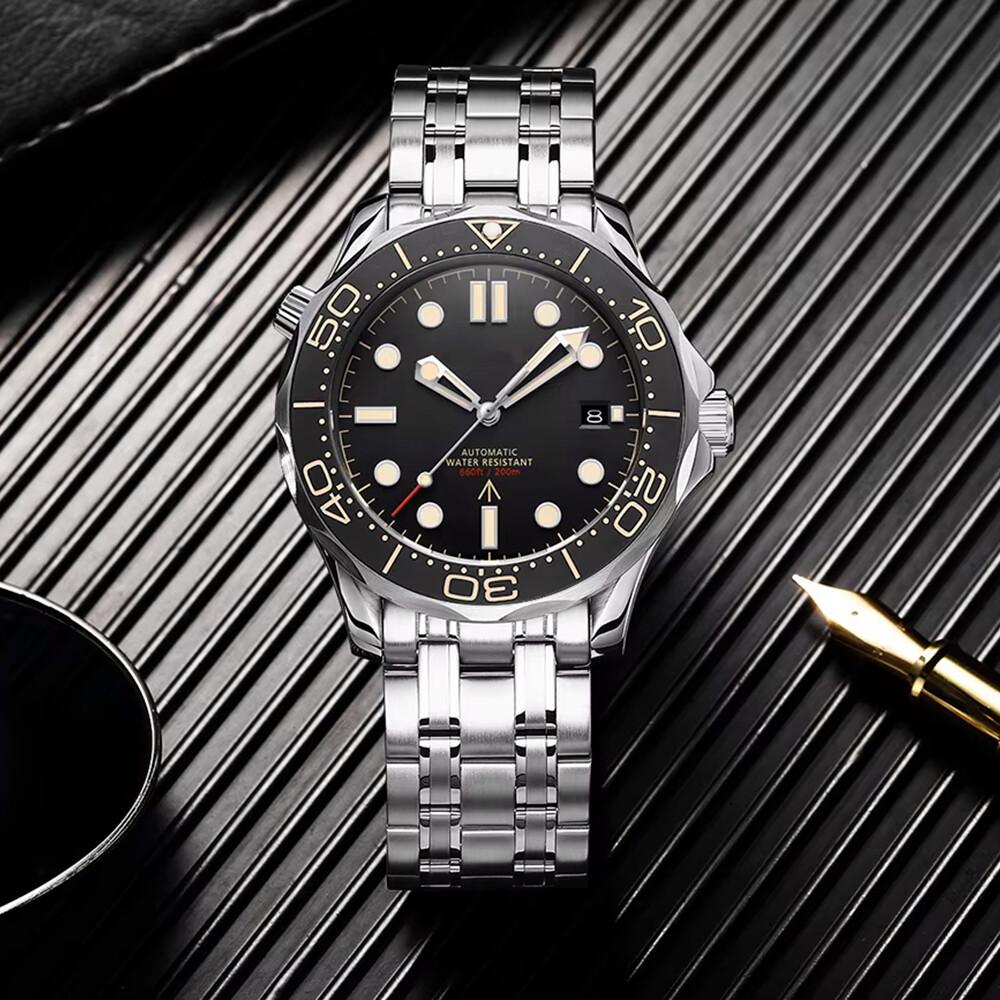
For example, the Rexx Diver Super Ocean 41mm – 007 shown with this guide is specified with 20 ATM water resistance, a 120-click ceramic bezel, sapphire crystal, and a stainless-steel case and bracelet. Those are useful dive-style specifications. Rexx does not currently claim ISO 6425 certification for this model, so this article does not invent one.
3. The Crown Matters More Than Its Marketing Name
A screw-down crown threads against the case and helps keep the crown in its intended sealed position. It is a practical feature, especially on a watch expected to meet water often, but it is not magic. Cross-threading, damaged crown tubes, worn gaskets, dirt, or simply leaving the crown unlocked can compromise the system.
Citizen warns against using a screw-lock crown while it is unlocked and against operating a crown or buttons while the watch is wet. Seiko gives similar guidance in its diver manuals. The important habit is simple: set the watch while it is dry, close the crown correctly, and check it before water exposure.
Read our one-minute guide to screw-down crowns for the mechanism itself. When shopping, also look at crown guards, grip, threading feel, and how easily the crown can be checked without tools.
4. A Dive Bezel Must Be Readable and Usable
A dive bezel is not valuable because it has 120 clicks instead of 60. Click count can make alignment feel finer, but the more important questions are practical:
- Can you grip it with wet hands or gloves?
- Does it turn deliberately without being painfully stiff?
- Is the zero marker easy to align with the minute hand?
- Can the elapsed-time scale be read quickly?
- Does it resist accidental movement in the unsafe direction?
Seiko’s current diver instructions explain the logic of a one-way bezel: if it is moved accidentally, it should indicate more elapsed time rather than less. The bezel is still only a guide, and Seiko explicitly tells divers to verify their air supply separately.
The familiar triangle at 12 is part of that reading system, not merely decoration. Our guide to why dive watches use a triangle at 12 explains how orientation and elapsed-time reading work together.
5. Legibility Is a Full-Dial Test, Not a Lume Test
Bright lume photographs can hide poor dial design. A genuinely legible watch needs separation between the hour hand, minute hand, seconds indication, markers, bezel pip, and background. The minute hand should be unmistakable because it works with the timing bezel. The hands also need sufficient length and contrast.
Then test the watch across time, not only during the first glowing minute. Strong initial brightness is less useful if the display fades unevenly or the hands disappear before the markers. A date window, polished hands, busy texture, or reflective crystal can also weaken the reading even when the luminous compound itself is good.
Our guide to what watch lume is and why it matters covers charging, brightness, duration, and real-world contrast in more detail.
6. Crystal Material and Reflections Are Separate Questions
Sapphire is highly scratch resistant and is usually the premium choice on a modern sports watch. Mineral crystal is generally easier to scratch but can be less brittle under certain impacts and cheaper to replace. Neither material automatically delivers a clear view.
Crystal shape, thickness, surface curvature, and anti-reflective treatment influence legibility. A domed sapphire crystal without effective reflection control may turn into a mirror at the wrong angle. An internal anti-reflective coating can improve clarity while keeping the outer surface easier to maintain, although exact coating choices vary by brand.
When comparing dive watch specs, check both the crystal material and the visibility of the dial under strong side lighting. See our full comparison of sapphire and mineral watch crystals for the trade-offs beyond the word “sapphire.”
7. Case Dimensions Decide Whether the Watch Stays Secure
Case diameter alone is a weak fit predictor. Lug-to-lug length, thickness, bezel overhang, crown position, caseback shape, bracelet end links, and the effective span across the wrist all matter. Our guide to midsize dive watches applies those measurements to the current return of 38mm and 39mm divers.
A tall, heavy watch that moves around the wrist is harder to read and easier to knock. A smaller watch with a broad dial opening and clear minute track may be more useful than a larger watch whose bezel and case consume most of its width. Crown guards should protect the crown without making it impossible to operate.
Material changes the feel too. Titanium can reduce mass and resist corrosion well, while steel often feels denser and may show a different mix of polished and brushed surfaces. Coatings, plating, and surface finish are not the same as the base material. Our watch case materials guide explains those distinctions.
8. The Strap, Bracelet, and Clasp Are Safety Components
Buyers often treat the strap as an accessory. On a watch used in water, it is part of the retention system. Check the spring bars or screw bars, end-link fit, clasp security, adjustment range, and whether the material remains comfortable when wet.
A dive extension can be useful over exposure gear, but it is not automatically necessary for ordinary swimming or daily wear. A well-sized rubber strap may be more secure and easier to rinse than a loose bracelet. A bracelet with precise micro-adjustment can handle wrist expansion better than one that forces a choice between too tight and too loose.
The strongest option is the one that fits the intended use and stays closed. Decorative complexity is not a substitute for secure hardware.
9. Service History Can Matter More Than the Original Depth Rating
Water resistance is not permanent. Gaskets age, lubricants dry, crowns and tubes wear, crystals can be damaged, and opening the case interrupts the sealed system. Citizen recommends regular servicing and gasket replacement, while Rolex describes replacing seals and pressure-testing the assembled case during service.
For a watch that will be trusted around water, ask when it was last pressure-tested – especially after a battery change, movement service, crystal replacement, crown repair, or case opening. A vintage diver with an impressive original rating may deserve more caution than a modest modern watch with fresh seals and a recent successful test.
This is also where workshop discipline matters. The final quality of a custom or modified watch depends on compatible parts, clean assembly, correct gasket condition, properly closed case components, and actual testing. A parts list cannot prove the result.
What About Helium Escape Valves?
A helium escape valve solves a specialized problem associated with saturation-diving environments. It allows helium that has entered the case under prolonged pressure to escape during decompression. It is not a general upgrade for swimming, recreational diving, or everyday durability.
For most buyers, a well-executed crown, caseback, crystal seal, readable bezel, and recent pressure test matter more. A helium valve can be legitimate engineering, but it should not be treated as a universal badge of quality.
A Practical Dive Watch Specs Checklist
Before buying, work through this list in order:
- Intended use: everyday wear, swimming, recreational diving, or saturation work?
- Exact rating: what does the dial or caseback say, and what use does the manufacturer permit?
- Standard claim: is ISO 6425 compliance actually stated, or only assumed from the design?
- Crown state: is it secure, easy to check, and protected from accidental movement?
- Timing bezel: can it be gripped, aligned, and read without hesitation?
- Low-light reading: are the minute hand, markers, and bezel zero distinguishable after the initial glow?
- Fit: do lug-to-lug, thickness, mass, and clasp adjustment keep the watch stable?
- Retention: are the strap, bracelet, bars, and clasp appropriate for the intended activity?
- Condition: when were the seals and pressure resistance last checked?
The Watcher HQ Verdict
The best dive watch specs are the ones that form a coherent tool. A huge depth rating is less important than a secure crown, a usable bezel, a legible minute hand, a stable fit, and known gasket condition. Sapphire and ceramic can add durability, but they do not replace testing. Bright lume helps, but only when the dial remains easy to interpret.
For a real dive, follow the watch manufacturer’s instructions and your training, and use the bezel only as a secondary timing reference rather than a substitute for proper diving equipment. For everyday buyers, the same design discipline still matters: it is what separates a convincing sports watch from a pile of impressive words.
If you want to see how those choices appear in a workshop-connected collection, browse the Rexx Timepieces diver watches. Treat each model according to its stated specifications and intended use, not according to its silhouette alone.
Frequently Asked Questions
Is 200m water resistance enough for a dive watch?
A 200m rating can be appropriate, but the complete classification, manufacturer guidance, watch condition, crown state, and testing history still matter. A 200m marking alone does not prove ISO 6425 compliance.
Does a screw-down crown make a watch waterproof?
No watch should be treated as permanently waterproof. A screw-down crown helps hold the crown in its sealed position, but the system also depends on gaskets, the crown tube, caseback, crystal seal, condition, and correct closure.
Is sapphire always the best crystal for a dive watch?
Sapphire offers excellent scratch resistance, but visibility also depends on crystal shape and anti-reflective treatment. Material is only one part of the optical system.
Do I need a helium escape valve?
Most owners do not. The feature is intended for saturation-diving conditions involving helium exposure and decompression, not ordinary swimming or recreational use.