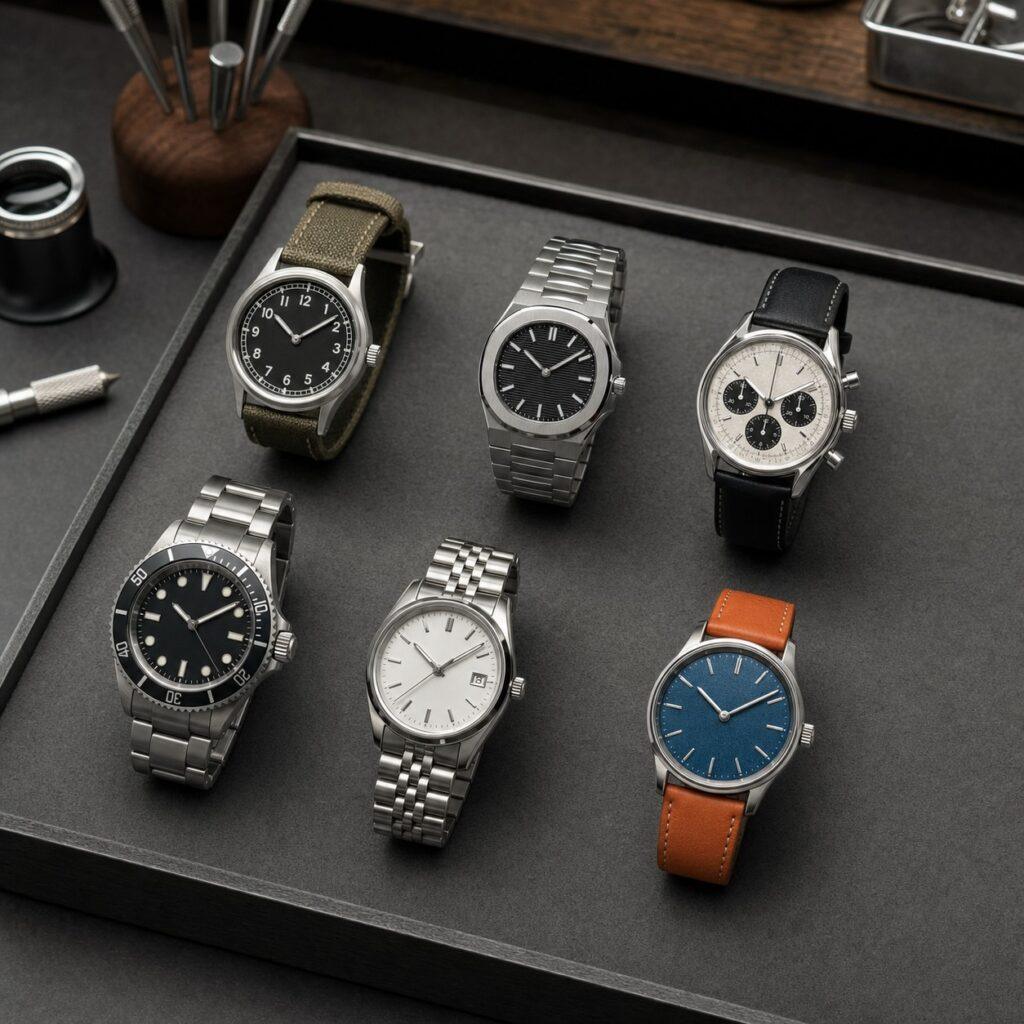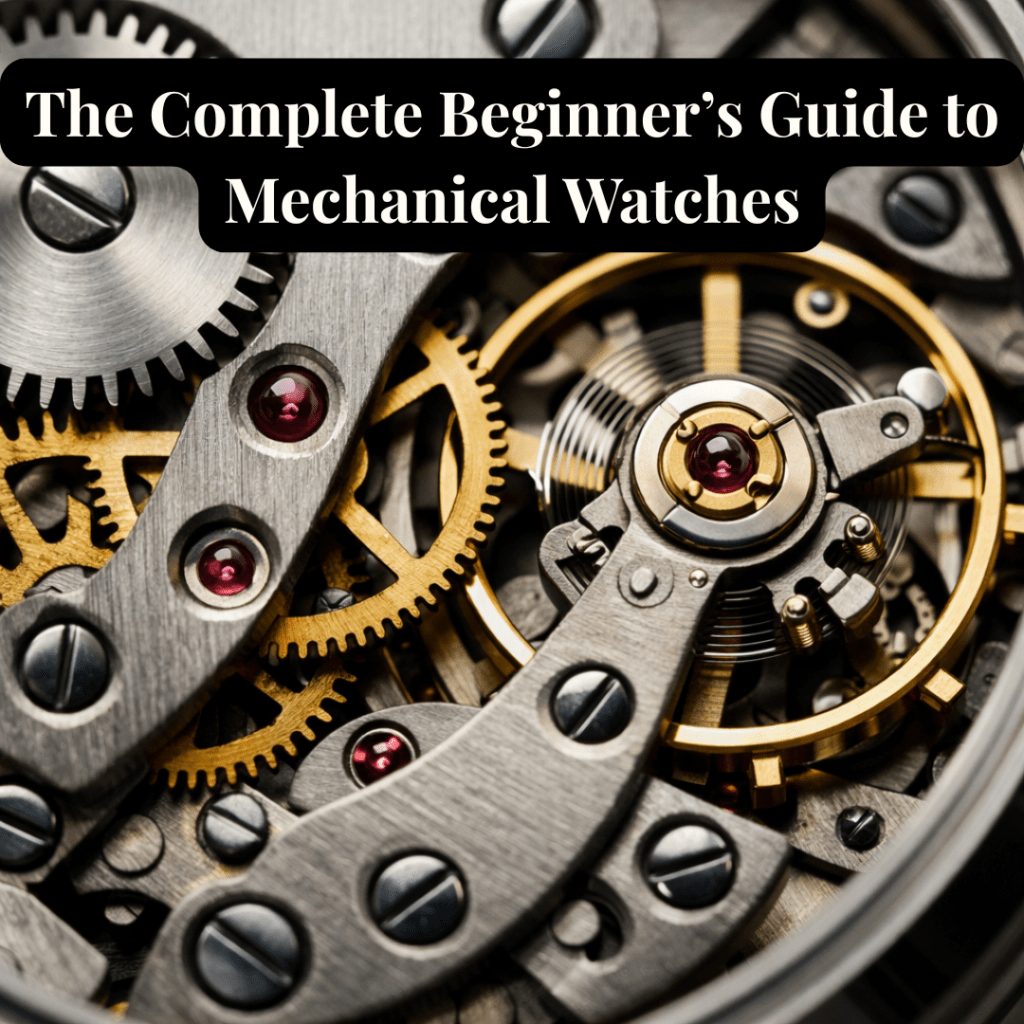
Miyota 9015 vs Sellita SW200-1 is a more revealing comparison than the usual Japanese-versus-Swiss argument suggests. Both are compact automatic movements with a date, hand winding, stop seconds, and a 28,800-vph frequency. Both can sit inside a refined independent watch. Yet they give a watch designer, watchmaker, and buyer different advantages.
The Miyota 9015 is substantially thinner and has a straightforward published specification. The Sellita SW200-1 offers Swiss provenance, multiple executions, and a familiar service environment. Neither movement makes a watch good by itself. Case construction, regulation, dial and hand installation, quality control, and after-sales support still decide how the finished object performs.
The useful question is not whether Japan or Switzerland makes the “better” movement. It is whether the 9015 or SW200-1 better supports the proportions, price, service plan, and ownership experience of the watch in front of you.
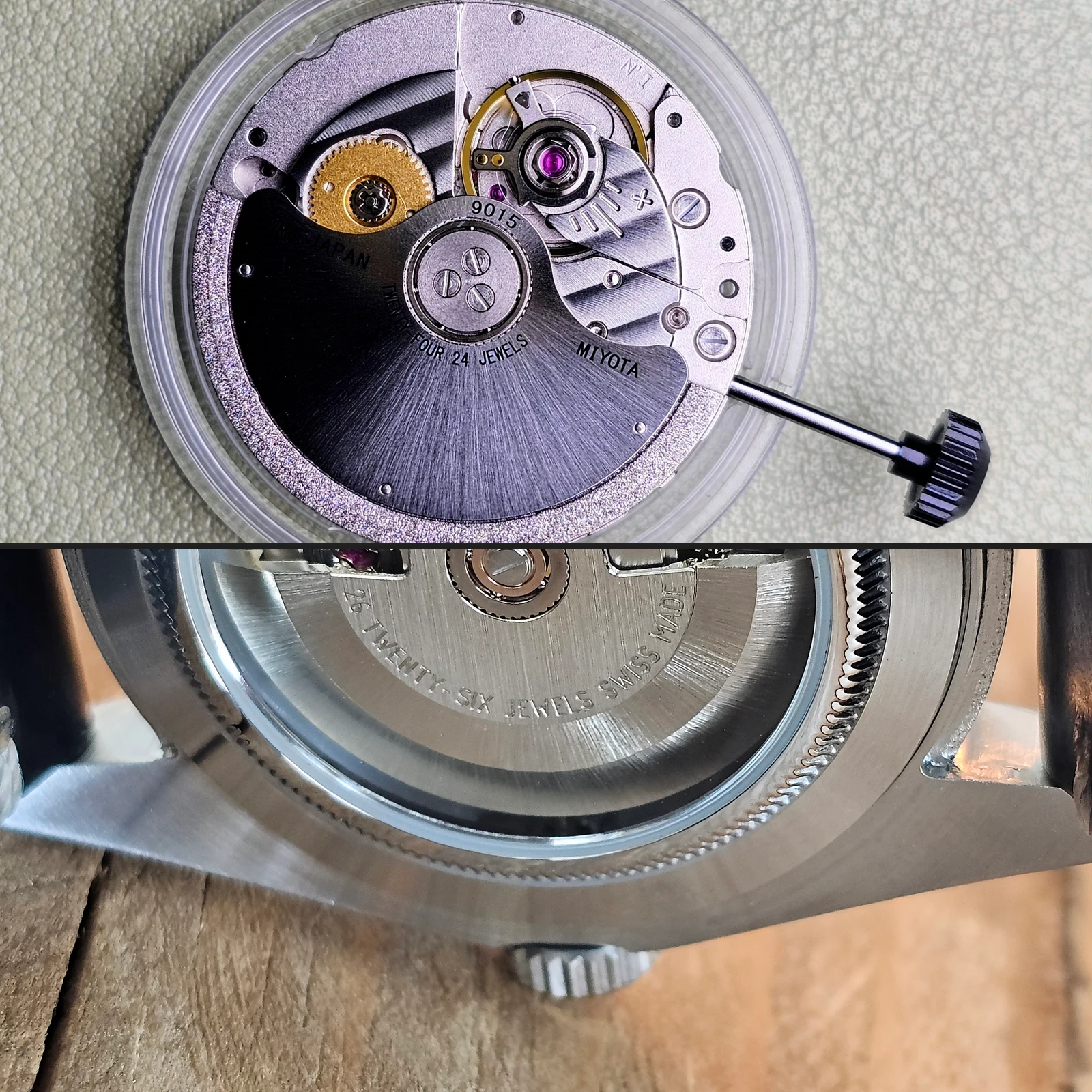
Miyota 9015 vs Sellita SW200-1: Official Specifications
Manufacturer documents are the best starting point. Miyota publishes a single baseline specification for the 9015. Sellita publishes a detailed technical document for the SW200-1, including several executions with different timing criteria. That distinction matters: a movement name alone does not tell you how a particular SW200-1 was graded or how a finished watch was regulated.
| Specification | Miyota 9015 | Sellita SW200-1 |
|---|---|---|
| Functions | Hours, minutes, central seconds, date | Hours, minutes, central seconds, date |
| Case-fitting size | 11.5 ligne | 11.5 ligne; 25.60mm |
| Height | 3.90mm | 4.60mm |
| Frequency | 28,800 vibrations per hour, 4 Hz | 28,800 vibrations per hour, 4 Hz |
| Jewels | 24 | 26 |
| Running time | Approximately 42 hours | Typical 41 hours; minimum 38 hours |
| Published timing information | -10 to +30 seconds per day | Grade- and execution-specific criteria |
| Winding and setting | Automatic, manual winding, quick-set date, stop seconds | Automatic, manual winding, quick date correction, stop seconds |
The figures above come from the official Miyota 9015 product page and Sellita’s official SW200-1 technical documentation, revision dated September 2, 2024. They describe base movements and published test criteria. They do not guarantee the performance of every finished watch.
1. The 9015 Is 0.70mm Thinner
The clearest physical difference in a Miyota 9015 vs Sellita SW200-1 comparison is height. The 9015 is 3.90mm high. The SW200-1 is 4.60mm high. A difference of 0.70mm sounds small on paper, but it is meaningful inside a mechanical watch.
The movement is only one layer in the vertical stack. A designer still has to accommodate the dial, hands, crystal, movement holder, rotor, caseback, gaskets, and water-resistance structure. Saving 0.70mm at the movement gives the case designer more freedom to lower the overall profile or spend that space on a more ambitious dial or crystal.
This advantage becomes especially visible in compact watches. A 36mm or 37mm case can feel elegant when diameter and thickness agree. The same diameter can feel top-heavy when the mid-case and caseback become too tall. The 9015 does not guarantee a thin watch, but it begins with the more favorable architecture.
The Meshberg 37 Automatic is a useful ecosystem example. Its compact proportions are a complete design decision, not a movement trick, but the 9015’s 3.90mm height supports that restrained direction.
2. Both Run at 4 Hz
Both movements operate at 28,800 vibrations per hour, or 4 Hz. Each advances the central seconds hand eight times per second. In normal use, both can therefore provide the finer visual sweep associated with this frequency.
That shared specification removes one of the easy talking points found in many movement comparisons. The SW200-1 does not sweep more smoothly simply because it is Swiss, and the 9015 is not a lower-frequency budget alternative. At the dial, the basic seconds-hand cadence is the same.
Frequency is not the same as accuracy. A movement can beat at 4 Hz and still be poorly regulated. It also does not tell you how stable the timing will remain across positions or over the full power reserve. The advantage is mainly visual and architectural: both movements let a brand build a compact automatic without accepting a visibly slower six-step-per-second motion.
For a fuller explanation of daily rate, consistency, positional variation, and certification context, read Watch Accuracy Explained.
3. Accuracy Cannot Be Compared With One Number
Miyota publishes the 9015 at -10 to +30 seconds per day. That gives buyers and builders a clear baseline. A well-regulated example may run more tightly, but the catalogue specification is the honest starting point.
Sellita takes a different approach. Its technical document lists multiple executions, including Elaboré, Top, and Chronomètre, with different positional and timing criteria. The words “Sellita SW200-1” on a product page therefore do not identify the exact execution, regulation standard, or finished-watch expectation.
This is why it is misleading to declare the SW200-1 automatically more accurate. A higher execution, carefully regulated in several positions, has a stronger timing proposition than an unspecified base movement. But a brand that merely lists “Swiss automatic” without naming the grade or its own regulation standard has not told the buyer enough.
Ask what the finished watch is expected to do. Was it checked after casing? Was it regulated, and in how many positions? What tolerance does the brand actually support? Those answers matter more than country of origin or an isolated forum result.
4. Power Reserve Is Essentially a Draw
Miyota states approximately 42 hours for the 9015. Sellita lists 41 hours as typical for the SW200-1 and 38 hours as the minimum. In daily ownership, these movements occupy the same practical category.
Wear either watch regularly and the reserve is adequate. Remove it for a full weekend and it may stop before Monday. Neither movement competes with newer 60-, 70-, or 80-hour designs, and the one-hour difference between their typical figures should not decide a purchase.
Actual running time depends on how fully the mainspring was wound, the owner’s activity, lubrication, movement condition, and automatic winding performance. A watchmaker can measure the individual watch; a catalogue can only describe the intended baseline.
5. Their Winding Character Is Different
The movements can feel different even though both wind automatically. Sellita specifies an oscillating weight with a heavy-metal segment and ball bearing. The 9015 has its own winding architecture and is sometimes more noticeable to owners when the rotor moves quickly.
That does not make one refined and the other crude. Case construction changes what reaches the wrist and ear. A solid caseback, exhibition back, movement fit, lubrication, and the amount of empty space inside the case can all affect perceived sound and vibration.
A faint rotor response is normal mechanical behavior. Scraping, impact, or a loose sensation is not something to dismiss because of the calibre name. Judge the exact finished watch, not a stereotype repeated across every model using the movement.
6. The SW200-1 Has the More Familiar Swiss Service Context
The SW200-1 belongs to a long-established Swiss movement environment that many professional watchmakers recognize. Its conventional layout, multiple executions, and broad use across independent brands can make it a comfortable proposition for a buyer who values familiar service routes.
The 9015 is not disposable or obscure. It is a current Citizen-group movement with published documentation and widespread use. It can be serviced, regulated, or replaced depending on the watch, the problem, parts access, labor cost, and the owner’s preference.
Serviceability is local. A movement that is familiar in one workshop may be less convenient in another. Some brands maintain replacement movements; others support component-level repair. Before buying an expensive independent watch, ask who handles warranty work, what happens after the warranty, and whether the brand can support the exact case, crown, stem, dial, and hand set as well as the movement.
A familiar calibre is useful, but the brand’s service plan is the real ownership feature.
7. Swiss Made and Japanese Manufacture Mean Different Things
Sellita identifies the SW200-1 as Swiss Made. Miyota manufactures the 9015 in Japan. Those origins are real and relevant, but they should not be turned into a shortcut for judging the entire watch.
A Swiss-made movement does not automatically make the finished watch legally Swiss Made. The complete watch has to meet separate origin requirements. Likewise, a Japanese movement inside a watch assembled elsewhere should not be described as a Japanese-made watch unless the full claim is accurate.
For buyers, provenance can carry emotional and resale value. Some collectors prefer a Swiss calibre in a Swiss-oriented microbrand. Others value the 9015 because it offers a thin 4 Hz architecture without forcing the watch into a higher price tier.
Origin should be stated precisely. It should not replace information about grade, regulation, assembly, water-resistance testing, or warranty.
8. The Movements Are Not Drop-In Alternatives
Both movements are described as 11.5 ligne, but that does not make them interchangeable. Height, dial attachment, stem geometry, date position, hand fitting, movement holder, caseback clearance, and crown alignment all have to match the specific calibre and case.
A brand cannot swap from a 9015 to an SW200-1 late in development and assume the same case, dial, hands, and holder will work. A custom builder should never order parts by diameter alone. The entire compatibility chain has to be planned around the chosen movement.
This is the same lesson that matters across the broader movement cluster. Our Miyota 9015 vs NH35 comparison explains why the 9015 leads to a slimmer design while the NH35 leads to a larger modding ecosystem. Our Sellita SW200-1 vs NH35 comparison shows how Swiss grade structure and service context differ from the practical Seiko-style platform.
Real Watches Show What Specifications Cannot
Movement specifications are most useful when they explain real design decisions. The Meshberg 37 Automatic uses the Miyota 9015 in a quiet 37mm small-batch watch. Its appeal comes from the whole object: dial balance, case proportions, hands, strap or bracelet, and the way those elements sit on the wrist.
Meshberg Strata takes a different route. The 36.5mm workshop project uses a Sellita SW200-1 with a laser-made, hand-finished, chemically darkened dial developed through a collaboration between Meshberg Watches and the workshop side of Rexx Timepieces and Rexx StudioWorks. The movement adds a Swiss mechanical foundation, but the watch’s identity comes from the physical dial process and the final proportions.
Our guide to 36mm vs 37mm watches uses both projects to show why diameter alone cannot predict wrist presence. The Meshberg workshop provides broader context for the tools, finishing, and small-batch decisions behind that work.
These examples make the central point: the movement creates possibilities and constraints. The watchmaker and designer still have to turn them into a coherent watch.
Which Movement Should You Choose?
Choose the Miyota 9015 when:
- A thinner case architecture is a priority.
- You want a 4 Hz movement at a value-conscious independent-watch price.
- A clear baseline accuracy specification is more useful than a complex grade structure.
- The brand has demonstrated good regulation, casing, and after-sales support.
Choose the Sellita SW200-1 when:
- Swiss movement provenance matters to the concept and buyer.
- The brand clearly identifies the execution or states its own regulation standard.
- You value a familiar Swiss service context.
- The slightly greater movement height fits the intended case proportions.
Do not choose either movement by name alone. A poorly proportioned or poorly regulated SW200-1 watch is not rescued by the words Swiss Made. A carefully designed and inspected 9015 watch is not inherently second-tier because its movement is Japanese. Compare the finished watch, the brand’s quality control, and the service promise.
Buyer Checklist
- What is the complete case thickness, not only the movement height?
- Does the brand identify the SW200-1 execution or its finished-watch timing tolerance?
- Is the watch regulated and inspected after casing?
- Who performs warranty and post-warranty service?
- Are replacement crowns, stems, hands, dials, and movement holders available?
- Does the movement choice support the watch’s price and design, or is it being used as a marketing label?
Frequently Asked Questions
Is the Sellita SW200-1 better than the Miyota 9015?
Not universally. The SW200-1 offers Swiss provenance, multiple executions, and a familiar service context. The 9015 is 0.70mm thinner and offers a strong 4 Hz specification at a different cost and design position. The better choice depends on the finished watch and the brand’s regulation, quality control, and support.
Which movement is thinner?
The Miyota 9015 is thinner at 3.90mm. Sellita specifies the SW200-1 at 4.60mm. The 0.70mm difference gives the 9015 an architectural advantage for slim or compact watches, although total case thickness still depends on the complete design.
Which movement has the better power reserve?
The difference is negligible for daily use. Miyota publishes approximately 42 hours. Sellita lists a typical 41 hours and minimum 38 hours. Both normally need resetting after sitting unused for a full weekend.
Is every SW200-1 equally accurate?
No. Sellita publishes different executions with different timing criteria, and brands may regulate the finished watch to their own standards. Ask for the exact grade or the brand’s supported tolerance.
Can a 9015 be replaced with an SW200-1 in the same case?
Not as a simple drop-in swap. The case, holder, dial, hands, stem, crown, date position, and vertical clearances must all be designed for the selected movement.