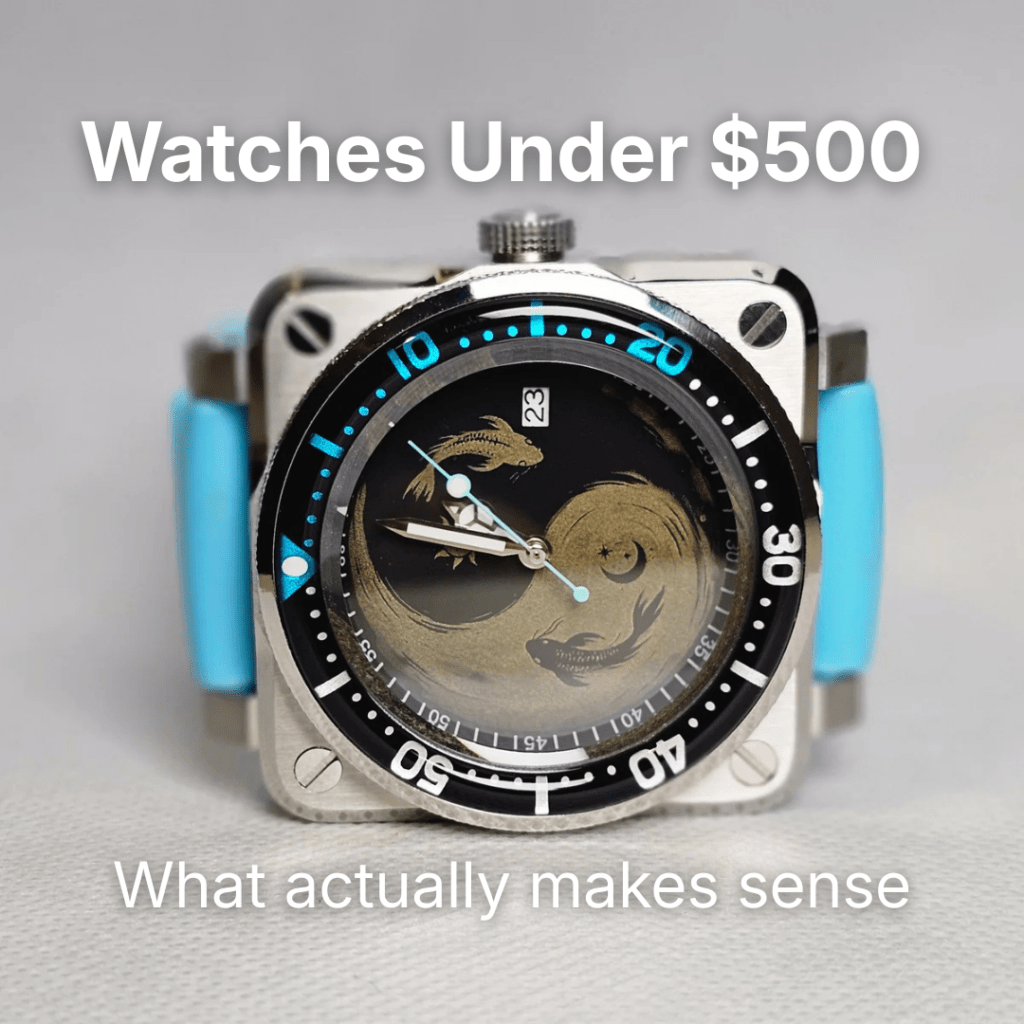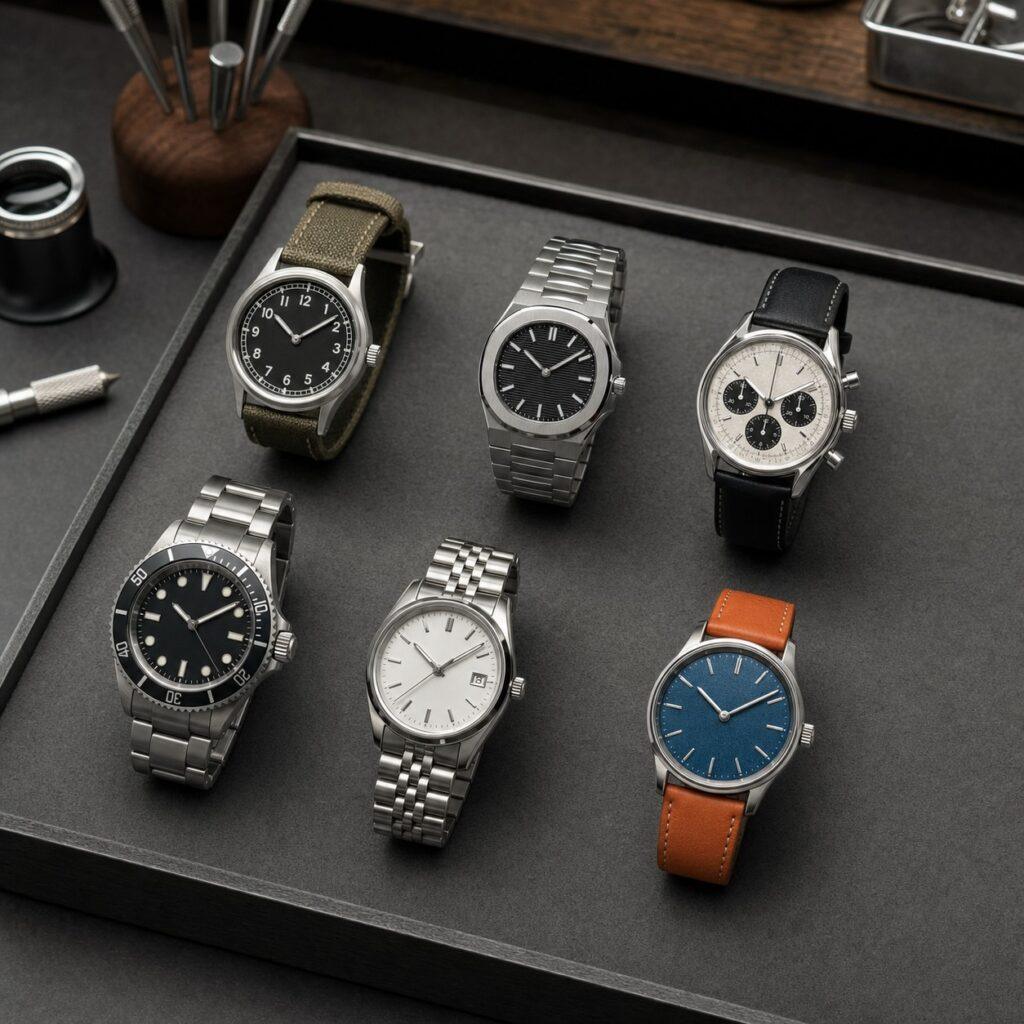
Midsize dive watches are no longer a niche correction to years of oversized sports watches. Across current releases, 37-40mm cases are being treated as deliberate options: compact enough for daily wear, but still large enough to preserve the bezel, hands, markers, crown and bracelet that give a dive watch its visual authority.
The interesting part is not that smaller watches are fashionable again. The interesting part is that dive-watch architecture handles the change unusually well. A rotating bezel already reduces the visible dial opening. Bold hands and markers create presence without needing a broad dial. Shorter lugs can improve stability, while a thinner case makes the watch easier to wear under a cuff and less likely to roll around the wrist.
That does not make every 38mm diver better than every 42mm diver. Diameter is only one measurement, and genuine underwater use can reward a larger, easier-to-grip instrument. The useful question is more specific: why do 37-40mm dive watches often feel complete rather than compromised, and how can you tell when the proportions actually work?
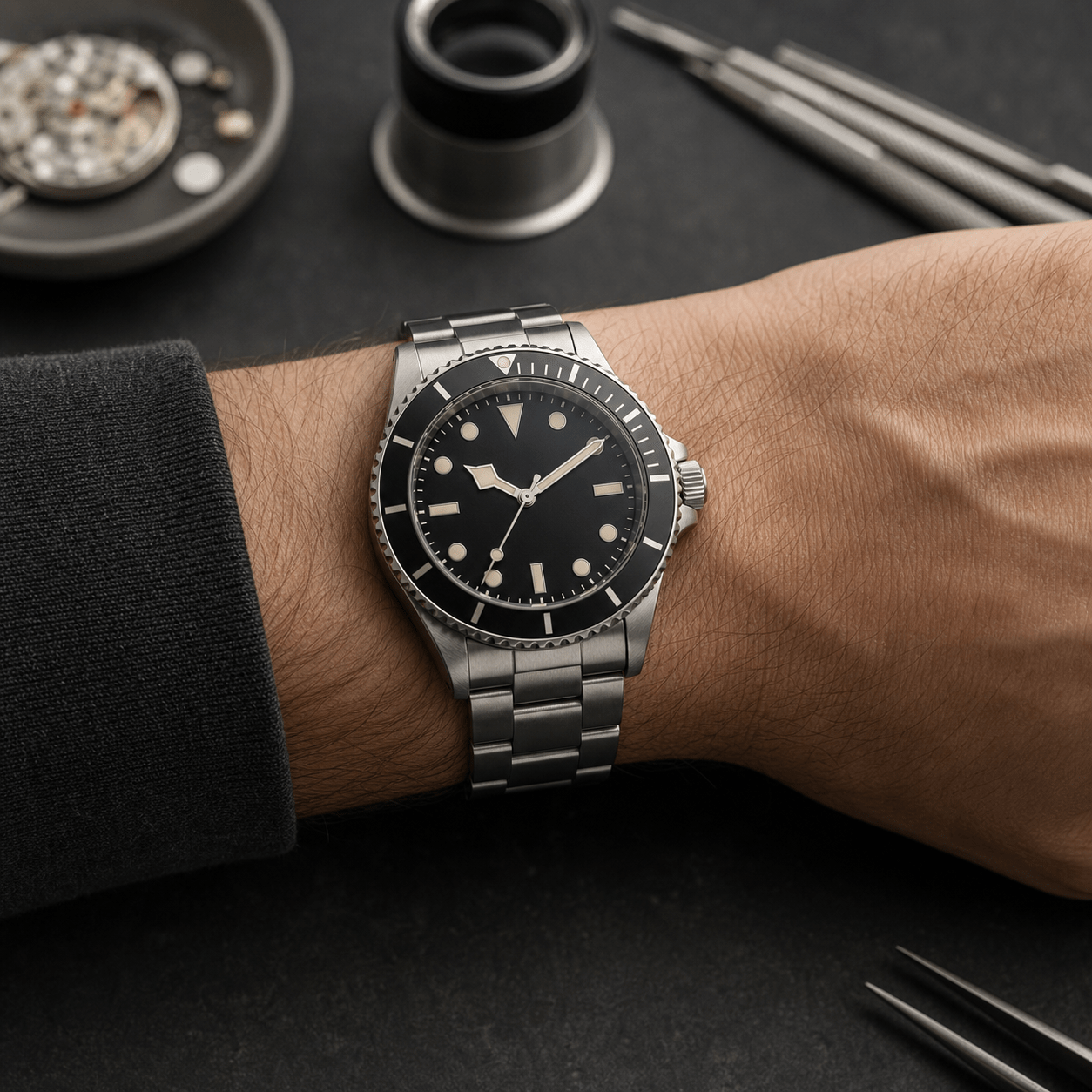
What Counts as a Midsize Dive Watch?
There is no universal legal boundary for the term midsize. In current collector language, it usually describes dive and dive-style watches around 37-40mm, especially when they are positioned below a brand’s larger 41-44mm alternatives. The label is useful, but it should not become another number to worship.
A 39mm case with long, flat lugs can occupy more wrist than a 41mm cushion case with a short span. A 37mm watch with a broad dial opening may look larger than a 39mm diver whose bezel consumes several millimetres of the face. Thickness, caseback shape, bracelet end links and the location of the crown all change the result.
For the broader sizing principles, our 36mm vs 37mm watch guide explains why diameter is only the beginning. This article has a narrower job: applying those principles to watches with a timing bezel and a dive-watch visual system.
Why Midsize Dive Watches Keep Their Presence
A simple dress watch can lose visual weight quickly as its case shrinks. A dive watch has more structure to work with. The bezel forms a strong outer frame. A luminous triangle establishes orientation. Broad hands and high-contrast markers create an immediate reading hierarchy. Crown guards, case shoulders and a substantial strap or bracelet add mass outside the dial.
This is why a well-designed 38mm diver can still feel like a sports watch. The case is smaller, but the visual grammar remains assertive. In fact, a compact case can make the bezel and dial feel more concentrated. Nothing needs to be enlarged merely to fill empty space.
The design fails when the parts are reduced without being reconsidered. A bezel can become too narrow to grip. Hands can look short. A large date window can dominate the dial. An unchanged movement may force the date too far inward, revealing that the exterior was resized around an internal layout that no longer fits visually. Good midsize design is not a scaled-down render. It is a new set of proportions.
Five Measurements Matter More Than Diameter Alone
1. Lug-to-lug length
Lug-to-lug is the fixed distance from the top of the case to the bottom. It gives a better first estimate of wrist coverage than diameter. Curved lugs can make that span wear smaller, while straight lugs can make it feel larger.
2. Effective bracelet span
Male end links can extend beyond the stated lugs before the bracelet articulates. That effective span may decide whether a compact case actually hugs the wrist. Female end links or immediately articulating links usually help a smaller watch deliver on its promise.
3. Thickness and centre of gravity
Thickness matters more as diameter falls. A 13.5mm watch at 38mm can feel top-heavy even if the top view looks ideal. Caseback shape and where the mass sits are just as important as the published number.
4. Dial opening and bezel width
A broad bezel makes the dial smaller and can reduce the apparent size. A thin bezel exposes more dial and can make the same case look wider. Legibility depends on how the hands and markers use that opening, not on the case diameter printed in the specifications.
5. Strap width and taper
A 20mm strap or bracelet can give a 37-39mm case a planted, sporty stance. The taper then affects elegance and comfort. Too little taper can make the watch feel blocky; too much can make the head feel disconnected from the band.
Current Watches Show This Is a Real Design Direction
No single release proves a market-wide sales trend. Taken together, however, current models show that compact dive-watch proportions are receiving serious design attention across affordable, specialist and premium brands.
| Example | Case | Lug-to-lug | Thickness | What it demonstrates |
|---|---|---|---|---|
| Seiko 5 Sports x Rowing Blazers SRPM21 | 38mm | 44.2mm | 12.1mm | The same collaboration deliberately offered in compact and larger formats |
| Orient Diver Design 40 / Mako 40 | 39.9mm | 46.5mm | 12.8mm | An affordable 200m dive-style sports watch shaped for everyday wear |
| DOXA SUB 200T | 39mm | 41.5mm | 10.7mm | A specialist dive-watch design made notably shorter and thinner |
| Tudor Black Bay 54 | 37mm | Not stated | 11.2mm | A premium 200m format built around historically compact proportions |
The most revealing 2026 example is Seiko’s Rowing Blazers collaboration. Seiko released the same Rally Diver concept in two distinct sizes: the green SRPM21 at 38mm by 44.2mm and 12.1mm thick, and the blue SRPM19 at 42.5mm by 46mm and 13.4mm thick. Both use the automatic 4R36 and are rated to 100 metres. The smaller version is not merely one millimetre less; it changes case span, thickness and lug width together.
That pair makes size a design choice rather than a gender label or an afterthought. It also requires accurate language: these are Seiko 5 Sports watches with unidirectional bezels and 100m ratings, not products that Seiko presents as professional ISO divers.
Orient’s 2026 release provides another useful signal. The official announcement describes five new Diver Design 40 models with 39.9mm cases, 46.5mm lug-to-lug dimensions, 12.8mm thickness, sapphire crystals, screw-down crowns and 20-bar water resistance. Orient also states plainly that they are not ISO-standard divers’ watches. That disclosure does not make them poor watches. It tells buyers exactly which claim is being made.
At a more specialised level, the 39mm DOXA SUB 200T is reported at only 41.5mm lug-to-lug and 10.7mm thick, while retaining a 200m rating, screw-down crown and unidirectional bezel. Monochrome’s launch coverage is useful here because it shows how short overall length and low thickness can matter more than the headline diameter.
Tudor takes the idea to 37mm with the Black Bay 54. Tudor lists an 11.2mm case, 200m water resistance, a unidirectional bezel, sapphire crystal and its COSC-certified MT5400 movement. This is not proof that 37mm is the new universal ideal. It is proof that a compact case can still support a serious, coherent modern specification.
Midsize Is Not Automatically Better
Smaller cases solve real problems, but they create trade-offs too. A narrow bezel edge can be harder to turn with wet hands or gloves. Reduced dial area can make the date, logo and text compete with the hands. A compact crown may be less convenient to operate. A smaller watch may also look visually lost on a very broad wrist, especially when paired with a narrow strap.
Actual diving adds another layer. A watch worn over exposure gear needs sufficient strap length or an appropriate extension. The bezel has to remain readable and usable. The minute hand, bezel zero and running indication need strong low-light distinction. A comfortable office diver is not automatically a better underwater instrument.
This is where the size conversation must reconnect with function. Our guide to the dive watch specs that actually matter covers water-resistance claims, ISO 6425, crowns, bezels, lume, retention and pressure testing. Use this article to judge proportions; use that guide to judge capability.
Dive Watch, Dive-Style Watch, or Actual Diving Instrument?
The silhouette does not answer that question. A rotating bezel, luminous markers and 200m text can describe a capable sports watch, but they do not automatically establish ISO 6425 compliance. Manufacturers may state a standard, publish their own permitted-use guidance, or deliberately call a model a diver-design watch rather than a diver’s watch.
Read the exact product language. Check the crown, bezel direction, water-resistance guidance, low-light display, strap or bracelet and testing history. A vintage-inspired watch may prioritise appearance. A recreational sports watch may provide useful water resistance without making an ISO claim. A certified diving instrument has a more specific job.
This distinction matters because compactness can hide compromises. The current Orient Mako 40 is a good example of honest positioning: strong everyday specifications and 200m water resistance, paired with the manufacturer’s explicit note that it is not an ISO-standard diver. The buyer can appreciate it without upgrading the claim.
How to Choose a 37-40mm Dive Watch
- Define the use. Daily wear, swimming and actual diving impose different priorities.
- Compare lug-to-lug before diameter. For smaller wrists, the fixed and effective spans should stay within the wrist’s usable flat surface.
- Check thickness in proportion. A compact watch should not become a tall cylinder unless that character is intentional.
- Inspect the end links. Look for the point where the bracelet begins to articulate.
- Judge the minute hand and bezel together. They are the central timing system, not separate decorative parts.
- Look at real wrist photographs. Renders can conceal thickness, reflections and how the lugs meet the wrist.
- Confirm the exact water-use claim. Do not convert a depth rating into an ISO certification the brand never made.
- Try the bezel and crown if possible. Compact controls still need usable grip.
When comparing images online, our guide to watch renders versus real watches explains why case height, lug shape, crystal reflections and bracelet behaviour often change once a physical watch reaches the wrist.
What Midsize Geometry Changes in a Custom Build
In a custom watch, the case diameter cannot be chosen in isolation. The movement determines stem position, dial-feet options and date location. The case controls crystal clearance, chapter-ring space and hand-stack limits. The bezel, dial opening and handset then decide whether the finished watch reads as compact and deliberate or simply crowded.
A smaller dive-style build often benefits from restraint: fewer lines of dial text, clear minute markers, hands that reach their tracks, and a bracelet or strap that supports rather than overwhelms the case. A large dial texture may need to be scaled or simplified so it remains legible inside the reduced opening.
If an off-the-shelf case does not create the proportions you want, the right next step is not to force incompatible parts together. It is to discuss the complete system. Rexx Timepieces custom watch builds are the relevant workshop route for case, dial, handset, movement and finishing decisions considered as one watch.
The Watcher HQ Verdict
Midsize dive watches are winning attention again because they preserve the strongest parts of dive-watch design while removing bulk many owners never needed. The bezel still frames the dial. The hands and markers still carry authority. The watch can remain sporty without spanning the wrist or standing excessively high above it.
The trend is not a command to buy smaller. It is an expansion of choice. Seiko offering one concept in 38mm and 42.5mm may be the clearest expression of that idea: neither size has to invalidate the other.
The best 37-40mm dive watch is therefore not the one with the smallest number. It is the one whose lug span, thickness, bezel, dial opening, controls and bracelet form a coherent tool for the way it will actually be worn.
Frequently Asked Questions
Is 39mm too small for a dive watch?
No. A 39mm dive watch can retain strong legibility and wrist presence when the bezel, hands, markers, lug span and thickness are well proportioned. Actual fit depends on the complete geometry and the wearer’s wrist.
What wrist size suits a midsize dive watch?
There is no fixed cutoff. Lug-to-lug length, end-link span and wrist shape matter more than circumference alone. Compact divers are often useful for smaller wrists, but many larger-wristed owners also prefer their stability and restraint.
Are all 37-40mm dive watches ISO certified?
No. Case size has nothing to do with certification. Check the manufacturer’s exact claim. Some are certified or standards-compliant diving instruments, while others are dive-style sports watches with useful water resistance.
Is lug-to-lug more important than diameter?
For fit, it is often the better first measurement because it describes fixed wrist coverage. Diameter still affects visual scale, bezel width and dial opening, so the two should be considered together.