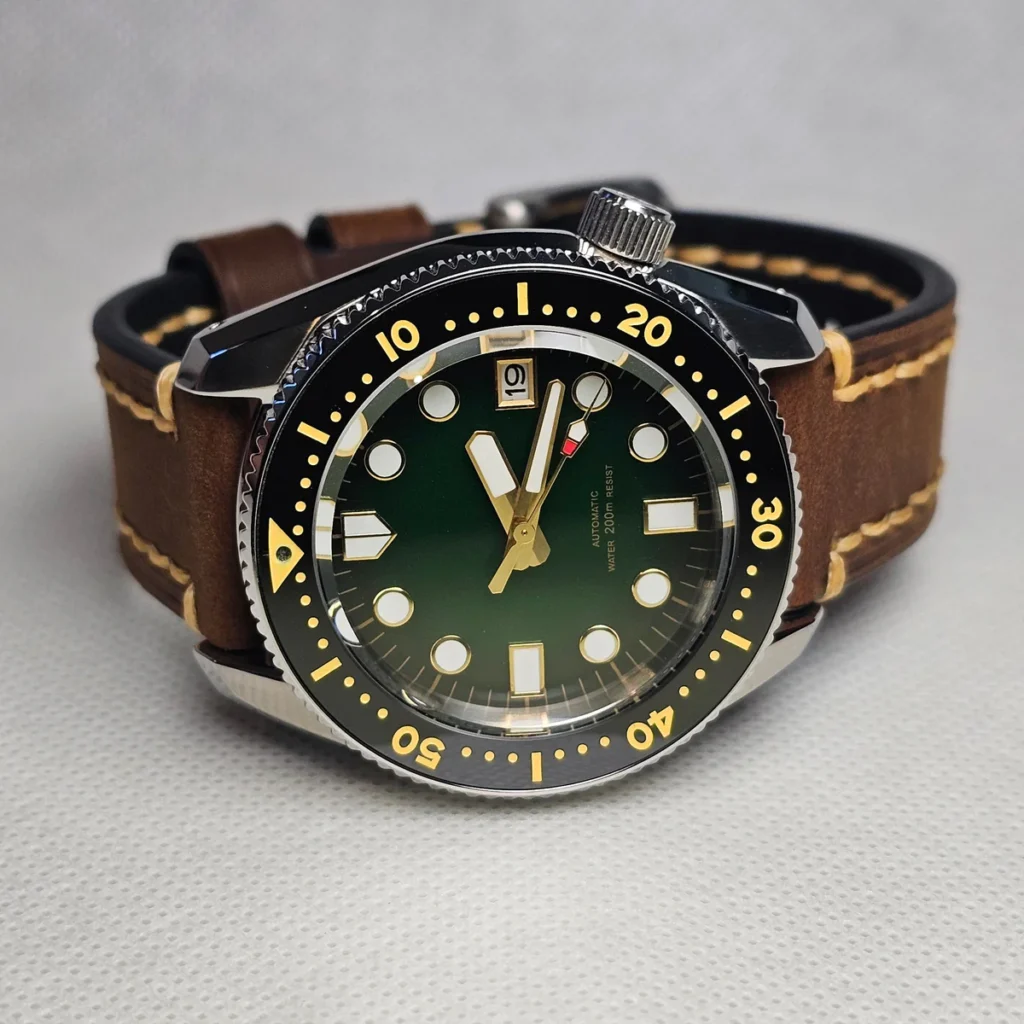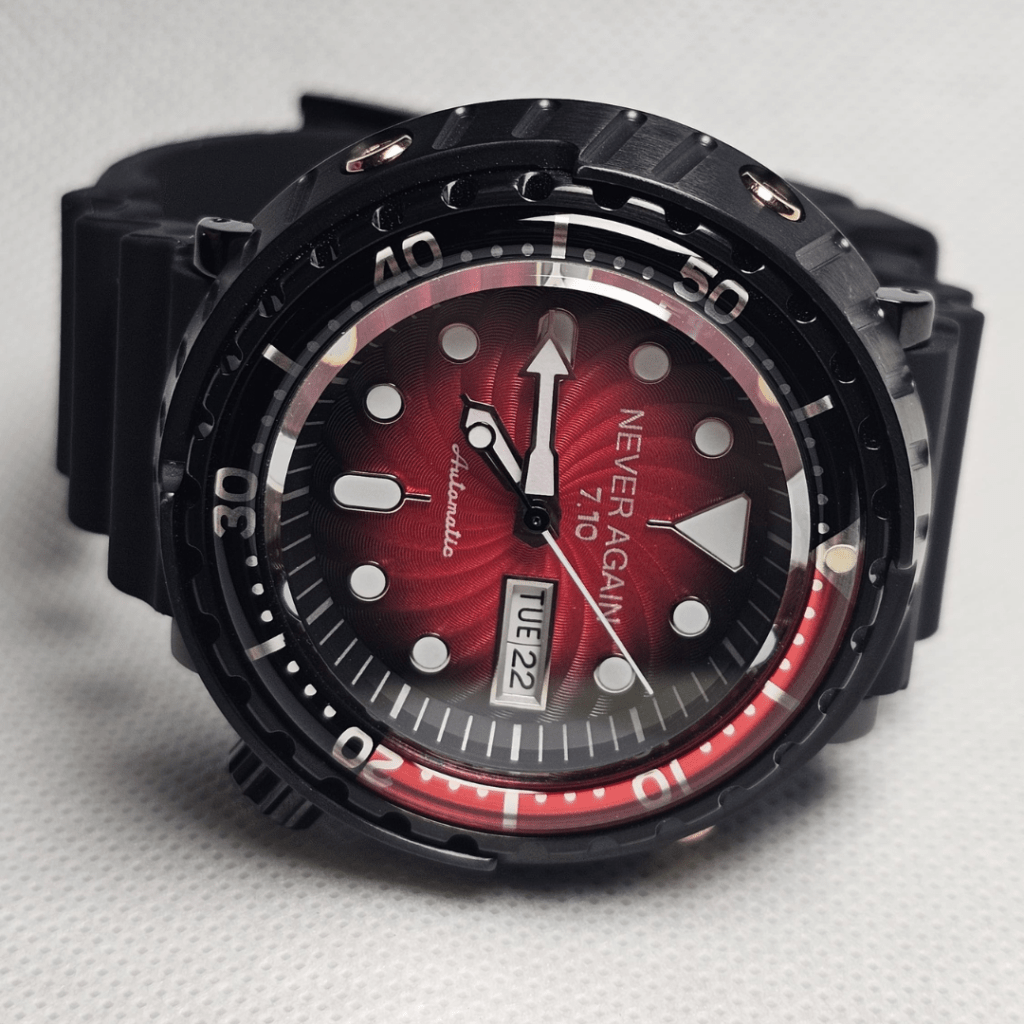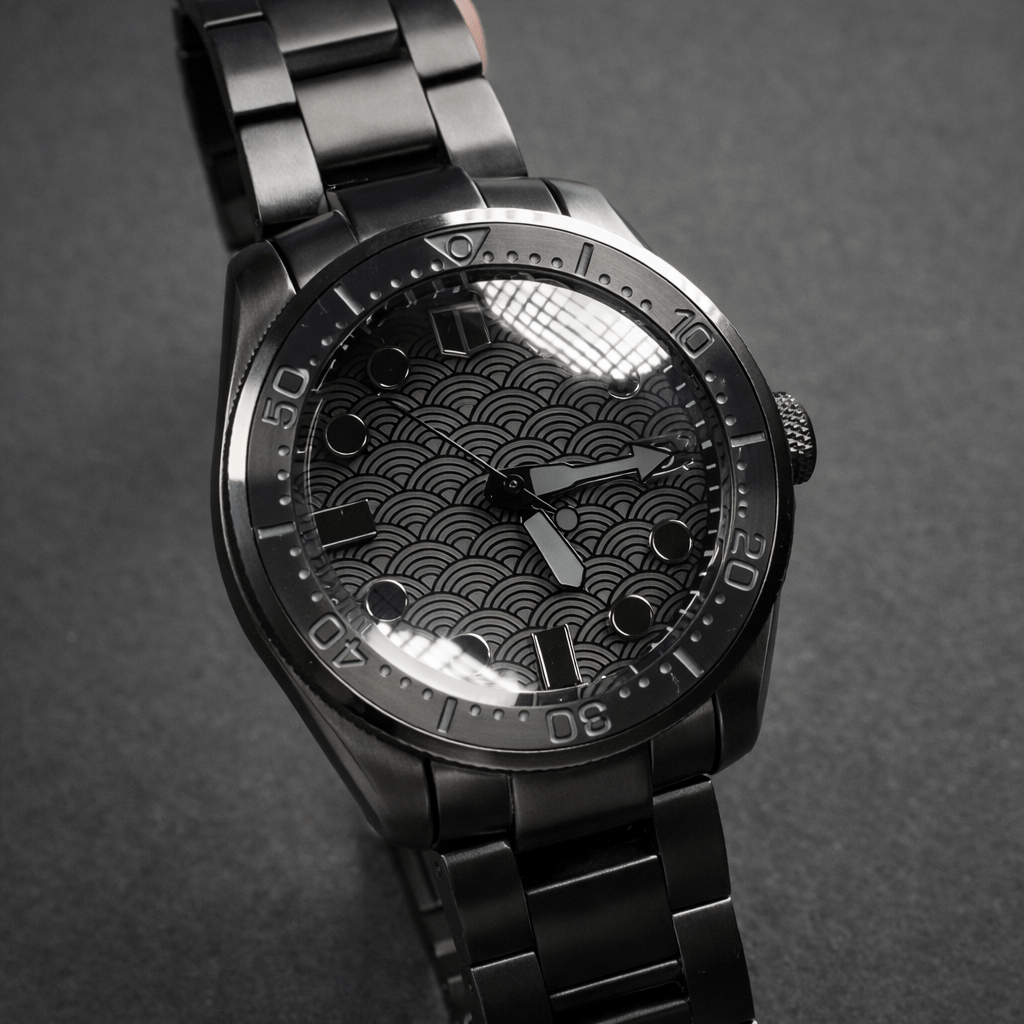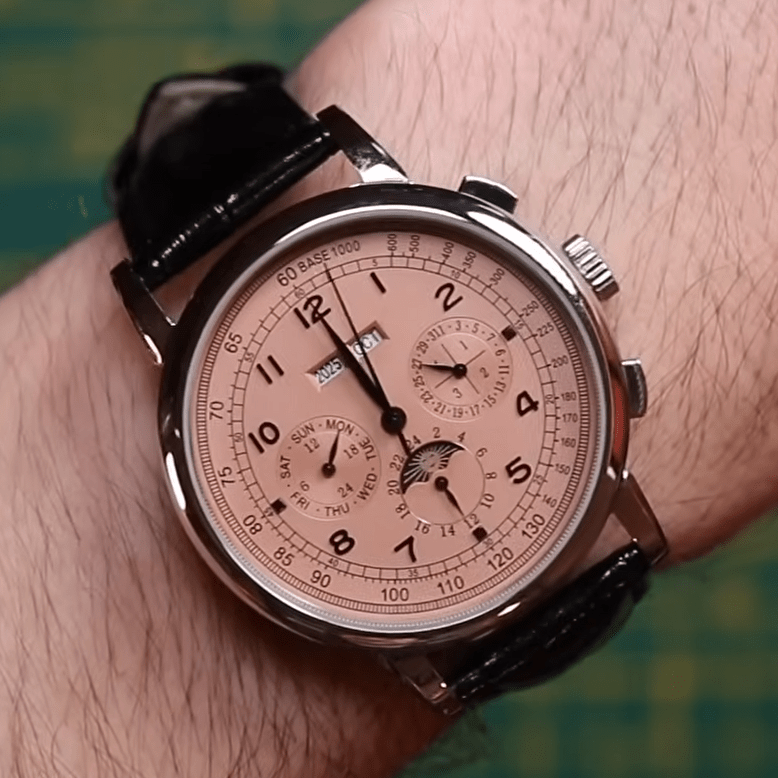
Seiko mod parts compatibility is not one yes-or-no question. A movement may fit the case while the dial feet, date window, hand stack, chapter ring, crystal, crown, or bracelet still fail somewhere else in the build.
That is why a product listing that says “NH35 compatible” is only a starting point. Compatibility is a chain. The finished watch works only when every interface in that chain agrees.
This guide explains the parts, the measurements that matter, the order in which to choose them, and the checks that should happen before money is spent or hands are pressed onto a movement.
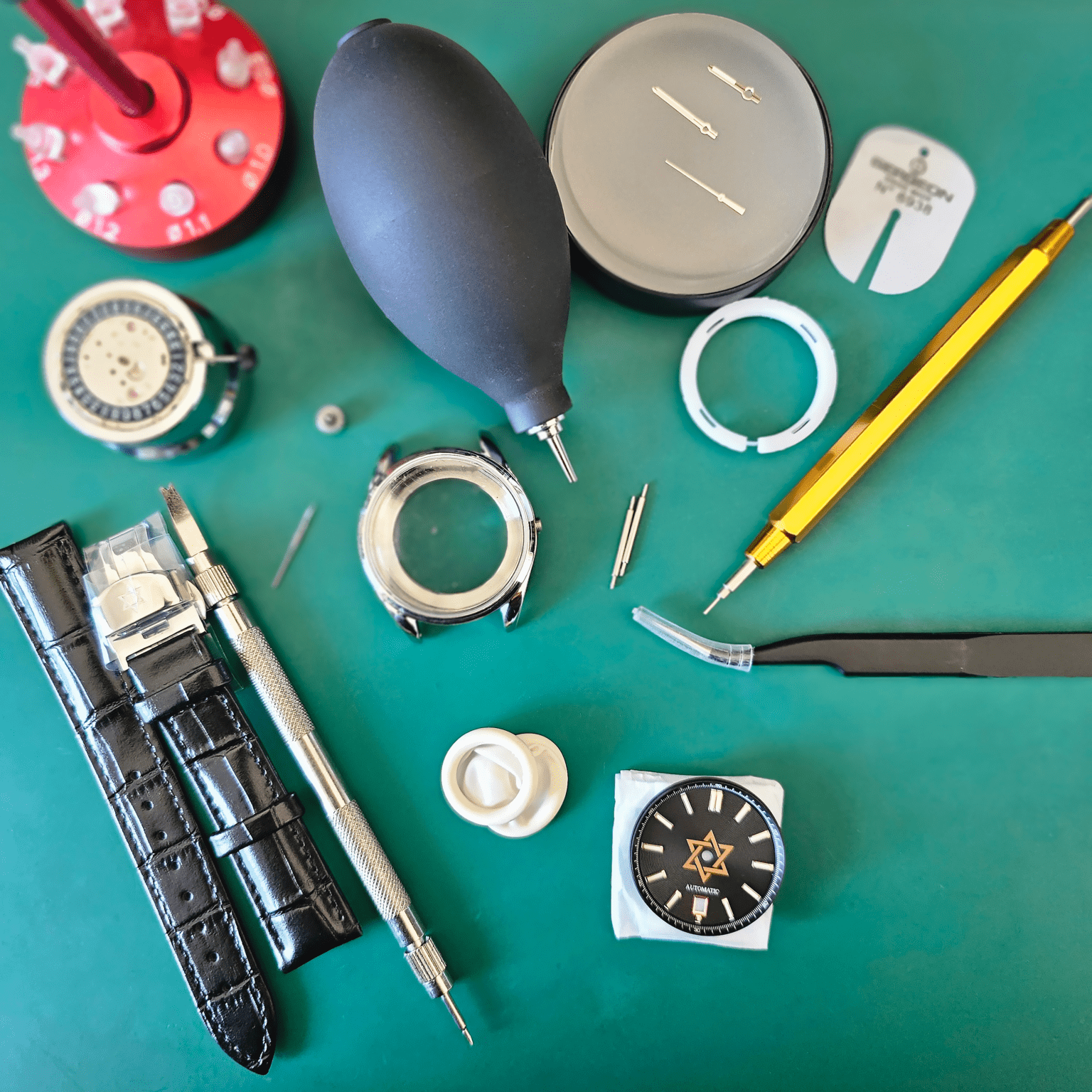
The Short Answer
Choose the movement and case architecture first. Then verify the dial, date or day-date layout, dial mounting, hand fitting, hand height, crystal clearance, chapter ring, bezel insert, crown, stem, caseback, and bracelet against those exact components.
Do not assume that all NH-series parts are interchangeable. NH35, NH36, and NH34 movements share a family, but they do not create the same dial layout or hand stack. Even within one calibre, the full movement reference can identify different hand-height, date-disc, day-disc, language, origin, or stem options.
What “Compatible” Actually Means
A useful compatibility check has five layers:
- Platform compatibility: the case, bezel, crystal, chapter ring, caseback, crown, and bracelet belong to the same case system.
- Movement compatibility: the case and movement holder accept the exact calibre and place the winding stem at the correct height.
- Dial compatibility: diameter, center opening, date window, dial feet or mounting method, thickness, and marker height suit the movement and case.
- Hand compatibility: hole sizes, lengths, vertical stack, and installed height suit the movement, dial, markers, and crystal.
- Finished-watch compatibility: the crown engages correctly, the rotor and hands move freely, the calendar changes properly, the case closes without pressure, and the assembled watch can be tested.
A part can pass one layer and fail the next. That is the central lesson behind most expensive Seiko mod mistakes.
The Movement-Swap Compatibility Stack
A movement swap should be treated as a controlled chain of interfaces, not a comparison of movement diameter alone. The correct order is:
- Case geometry: confirm the movement seat, internal diameter, case depth, dial opening, caseback shape, and the space reserved for a holder or spacer.
- Stem height and crown tube: compare the installed movement centerline with the case’s crown-tube centerline. A stem that bends to reach the movement is not a fit.
- Movement holder and clamps: identify how the movement is located vertically and prevented from rotating or shifting when the crown is used.
- Dial interface: check dial diameter, center opening, thickness, feet or attachment method, crown orientation, and any date or day window.
- Hand-post sizes and stack: verify the fittings for every hand and the installed height created by the candidate movement.
- Crystal and chapter-ring clearance: test the highest hand, applied marker, and chapter ring through a complete cycle rather than judging the empty case.
- Caseback and rotor clearance: close the case without forcing it, then confirm rotor movement, winding, setting, and stem operation.
- Clamps, gaskets, and final testing: confirm every retaining and sealing component before regulation, function checks, and any required pressure test.
This order matters because an early mismatch changes every measurement above it. A holder that places the movement too high can make the stem, dial, hands, crystal, and caseback all appear incompatible even when the individual parts were sold for the same broad movement family.
A practical movement-swap worksheet
Record measured values for the actual parts on the bench. Do not copy a marketplace diagram into the “measured” column or fill a missing number with a family-level assumption.
| Interface | Source configuration | Candidate configuration | Physical check |
|---|---|---|---|
| Movement seat and holder | Exact holder, seat depth, clamp method | Exact holder, seat depth, clamp method | Sits flat and cannot rotate |
| Stem centerline | Measured installed stem height | Measured installed stem height | Enters the crown tube without deflection |
| Dial mounting | Feet, diameter, thickness, calendar geometry | Feet, diameter, thickness, calendar geometry | Flat, centered, secure, calendar aligned |
| Hand fittings | Hour, minute, seconds and any GMT sizes | Hour, minute, seconds and any GMT sizes | Correct friction fit without force |
| Vertical hand stack | Installed heights above the dial | Installed heights above the dial | Hands clear dial, markers and each other |
| Top clearance | Chapter ring and crystal relationship | Chapter ring and crystal relationship | Highest hand clears through a full cycle |
| Rear clearance | Rotor or bridge to caseback | Rotor or bridge to caseback | Case closes freely; rotor does not rub |
| Finished assembly | Functions and sealing arrangement | Functions and sealing arrangement | Wind, set, change calendar, regulate and test |
Workshop evidence rule: manufacturer drawings establish a technical baseline, supplier listings describe an intended fit, and bench measurements confirm the actual components received. Keep those three kinds of evidence separate.
The movement maker, component suppliers, assembly workshop, and brand can all be different entities. Our guide to who really makes a watch explains how those responsibilities should be disclosed without treating outside production as a defect.
Start With the Exact Movement, Not Just the Family Name
The movement decides the functions and much of the geometry around them. NH35 is normally used for a three-hand date watch. NH36 adds day and date. NH34 adds a central GMT hand. Those differences affect the dial openings, calendar display, hand set, case clearance, and design brief.
The official TMI NH movement line-up lists each calibre separately. TMI’s product-code records also show why the complete reference matters: NH35 and NH36 are offered with defined hand-height and calendar options, while the NH34 references identify the GMT configuration and their own dial and hand requirements.
Before ordering surrounding parts, record:
- The full movement calibre and reference, not only “NH-series”
- Date-only, day-date, no-date, open-heart, or GMT display
- Calendar-disc color and day language where relevant
- The movement’s hand-height option
- Crown location and the case’s intended stem position
- The movement holder or spacer required by the case
For a direct comparison of the three most common modding choices, read NH35 vs NH36 vs NH34.
Case and Movement Compatibility
A case listing should identify the movement it accepts, but that statement does not automatically validate the entire build. The movement still needs to sit at the correct depth, remain secure in its holder, align with the crown tube, and leave enough room under the caseback.
Check the following together:
- Movement seat and holder: the movement should not rotate, tilt, or move when the crown is operated.
- Stem centerline: the winding stem must meet the crown tube without bending upward or downward.
- Crown position: a 3 o’clock and an offset crown case can require different dial-foot or orientation decisions.
- Caseback depth: the caseback must close without touching the rotor, movement, holder, or stem release area.
- Dial opening: the case and chapter ring must reveal the intended part of the dial without covering markers or the minute track.
Never force a caseback closed to solve a spacing problem. Pressure on the movement, dial, or hand stack is evidence that the parts relationship is wrong.
Dial Compatibility: More Than Diameter
Many aftermarket NH dials are around 28.5 mm, but that common size is not a universal guarantee. The case opening, chapter ring, movement, and dial mounting method all matter.
Dial diameter and visible opening
The dial must be large enough to sit securely yet small enough to enter the case. It must also work visually with the chapter ring and dial opening. A dial can physically fit while its minute track disappears under the chapter ring.
Dial feet and crown position
Dial feet locate the dial on the movement. Their positions need to match the movement and the intended crown orientation. Some aftermarket dials provide multiple feet so the unused pair can be removed. Others require a different mounting method.
Dial dots can solve some mounting problems, but they are not a free correction. Poor placement can leave the dial tilted, raised, or close enough to interfere with the date wheel or hands.
Date and day windows
The date window must align with the calendar disc in the assembled orientation. NH36 builds add a day display and language choice. A no-date dial can hide a date mechanism, but the crown may still have a calendar-setting position. That is a design decision, not the same thing as using a true no-date movement.
Center opening, dial thickness, and markers
The center opening must accommodate the movement’s hand stack. This becomes especially important when an NH34 GMT movement is introduced into a parts set originally described around NH35. The GMT hand adds another layer, and the dial opening and case clearance must be verified rather than assumed.
Applied markers, engraved surfaces, paint, resin, lume, and handmade textures also create physical height. A custom dial is not compatible merely because its diameter is correct. Its total thickness and tallest details must leave room for the hands.
For the material and workshop side of this subject, see Watch Dial Materials and How Custom Watch Dials Are Made.
Hand Compatibility: Hole Size, Length, and Vertical Clearance
Hands have three separate compatibility jobs. They must fit the movement posts, reach the right place on the dial, and clear every surface above and below them.
Fitting dimensions
Hour, minute, seconds, and GMT hands use different fitting dimensions. A listing should specify the movement or the actual sizes it supports. “Seiko compatible” is too vague when the hand set is the part being pressed onto the movement.
Hand length
The minute hand should reach the minute track deliberately. The seconds hand should not end awkwardly inside the hour markers or extend far enough to strike an applied index. A hand set can fit mechanically and still look poorly proportioned.
Installed height
The hour hand must clear the dial and applied markers. The minute hand must clear the hour hand. The seconds hand must clear the minute hand and the underside of the crystal. A GMT build adds one more hand and one more possible collision.
After installing each hand, rotate the movement slowly through a full 12-hour cycle. Check the stack at several angles under magnification. Do not assume that clearance at 12 o’clock proves clearance everywhere; slightly bent or uneven hands may touch only at another position.
Why an NH34 Is Not Automatically a Drop-In NH35 Upgrade
NH34, NH35, and NH36 belong to the same broad movement family, but the NH34’s central GMT hand changes the build. It needs a compatible GMT hand, a dial center opening that clears the additional post, a dial and bezel or chapter-ring design that communicates 24-hour time, and enough vertical room under the crystal.
A case advertised for NH35 may share useful dimensions, but that does not prove it provides the required NH34 hand-stack clearance. The seller should explicitly support the intended configuration, or the builder should verify the internal geometry directly.
This is also why an NH34 build should be planned as a GMT watch from the beginning rather than treated as a last-minute movement swap.
Chapter Ring, Crystal, Bezel, and Insert Must Be Treated as One System
The top half of the case is another compatibility chain. The dial sits below the chapter ring. The chapter ring sits below or around the crystal. The bezel insert frames the crystal. Changing one part can alter the space or appearance of the others.
- Chapter ring: confirm diameter, height, alignment method, and whether it covers the dial’s outer printing.
- Crystal: confirm diameter, edge geometry, gasket, profile, and internal clearance.
- Bezel: confirm it belongs to the exact case system and accepts the intended insert.
- Bezel insert: verify outer diameter, inner diameter, thickness, and flat or sloped profile.
A domed crystal may create more visual height without automatically creating more usable space underneath. Internal clearance depends on the crystal seat and the whole case design. Verify the actual component combination.
Crown and Stem Compatibility
The movement stem, crown threads, crown tube, and case depth have to agree. In many builds, the stem is supplied long and trimmed during casing. This is precision fitting, not a one-cut task.
Work in small steps. A stem that is too long can keep the crown from seating or leave the movement under tension. A stem cut too short may fail to engage properly and can be impossible to recover without replacement.
Before final trimming, make sure the movement and dial are seated at their final depth, the movement holder is installed, and the correct gasket arrangement is present. Otherwise the measurement is being taken from an unfinished stack.
Caseback, Rotor, and Movement-Holder Clearance
Display casebacks, slim casebacks, and aftermarket rotors can change the space behind the movement. The rotor must spin without rubbing. The movement holder must remain secure. Nothing should be compressed merely so the caseback threads can engage.
After the caseback is installed, rotate the watch and listen for abnormal rubbing rather than assuming every sound is ordinary rotor noise. Then confirm that winding, setting, and automatic winding still behave normally.
Bracelet Compatibility Is More Than Lug Width
A 20 mm bracelet is not automatically compatible with every 20 mm case. Straight-end straps are forgiving, but fitted end links depend on case curvature, lug-hole position, spring-bar diameter, end-link thickness, and the shape underneath the case.
If a bracelet uses fitted end links, buy it for the exact case or from a supplier that confirms the pairing. Lug width alone is enough to choose many leather, rubber, or fabric straps; it is not enough to guarantee a clean fitted-bracelet connection.
Water Resistance Is a Finished-Watch Test
A screw-down crown, sapphire crystal, lubricated gaskets, and a marked caseback are components of a water-resistant design. They are not proof that a custom build is water resistant.
Gaskets must be the correct size and condition. Sealing surfaces must be clean. The crown and tube must engage correctly. The crystal and caseback must be seated properly. If water resistance matters, the completed watch needs pressure testing after assembly and after any later work that opens the case.
The Safest Order for Buying Seiko Mod Parts
- Define the function: date, day-date, no-date, GMT, diver, field, dress, or another clear direction.
- Select the exact movement reference: record its display, hand-height, calendar, and stem details.
- Select a case made for that movement: include the holder, crown position, caseback, and top-stack architecture.
- Select the dial: verify diameter, feet, calendar windows, center opening, thickness, and marker height.
- Select the hands: verify fitting dimensions, length, lume, and vertical clearance.
- Complete the top stack: treat chapter ring, crystal, bezel, and insert as one system.
- Confirm crown and stem: use the parts intended for the case and movement pairing.
- Choose the bracelet or strap last: use exact-case end links where a fitted bracelet is required.
If you want the shopping side rather than the engineering logic, continue with Best Seiko Mod Parts. For the assembly sequence, use How to Build a Seiko Mod.
What Can Be Adapted, and What Should Not Be Forced?
Some incompatibilities can be handled safely by an experienced builder. Unused dial feet may be removed when the dial has an appropriate alternative mounting method. A stem is normally cut to length. A strap can be changed. A different spacer may be part of a documented case design.
Other problems are warnings, not invitations to improvise:
- Hands that bind on their posts or scrape each other
- A dial that rocks, bows, or presses on the calendar
- A date or day window that does not align
- A crystal or chapter ring that touches the hand stack
- A stem that enters the movement at an angle
- A caseback that closes only under force
- A fitted bracelet whose end links fight the lug holes
If force appears to be the solution, stop and identify which specification is wrong.
Final Compatibility Checklist Before Assembly
- The exact movement reference matches the case and holder
- The crown tube and movement stem share the correct centerline
- The dial diameter and visible opening suit the case
- Dial feet or the mounting method suit the crown orientation
- Date and day windows align with the installed calendar discs
- The dial center opening suits the full hand stack
- Dial thickness and applied markers leave enough hand clearance
- Every hand fits its post and reaches the dial correctly
- The hands clear the dial, each other, and the crystal through a full cycle
- The chapter ring does not cover important dial printing
- Crystal, gasket, bezel, and insert belong to the same case system
- The stem is trimmed only after the movement reaches its final seated depth
- The caseback closes without contacting the rotor or movement
- Fitted bracelet end links are confirmed for the exact case
- Calendar change, winding, setting, rotor movement, and timekeeping are tested
- Water resistance is pressure tested if it will be relied upon
Using a Configurator to Prepare a Build Brief
A visual configurator helps you communicate a design. Its preview does not replace the physical checks in this guide. A useful build brief records the movement layout, crown position, dial direction, hands, bezel, chapter ring, strap and engraving, then leaves the workshop to confirm the exact parts and clearances.
The Rexx dial and watch designer offers two starting points. Make a dial creates a standalone custom dial; the receiving watch still determines its mounting, openings, thickness and available hand clearance. Build a watch lets you configure a complete Rexx watch using an SKX diver, classic fluted, classic rounded or classic flat case style, then review the design and order through the Rexx store.
For example, choosing a date layout and an offset crown gives the workshop a clearer brief than asking for a blue diver. It still does not prove that a particular dial-foot arrangement, calendar window or hand stack fits the actual components. The configured order records the selected design; the workshop checks final parts, fit and engraving before production. Projects outside the available options can go through a separate workshop inquiry.
Disclosure: The Watcher HQ and Rexx Timepieces belong to the same connected watch ecosystem. This is a configurator example, not an independently tested build or evidence that every previewed combination has passed a bench inspection.
For the practical next step, the Rexx configurator walkthrough explains standalone-dial ordering, complete-watch checkout and how to brief a project beyond the online builder. The workshop project gallery includes a completed openwork NH72 build and a before-and-after watch makeover. Use them to communicate the appearance you want; their photos and videos do not substitute for measured clearance, a checked parts list or pressure-test results.
Watch the Parts Become a Finished Watch
The specifications make more sense when the sequence is visible. This Rexx Timepieces build shows a complete NH35 watch moving from selected components to final casing, with the dial, hands, case, crown, gasket, and finishing decisions working as one system.
If choosing the parts feels less interesting than defining the watch itself, Rexx Timepieces custom watch builds provide the workshop route. The point is not to hide the technical limits. It is to use them to make a watch that fits, works, and follows a coherent brief.
Frequently Asked Questions
Are all NH35 cases compatible with NH36?
The movement family is closely related, but the complete watch still needs a compatible dial, day-date layout, crown orientation, holder, stem alignment, and case architecture. Confirm the exact case specification rather than relying on the family name.
Can an NH34 fit in an NH35 case?
Some cases support both, but compatibility should be explicit. NH34 adds a GMT hand and a taller functional hand stack, so dial-center and crystal-clearance requirements must be checked. Do not assume every NH35 case is an NH34 case.
Why do compatible hands still stop the watch?
The holes may fit while the installed heights do not. A hand can touch the dial, an applied marker, another hand, or the crystal. Bent or uneven hands may rub only at one part of the rotation.
Can dial dots fix the wrong dial feet?
They can provide an alternative mounting method in some builds, but the dial must remain flat, centered, secure, and clear of the calendar and hands. They do not correct the wrong diameter, date position, thickness, or center opening.
Does a screw-down crown make a mod water resistant?
No. Water resistance belongs to the finished and tested assembly. Crown, tube, crystal, caseback, gaskets, sealing surfaces, and installation all matter.
Final Thoughts
Seiko mod parts compatibility is the discipline of checking relationships, not collecting labels. The movement must suit the case. The dial must suit the movement and opening. The hands must suit the posts and available height. The top stack, crown, caseback, and bracelet must work with the exact case.
Choose parts in order, verify the full references, dry-fit before forcing anything, and test the finished watch as a machine rather than judging it only as a photograph. That is how a box of attractive components becomes a reliable custom watch.