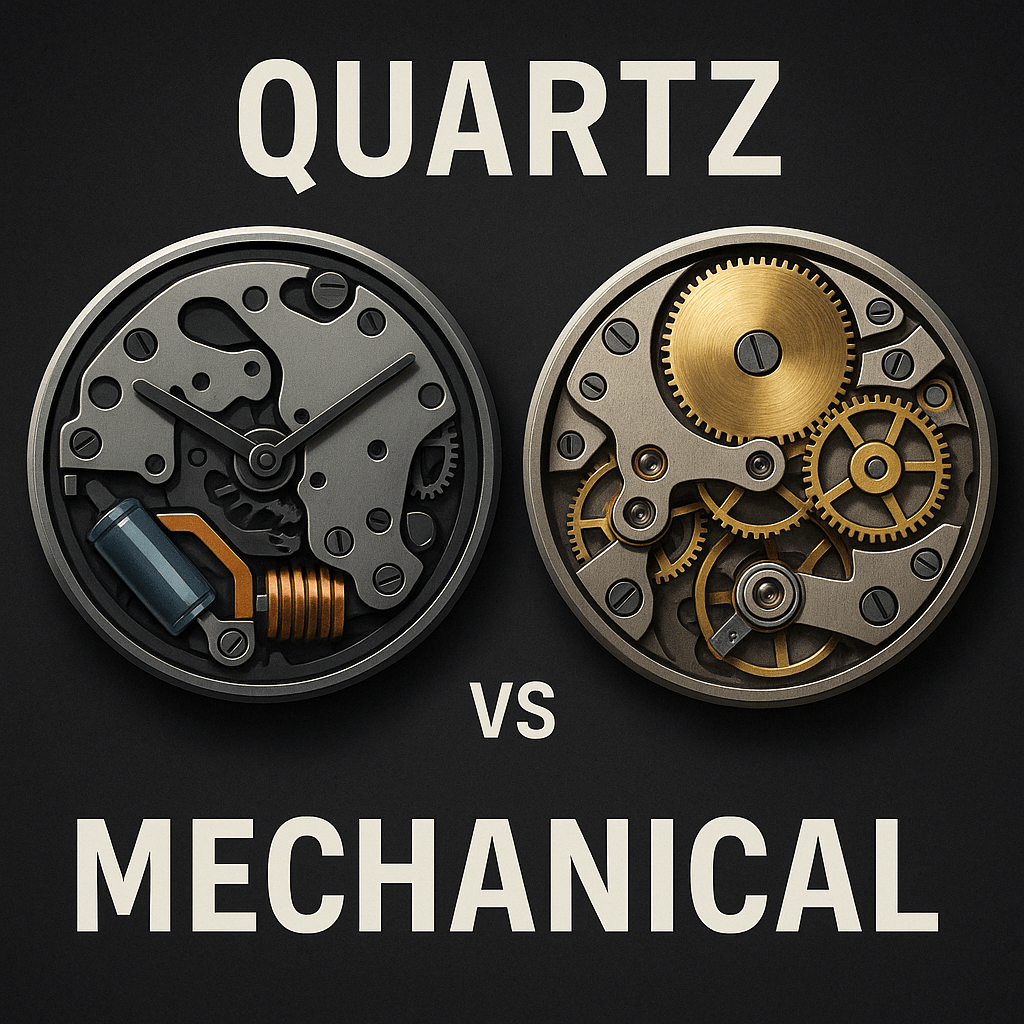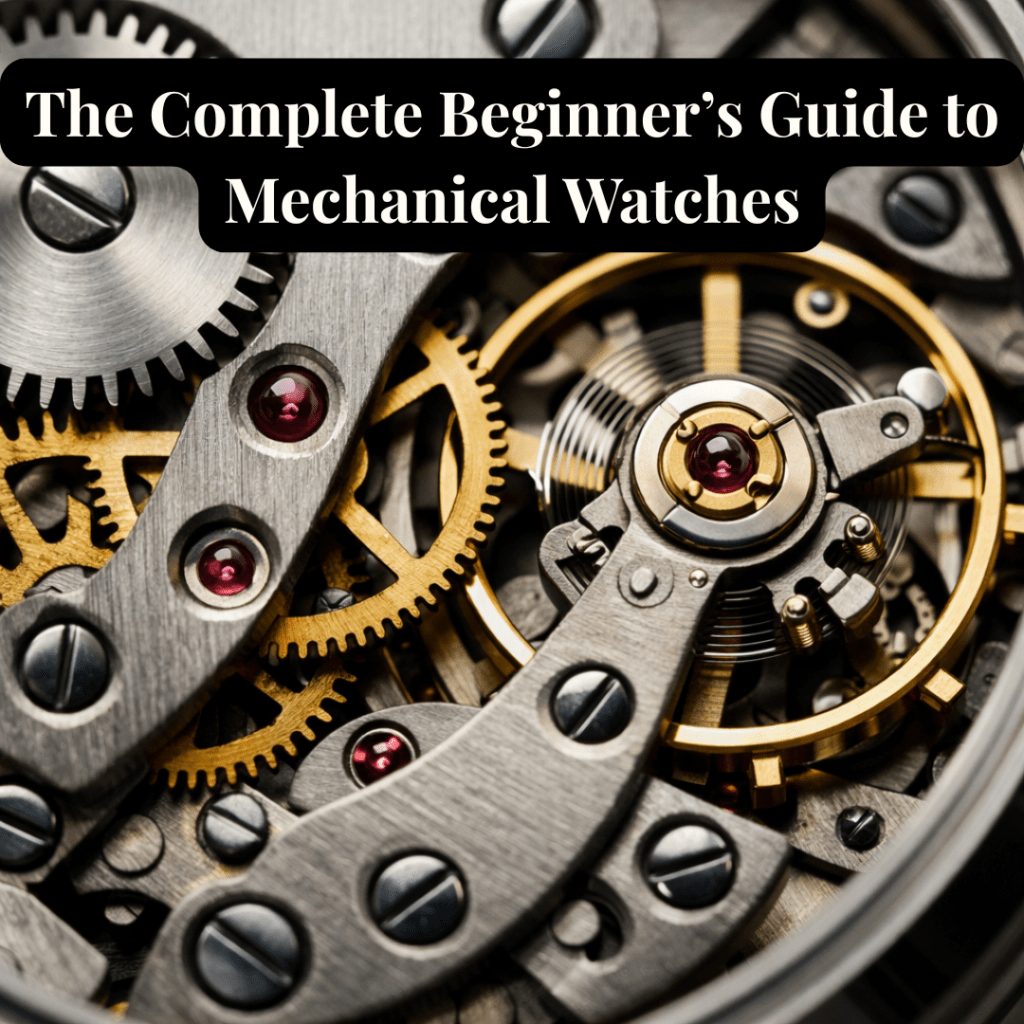
Sellita SW200-1 vs NH35 is not a simple Swiss-versus-Japanese contest. Both are automatic, hand-winding, hacking movements with a date. Both can power a dependable daily watch. But they create different constraints around case thickness, dial and hand compatibility, visual feel, servicing, and the economics of a build.
The useful question is not which movement sounds more prestigious. It is which movement supports the watch you are actually trying to make or buy. A compact small-batch watch, an affordable Seiko-style mod, and a one-off workshop project do not need the same movement strategy.
This guide compares official manufacturer specifications with practical workshop consequences. The aim is to make the movement choice clearer without pretending that a calibre decides the quality of the whole watch by itself.
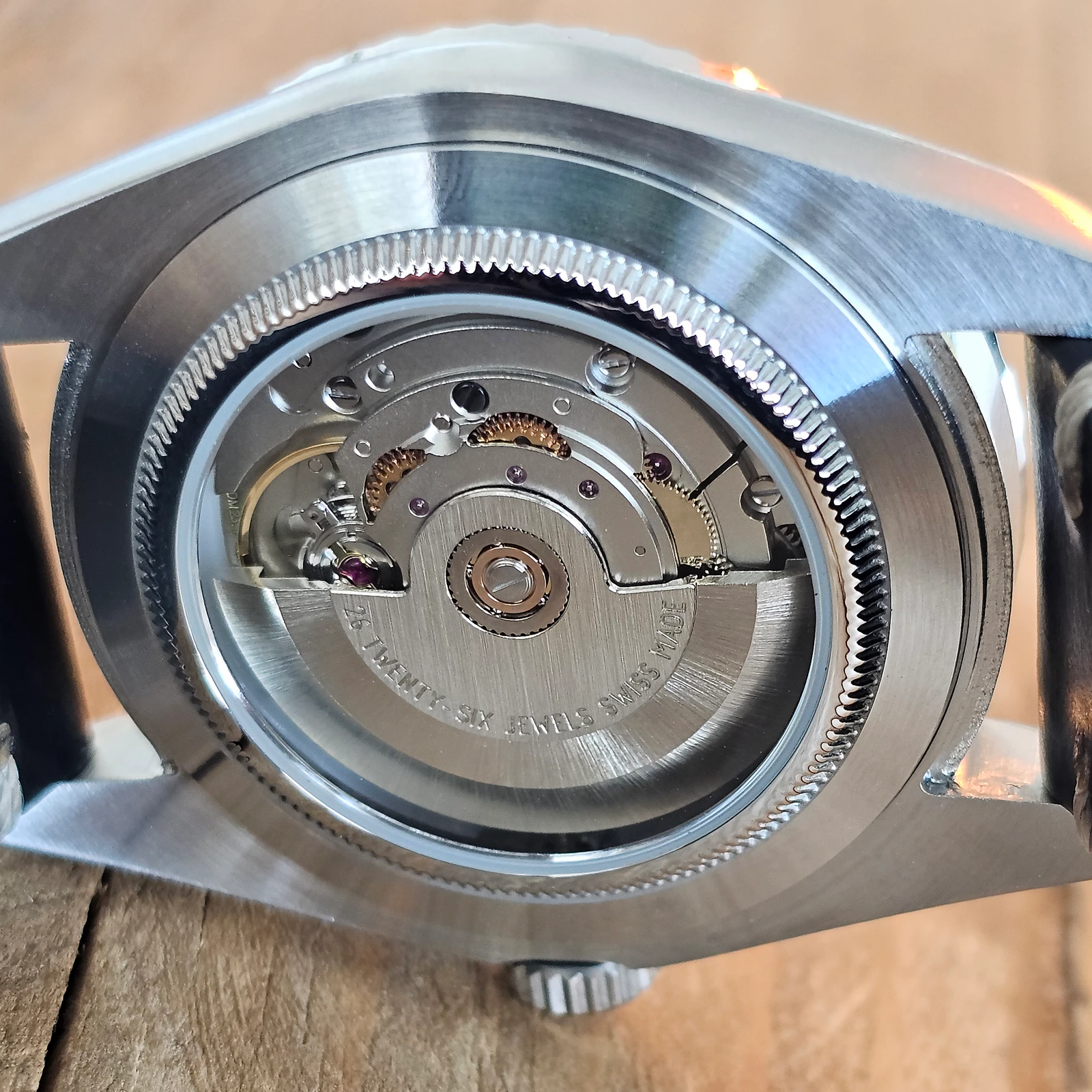
Sellita SW200-1 vs NH35: Official Specs at a Glance
The comparison begins with the manufacturers. Sellita documents the SW200-1 as an 11.5 ligne automatic movement. The NH35 is documented by Time Module Inc., or TMI, as part of the NH3 family. People commonly call it a Seiko NH35 because it belongs to the Seiko movement ecosystem, but TMI is the name found on the current product documentation and many supplied movements.
| Specification | Sellita SW200-1 | TMI NH35A |
|---|---|---|
| Functions | Hours, minutes, central seconds, date | Hours, minutes, central seconds, date |
| Diameter / size | 25.60mm, 11.5 ligne | 12 ligne; 27.40mm movement outside diameter |
| Height | 4.60mm | 5.32mm |
| Frequency | 28,800 vibrations per hour, 4 Hz | 21,600 vibrations per hour, 3 Hz |
| Jewels | 26 | 24 |
| Power reserve | Typical 41 hours | More than 41 hours under the stated test condition |
| Winding and setting | Automatic, manual winding, quick-set date, stop seconds | Automatic, manual winding, quick-set date, stop seconds |
The data comes from the official Sellita movement catalogue, the current SW200-1 technical documentation, and the official TMI NH-series product page. These figures describe the base movements. A finished watch still depends on the exact execution, regulation, casing, hands, dial, assembly, and quality control.
1. Movement Size Changes the Whole Case
The Sellita SW200-1 vs NH35 size comparison begins with a clear difference: the SW200-1 is both smaller in diameter and thinner. A difference of 0.72mm in movement height may sound trivial, but watch architecture is a stack of small clearances. The movement, dial, hands, crystal, movement holder, caseback, rotor space, and water-resistance structure all compete for depth.
A thinner movement gives the designer more freedom to keep a watch compact or to spend that space on a stronger caseback, a particular crystal profile, or extra hand clearance. It does not automatically produce a thin watch; a brand can still build a thick SW200-1 watch. It simply offers a more favorable starting point.
The NH35 is physically larger and usually arrives with a plastic movement holder that becomes part of the casing system. That has advantages. Builders can work with a mature family of known cases, holders, dials, hands, stems, and chapter rings. The cost is that the finished watch often needs more vertical room.
This is why movement choice should happen before case and dial selection. Our Seiko modding parts guide explains the same dependency from the NH side: the movement is not an isolated component. It establishes the geometry around which the rest of the watch has to work.
2. Four Hertz and Three Hertz Feel Different
The Sellita SW200-1 vs NH35 beat-rate difference is easy to state. The SW200-1 runs at 28,800 vibrations per hour, or 4 Hz. The NH35 runs at 21,600 vibrations per hour, or 3 Hz. In practical visual terms, the SW200-1 advances the seconds hand eight times per second while the NH35 advances it six times per second.
That gives the SW200-1 a visibly finer sweep. It is not continuous, and it does not make the watch inherently more accurate, but the motion can feel more refined. On a clean dial with a long seconds hand, the difference is easier to notice. On a small, busy, or heavily textured dial, it may matter much less.
For the difference between a factory range, regulation, and real wrist performance, see Watch Accuracy Explained.
A higher beat rate also means the escapement is doing more work over time. That is not an argument against 4 Hz; it is one reason service condition, lubrication, and correct assembly still matter. The NH35’s slower beat is part of its practical character. It looks slightly more deliberate and has earned its reputation through broad everyday use rather than visual smoothness.
Choose 4 Hz when the finer seconds motion supports the design. Choose 3 Hz when robust familiarity and the larger build ecosystem matter more. Do not choose either solely because a number looks superior on a product page.
3. Power Reserve Is Effectively a Draw
In the Sellita SW200-1 vs NH35 power-reserve comparison, both movements sit around the same daily-use window. Sellita states a typical 41-hour power reserve for the SW200-1. TMI specifies more than 41 hours for the NH3 family after a full wind under its stated test posture.
In ordinary use, that means neither is a modern long-reserve movement. Take the watch off on Friday evening and it may not still be running on Monday morning. Wear it regularly and both can be entirely practical.
Power reserve figures should also be read carefully. A laboratory figure does not promise identical real-world running time in every watch. Automatic winding efficiency, movement condition, how much the owner moves, and how fully the mainspring was wound all affect the result.
If a buyer needs a watch that can sit for an entire weekend and remain running, neither movement wins this comparison decisively. If the watch will be worn most days, the difference is unlikely to decide the purchase.
4. Accuracy Depends on Execution, Not Nationality
Accuracy is the most easily oversimplified part of a Sellita SW200-1 vs NH35 comparison. TMI publishes a static accuracy range of -20 to +40 seconds per day for the NH35 under its stated measurement conditions. That is a factory specification, not a prediction that every finished NH35 watch will gain or lose exactly that amount. A well-regulated individual movement may perform much better, while a poorly handled or magnetized watch may perform worse.
The SW200-1 is available in different executions and can be regulated to different standards by the brand using it. That makes a single universal SW200-1 accuracy claim misleading. A standard movement installed without careful regulation and a better-finished execution adjusted by a competent watchmaker should not be treated as the same product simply because the calibre name matches.
The honest hierarchy is straightforward:
- Movement architecture establishes the potential and the manufacturer’s baseline.
- Grade or execution can change components, decoration, and timing expectations.
- Regulation determines how the individual movement is adjusted at the bench.
- Casing and handling affect the result after the movement leaves the tray.
- Real wearing position changes what the owner sees from day to day.
A buyer should ask what the finished watch is regulated to, whether the seller checks it, and what the warranty actually covers. “Swiss” and “Japanese” are origins, not timing-machine results.
5. Service Economics Favor Different Owners
The Sellita SW200-1 vs NH35 service question starts with very different economics. The NH35 is inexpensive enough that replacement is often economically sensible when a movement is badly damaged. Parts and complete movements are widely available, and many modders and independent workshops know the platform. That keeps experimentation accessible and limits the financial consequence of a beginner mistake.
The SW200-1 usually belongs in a more expensive watch and carries a different service expectation. It is a conventional Swiss movement with a large professional service ecosystem. A watchmaker can service it properly, and the movement is familiar across many independent brands. But labor, parts, and the replacement movement itself normally cost more than the NH35 route.
Neither model should be treated as disposable by default. Replacement can make practical sense, but a competent repair is often the better choice when the watch has emotional value, a carefully fitted movement, or a small-batch identity. The decision belongs to the whole watch, not only the wholesale price of the calibre.
For a first mod, the NH35 reduces risk. For a more refined small-batch watch intended to be maintained over time, the SW200-1 can support the ownership model well. The important thing is that the brand explains which model it is offering.
6. The NH35 Wins the Modding Ecosystem
The strongest practical argument in the Sellita SW200-1 vs NH35 decision favors the NH35: compatibility. Cases, dials, hands, stems, crowns, movement holders, spacers, and complete kits are available from a huge range of suppliers. That makes it easier to plan a build, replace a damaged part, or change direction later.
This is also why the NH35 is such a good teaching movement. A builder can focus on hand installation, dial fit, stem cutting, dust control, case preparation, and visual balance without paying Swiss-movement money for every mistake. The short version is covered in why NH35 movements are popular in Seiko mods.
The ecosystem is not foolproof. “NH35 compatible” does not guarantee that every case, dial, and hand set will work together. Crown position, date-window placement, hand height, dial feet, chapter-ring clearance, and crystal space still need to be checked. A large parts market gives the builder options; it does not remove the need for measurement.
Within the NH family, the complication changes the build architecture. Use our NH35 vs NH36 vs NH34 comparison to check the date, day-date, GMT hand stack, dial, and case requirements before choosing parts.
Rexx Timepieces uses NH-series movements across custom and Seiko-style builds because the platform is practical and flexible. The Rexx NH-series movement guide shows how date, day-date, GMT, no-date, and open-worked variants change the project before the aesthetic decisions begin.
7. The SW200-1 Makes Sense When Proportion Leads
In the Sellita SW200-1 vs NH35 proportion comparison, the SW200-1 becomes persuasive when the watch is being designed around compact proportions, a finer seconds motion, and a more traditional Swiss service path. Its smaller footprint does not guarantee elegance, but it gives the case designer useful room to pursue it.
Meshberg Strata is a useful ecosystem example. It is a separate project from the Meshberg 37 Automatic: a 36.5mm watch using the SW200-1 with a laser-made, hand-finished, chemically darkened dial developed through the Meshberg and Rexx workshop connection.
The movement is not the whole reason Strata works. The compact case, bracelet, dial texture, marker scale, hand choice, and darkened surface have to agree. The SW200-1 supports the project’s proportions and finer mechanical character, but it cannot rescue weak dial design or careless assembly.
That is the larger lesson. A movement should serve the object. Strata does not need an NH35 simply because the NH35 is dependable, and a rugged Seiko-style custom build does not need an SW200-1 simply because the name sounds more expensive.
Which Movement Should You Choose?
Choose the NH35 when:
- you are building a first or experimental custom watch;
- you want the broadest selection of compatible mod parts;
- replacement cost and easy sourcing matter;
- a slightly thicker case and 3 Hz seconds motion suit the project;
- you value a proven workhorse more than a Swiss designation.
Choose the SW200-1 when:
- the case needs a smaller, thinner movement foundation;
- a 4 Hz seconds motion supports the visual character;
- the watch belongs in a higher-cost small-batch or independent context;
- you want a conventional Swiss service path;
- the brand can explain the movement execution, regulation, and final quality control.
If the Sellita SW200-1 vs NH35 decision concerns a finished watch rather than a loose movement, evaluate the complete object. Case dimensions, lug-to-lug length, dial opening, bracelet, crown, water resistance, regulation, warranty, and after-sales support may matter more than the calibre name. Our guide to 36mm vs 37mm watches shows how small dimensional changes can affect wrist presence more than a headline diameter suggests.
Final Verdict: Better for What?
The final Sellita SW200-1 vs NH35 verdict is purpose-led. The NH35 is the stronger platform for accessible modding, learning, parts availability, and cost-controlled custom work. The SW200-1 is the stronger starting point when compact architecture, a 4 Hz sweep, and a Swiss independent-watch service model support the intended watch.
For the same NH35 benchmark against a thinner Japanese 4 Hz movement, continue with our Miyota 9015 vs NH35 comparison.
That is not a compromise answer. It is the practical answer. Movements are engineering choices inside larger objects. The best calibre is the one that lets the case, dial, hands, crown, bracelet, and workshop execution become a coherent watch.
If you are still separating automatic from hand-wound and quartz movements, begin with our guide to automatic, quartz, and mechanical watches. If you are planning an NH-based build, continue with how to build a Seiko mod. For a workshop-led custom project, explore Rexx custom watches; for the quieter small-batch brand layer, visit Meshberg Watches.
\n
For the direct Swiss-versus-Japanese 4 Hz decision, continue with our Miyota 9015 vs Sellita SW200-1 comparison, including thickness, grade structure, reserve, service context, and real-watch fit.
\n