A 36mm vs 37mm watch question sounds simple until you put the watch on a wrist. One millimeter is not much on paper. In real life, it can disappear completely or change the whole personality of the watch, depending on the case shape, dial opening, thickness, bracelet, and the way the lugs fall.
That is why smaller watches are back in the conversation. Not because every watch should suddenly become small, and not because large watches are dead. The more useful shift is that collectors are getting better at reading proportions. A good 36mm or 37mm watch can feel compact, confident, elegant, practical, or surprisingly present when the design knows when to stop.
The current watch world keeps giving us reminders. A Blog To Watch recently reviewed the Hamilton A250 Khaki Field Mechanical 36mm, noting its 36mm case, 10.2mm thickness, and 46mm lug-to-lug measurement. That kind of release matters because it shows how a modern watch can use vintage-scale dimensions without feeling like a costume prop. The size is not the whole story. The proportions are.
This guide breaks down how to judge a 36mm vs 37mm watch properly: diameter, lug-to-lug, dial opening, bezel width, thickness, crystal shape, strap choice, and real wrist presence.
36mm vs 37mm Watch: The Short Answer
For a long time, many buyers treated 40mm as the safe modern middle. Anything smaller could be dismissed as dressy, vintage, or too delicate. That was always too simple. Plenty of serious tool watches, military watches, field watches, and everyday mechanical watches lived comfortably below 38mm for decades. The same shift is now visible in purpose-built sports watches; our guide to why midsize dive watches are winning again shows how bezel width, dial opening, and case geometry change the way a compact diver wears.
The difference now is visibility. Enthusiasts are more willing to talk about comfort, proportion, and design restraint instead of only wrist dominance. A smaller watch can look intentional. It can fit under a cuff. It can make the dial feel more focused. It can turn the watch back into an object you wear naturally, not an object that keeps asking to be noticed.
That does not mean a 36mm watch is automatically better than a 41mm watch. It means the lazy rulebook is weaker than it used to be. The question is not, “Is 36mm too small?” The question is, “Does this watch use its size well?”
Diameter Is Not the Whole Story
Case diameter is the number everyone sees first, but it is only one measurement. It tells you the width of the case, usually excluding the crown. It does not tell you how long the watch is, how thick it is, how much dial you see, how wide the bezel is, or how the bracelet begins to fall away from the case.
This is why the 36mm vs 37mm watch decision can be misleading. A 36mm watch with a large dial opening, thin bezel, long lugs, and bright dial can look bigger than a 37mm watch with a wider bezel and darker, more compact dial. A 37mm watch with short curved lugs can wear smaller than a 36mm watch with flat lugs that overhang the wrist.
Think of diameter as the first clue, not the verdict. The wrist reads the whole shape.
Lug-to-Lug Is the Number Most Buyers Forget
Lug-to-lug measurement is the distance from the top of the upper lug to the bottom of the lower lug. It often tells you more about fit than diameter. If the lug-to-lug is too long for your wrist, the watch can feel awkward even when the case diameter looks reasonable.
A compact 36mm or 37mm case usually works best when the lugs curve down or stay proportionate. The lugs are the bridge between the watch head and the wrist. If they are too long, too flat, or too stiff in shape, the watch can sit like a plate. If they are controlled, the watch can feel planted.
This is especially important on bracelets. End links can extend the effective lug-to-lug, making a watch wear longer than the spec sheet suggests. A leather strap or fabric strap may fall away more quickly, making the same case feel smaller and softer.
Dial Opening Can Make a Watch Feel Bigger
Dial opening is one of the hidden reasons watches wear differently. A watch with a narrow bezel and wide dial can look larger than its case diameter. A watch with a thick bezel, chapter ring, or darker outer edge can feel more compact.
Color matters too. Light dials often look larger because they reflect more light and make the visible surface feel open. Dark dials can shrink the watch visually, especially when paired with polished bezels or darker case details. High-contrast markers can make a small dial feel energetic. Low-contrast details can make it quieter.
This is why two watches with the same diameter can feel unrelated. The dial is not just decoration. It controls how the eye reads the watch.
Thickness and Crystal Shape Change Wrist Presence
A smaller diameter does not save a watch if the thickness is wrong. A 36mm watch that is very thick can feel top-heavy. A 37mm watch with balanced thickness can feel more refined and easier to wear. Thickness is not only a number; it is also how the case side, bezel, crystal, and caseback divide that height.
Crystal shape matters because it changes both the profile and the visual mood. A domed crystal can add vintage warmth and soften the watch, but it can also catch reflections. A flat sapphire crystal can look cleaner and more modern, but if the case is too slab-sided, the watch may feel less elegant.
If you want to understand why case material and finishing also change wrist feel, The Watcher HQ has a separate guide to watch case materials. Steel, titanium, finishing, and geometry all affect how a watch feels beyond diameter alone.
Strap Choice Can Shrink or Expand the Watch Visually
The strap or bracelet can make a smaller watch feel completely different. A bracelet adds visual mass. A thick leather strap can make a compact watch feel more casual and substantial. A thin tapered strap can make it feel dressier. A fabric strap can make the same watch feel more utilitarian.
Taper is especially important. If a strap stays too wide, it can make a small case look blocky. If it tapers too aggressively, the watch may feel more delicate than intended. Bracelet end links also matter because they can either flow from the case or make the watch wear longer than expected.
This is why a good 36mm vs 37mm watch comparison should include the strap or bracelet. The case does not live alone.
Who Should Consider a 36mm or 37mm Watch?
A 36mm or 37mm watch can work for more people than many buyers expect. Smaller wrists are the obvious fit, but that is not the whole audience. A larger wrist can also wear a smaller watch well if the design has enough dial presence, good lug shape, and the right strap or bracelet.
Consider a 36mm or 37mm watch if you want something that feels easy to wear all day, works with sleeves, avoids visual bulk, or gives the dial more intimacy. It can also be a good size for collectors who already own larger watches and want something quieter.
Be more careful if you prefer heavy sports watches, very bold bezels, or maximum wrist presence. In that case, a smaller watch may still work, but it needs the right visual strength. The goal is not to force yourself into a trend. The goal is to find the size where the design feels complete.
This is also where the ritual side of watches comes in. A smaller mechanical watch can feel more personal because it sits closer to the body and asks for less attention. That connects naturally to the reason people still care about watches at all, which we explored in the ritual of wearing a watch.
The Meshberg Angle: Quiet Proportions Over Size Flexing
Meshberg makes sense in this conversation because the brand is built around quiet proportions rather than loud size. The Meshberg 37 Automatic collection is the direct example: compact, restrained, and shaped around a 37mm case with small-batch dial character.
The point is not that every watch should copy that size. The point is that 37mm can be enough when the design has confidence. A good 37mm watch does not feel small because it lacks presence. It feels small because it has enough confidence to stop where the design is complete.
That same idea appears in broader independent watch culture. Many smaller brands are no longer trying to win by making the largest object possible. They win by making the object feel specific. For more on that shift, read our guide to microbrand watches and independent brands.
Strata as a 36.5mm Workshop Example
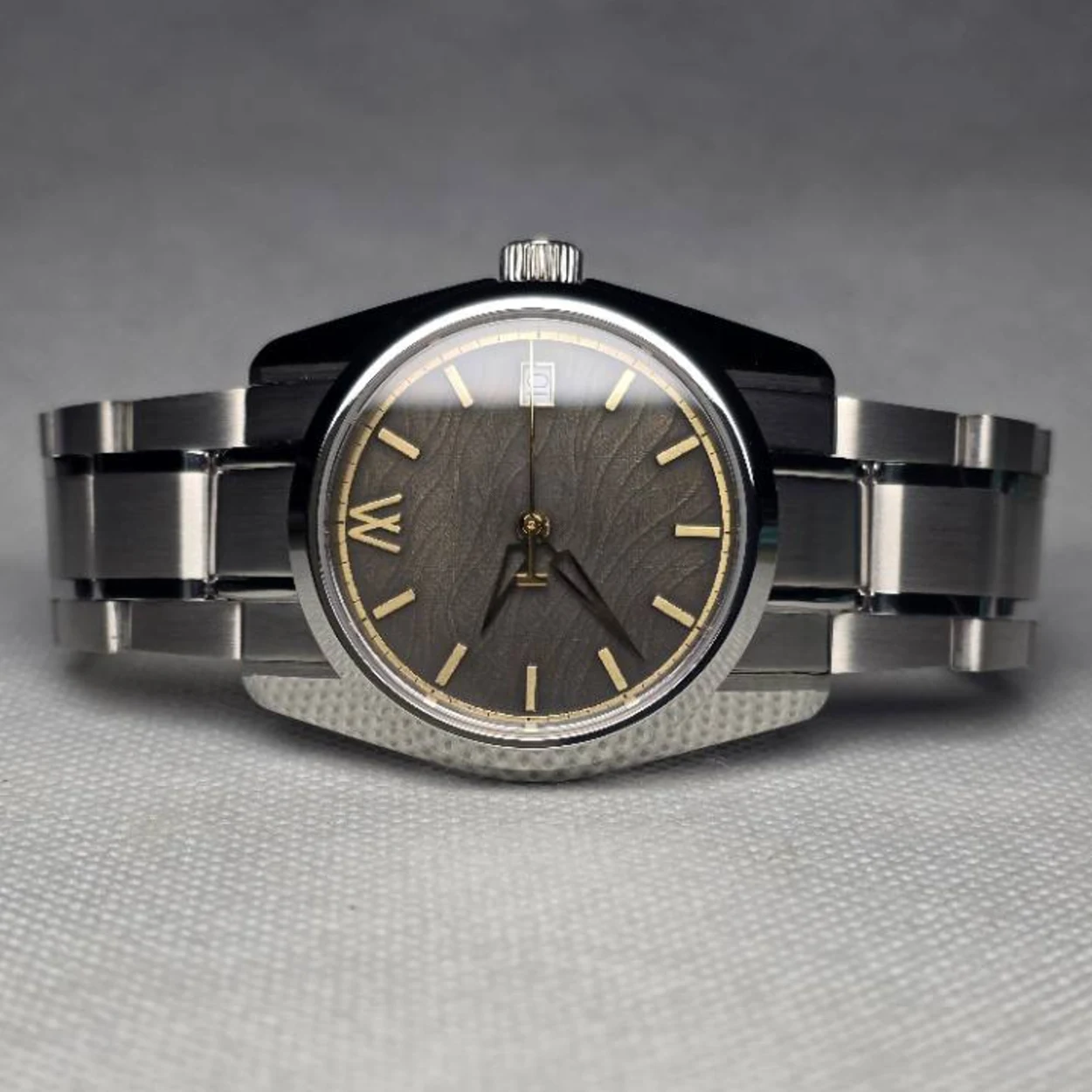
Meshberg Strata is a separate project from the Meshberg 37 Automatic, and it deserves to be identified accurately. Strata is a 36.5mm automatic watch powered by a Sellita SW200-1 movement. Its dial is laser-made, hand-finished, chemically darkened, and developed as a collaboration between Meshberg Watches and the workshop side of the ecosystem: Rexx Timepieces and Rexx StudioWorks.
That makes Strata useful for this guide because it shows the difference between a small watch and a small idea. The diameter is compact, but the dial has depth. The darker surface, gold-tone markers, bracelet mass, and handmade texture give the watch more presence than the number suggests.
The dial process is not just a claim on a spec sheet. Rexx Timepieces shows the handcrafting process in the YouTube Short “Handcrafting a Watch Dial for MESHBERG Watches | Rexx StudioWorks”. That kind of proof matters because a watch with a handmade dial is not only a diameter. It is a surface, a material process, and a set of real workshop decisions.
Strata also shows why the 36mm vs 37mm watch question should not be answered by size alone. A 36.5mm case can feel refined, but it can also carry real character when the dial, case, bracelet, and finishing are working together.
For more background on the practical side of dial work, see our guide to how custom watch dials are made.
How to Test a Smaller Watch Before Buying
If you are deciding whether a smaller watch will work for you, do not stop at the diameter. Look for wrist photos from multiple angles. Check the lug-to-lug measurement. Look at the side profile. Compare the thickness to the diameter. Notice whether the dial opening is large or restrained. Study the strap or bracelet taper.
If the watch has a dark dial, ask whether it still has enough contrast. If it has a light dial, ask whether it will feel larger than the case suggests. If it uses a bracelet, look at the end links. If it uses a strap, check whether the strap overwhelms the case or supports it.
And if the watch is being shown mostly through renders, be careful. Real wrist photos and workshop images matter. We covered that problem in more detail in watch renders vs real watches.
Quick 36mm vs 37mm Watch Checklist
- Do you know the lug-to-lug measurement?
- Is the case thickness balanced for the diameter?
- Does the dial opening make the watch look larger or smaller?
- Do the lugs curve down or sit flat?
- Does the bracelet or strap add too much visual mass?
- Is the dial readable in normal light?
- Are there real wrist photos, not only renders?
- Does the design feel complete at this size?
Final Take: Fit Is a Feeling, Not Just a Measurement
The real answer to the 36mm vs 37mm watch question is not hidden in the single millimeter between them. It is in the whole object. Diameter matters, but lug-to-lug, thickness, dial opening, crystal shape, strap choice, and visual balance matter just as much.
A smaller watch can feel underwhelming if the design is weak. It can also feel deeply confident when the proportions are right. That is why 36mm and 37mm watches are back: not as nostalgia, but as a reminder that restraint can be powerful.
When a compact watch has the right case, dial, and wearing feel, it does not need to shout. It just needs to make sense every time you put it on.