Miyota 9015 vs NH35 is one of the most useful Japanese movement comparisons for anyone choosing an automatic watch or planning a build. Both movements offer automatic winding, hand winding, stop seconds, a quick-set date, and a practical daily-wear power reserve. Beyond that shared foundation, they lead to noticeably different watches.
The Miyota 9015 is thinner, smaller, faster-beating, and supplied with a tighter published accuracy range. The TMI NH35 is thicker and slower-beating, but it sits at the center of an enormous Seiko-style parts ecosystem. One gives designers more freedom to pursue slim proportions. The other makes custom building, replacement, and experimentation unusually accessible.
The right question is therefore not which calibre is universally better. It is which movement supports the watch you actually want: a compact independent automatic, an affordable daily watch, or a parts-driven custom build.
Miyota 9015 vs NH35: Official Specifications
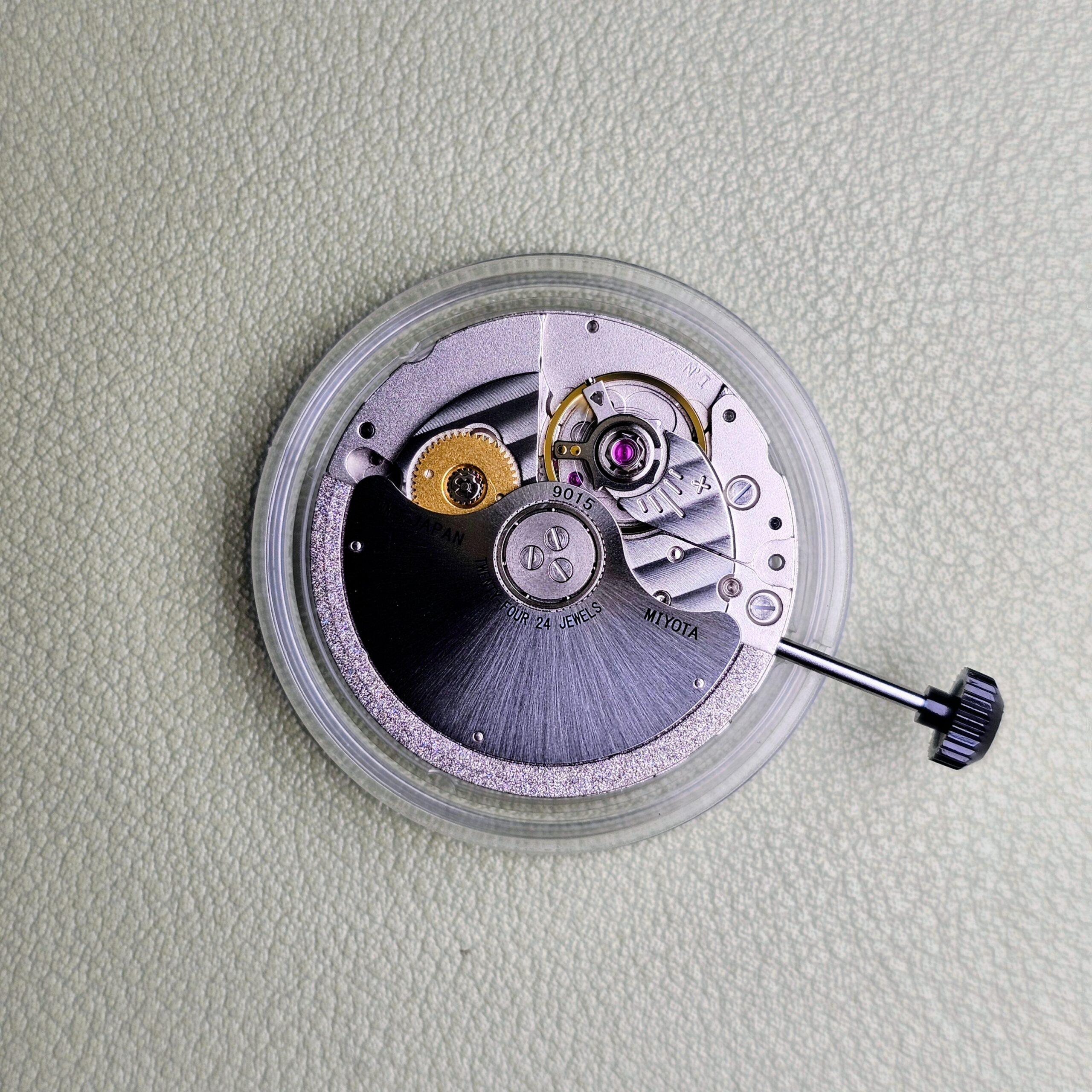
Start with the manufacturers rather than marketplace listings. Citizen-owned Miyota publishes the 9015 specifications directly. Time Module Inc., or TMI, publishes the NH35 as part of the NH3 mechanical family. The NH35 is commonly called a Seiko movement because it belongs to the Seiko movement ecosystem, but TMI is the name used on its current product documentation.
| Specification | Miyota 9015 | TMI NH35 |
|---|---|---|
| Functions | Hours, minutes, central seconds, date | Hours, minutes, central seconds, date |
| Size | 11.5 ligne | 12 ligne; 27.40mm movement diameter |
| Height | 3.90mm | 5.32mm |
| Frequency | 28,800 vibrations per hour, 4 Hz | 21,600 vibrations per hour, 3 Hz |
| Jewels | 24 | 24 |
| Published accuracy | -10 to +30 seconds per day | -20 to +40 seconds per day |
| Running time | Approximately 42 hours | More than 41 hours under TMI’s stated test condition |
| Winding and setting | Automatic, manual winding, quick-set date, stop seconds | Automatic, manual winding, quick-set date, stop seconds |
These figures come from the official Miyota 9015 product page, the official TMI NH-series page, and the official TMI NH35 technical listing. They describe base movements, not the quality of every finished watch using them. Regulation, casing, dial and hand installation, magnetic exposure, lubrication, and final inspection still matter.
1. The 9015 Is Much Thinner
The most important physical difference in a Miyota 9015 vs NH35 comparison is movement height. The 9015 is 3.90mm high. The NH35 is 5.32mm high. A difference of 1.42mm is substantial inside a watch, where the movement, dial, hands, crystal, rotor, holder, caseback, gaskets, and water-resistance structure all compete for vertical space.
A thinner movement does not guarantee a thin watch. Brands can place a 9015 inside a thick case, and clever engineering can keep an NH35 watch reasonably controlled. Still, the starting architecture matters. The 9015 gives a designer more room to pursue a lower case profile or to spend that saved space on the crystal, caseback, or dial construction.
This is especially relevant below 40mm. A compact diameter paired with too much thickness can make a watch look visually top-heavy. A slim movement helps the case, bezel, lugs, and bracelet feel like one object rather than a small dial sitting on a tall mechanical container.
The Meshberg 37 Automatic is a useful ecosystem example: its 37mm case uses the Miyota 9015 as part of a restrained small-batch watch architecture. The movement does not create the proportions alone, but its 3.90mm height makes those proportions easier to achieve.
2. Four Hertz Produces a Finer Seconds Motion
The Miyota 9015 runs at 28,800 vibrations per hour, or 4 Hz. The NH35 runs at 21,600 vibrations per hour, or 3 Hz. That means the 9015 advances its seconds hand eight times per second, while the NH35 advances six times per second.
The 9015 therefore gives the seconds hand a visibly finer sweep. It is not continuous, and a higher frequency does not automatically make a watch more accurate. But on a clean dial with a long seconds hand, the motion can make the watch feel more refined. The difference becomes less obvious on a short seconds hand, a visually busy dial, or a watch that the owner rarely studies closely.
The NH35’s lower frequency is not a defect. It is part of a practical movement architecture that has become familiar across affordable automatics and custom builds. The slightly more deliberate seconds motion suits tool-watch and Seiko-style designs perfectly well.
Choose 4 Hz because the visual rhythm supports the watch, not because a larger number sounds more luxurious. Choose 3 Hz when the movement’s compatibility and economics matter more than the last degree of sweep smoothness.
3. The 9015 Has the Tighter Factory Accuracy Range
Miyota publishes the 9015 at -10 to +30 seconds per day. TMI publishes the NH35 at -20 to +40 seconds per day under its stated static measurement conditions. On paper, the 9015 has the tighter range.
A published range is only the starting point. See Watch Accuracy Explained for positional variation, winding state, timegrapher readings, and the difference between regulation and service.
That does not mean every 9015 watch will outperform every NH35 watch. A carefully regulated NH35 can run well inside its broad factory tolerance. A poorly cased, magnetized, or badly handled 9015 can perform outside the experience its specification suggests. The individual movement and the work performed after it leaves the manufacturer both matter.
For buyers, the useful question is not only “which calibre is inside?” Ask whether the brand regulates the finished watch, inspects it after casing, and states a practical timing expectation. For builders, timing should be checked after assembly rather than assumed from the movement packet.
The 9015 begins with a stronger published accuracy position. The NH35 answers with inexpensive availability and straightforward regulation. Neither removes the need for final quality control.
4. Power Reserve Is Effectively a Draw
The Miyota 9015 vs NH35 power-reserve contest is not decisive. Miyota states approximately 42 hours for the 9015. TMI states more than 41 hours for the NH35 after full winding under its specified test condition.
In normal ownership, both movements occupy the same practical category. Wear the watch most days and either reserve is sufficient. Leave it off for an entire weekend and there is a good chance it will need to be reset before the next wear.
Real running time depends on more than the catalogue figure. How fully the mainspring was wound, how active the wearer is, the movement’s condition, and automatic winding efficiency all influence the result. Neither movement belongs to the newer generation of 60-, 70-, or 80-hour calibres.
If weekend continuity is the priority, look beyond both. If dependable daily wear is the goal, their one-hour published difference should not decide the purchase.
5. Rotor Feel Is Real, but It Is Not a Quality Score
Owners sometimes describe the Miyota 9015 as more noticeable on the wrist. Depending on the watch, the rotor can be heard or felt when it moves quickly. Other 9015 watches are quiet enough that the owner rarely notices. Case construction, caseback material, fit, lubrication, and the wearer’s sensitivity all affect the experience.
The NH35 generally has a different winding character and is often perceived as less free-spinning. That does not make it silent, and a noisy finished NH35 watch should not be excused automatically. Movement sounds need context: a faint rotor response is different from scraping, impact, or a loose component.
This is one area where a specification table cannot replace the finished object. If possible, handle the watch. If buying online, look for a return policy and honest owner feedback about the exact model rather than importing every comment about the calibre into every case that uses it.
A visible or audible mechanical personality may be charming to one owner and irritating to another. It is a user-experience difference, not a universal ranking of movement quality.
6. The NH35 Dominates the Modding Ecosystem
The NH35’s strongest advantage is not one line in its specification sheet. It is the system around it. Cases, dials, hands, stems, crowns, movement holders, chapter rings, date-compatible layouts, and complete kits are available from a very large supplier network.
That breadth makes the NH35 easier to use for a first build and easier to replace after a serious mistake. It also lets experienced builders move between diver, field, dress, and experimental designs without leaving the same basic platform. Our guide to Seiko modding parts explains why the movement, case, dial, hands, and chapter ring have to be planned as one compatibility chain.
The market is broad, not foolproof. An “NH35 compatible” label does not guarantee that every part works with every other part. Crown position, dial feet, date-window placement, hand hole sizes, hand-stack clearance, crystal depth, and movement-holder geometry still need to agree.
The 9015 has established case, dial, and hand options, especially for microbrands and manufacturers, but it does not offer the same open retail modding universe. It is more often selected as part of a designed watch architecture than as the center of a hobbyist parts catalogue.
For a deeper look at the NH platform, continue with our NH35 vs NH36 vs NH34 comparison. It shows how date, day-date, and GMT functions change dials, hands, case clearance, and the build plan.
7. Service and Replacement Follow Different Economics
Both movements can be serviced, but the economics around them differ. The NH35 is inexpensive and widely available enough that replacing a badly damaged movement is often more economical than a full traditional service. That is especially true in an entry-level mod where workshop labor can exceed the movement’s replacement cost.
The 9015 usually appears in a more expensive finished watch and costs more to replace. It is still a mainstream Japanese calibre rather than an obscure proprietary movement, which is reassuring for long-term ownership. A competent independent watchmaker can evaluate whether service or replacement makes sense for the complete watch.
Replacement should not be treated as the automatic answer. A watch may have emotional value, carefully fitted components, or a small-batch identity worth preserving. Equally, paying for extensive repair on a damaged low-cost movement is not always responsible. The sensible decision depends on the watch, the failure, parts availability, and local labor.
For owners, after-sales support matters more than theoretical serviceability. A brand that answers questions, provides a clear warranty, and can explain its repair path offers more practical security than a movement name presented without support.
8. Each Movement Serves a Different Kind of Watch
The 9015 makes the most sense when proportion leads. Its thinner architecture and 4 Hz frequency suit compact microbrand watches, refined everyday automatics, and designs where the seconds motion is part of the visual character. It is a strong choice when a brand is designing the complete watch rather than inviting the owner to exchange every component later.
The NH35 makes the most sense when flexibility leads. It supports accessible Seiko-style builds, replacement-friendly daily watches, learning projects, and custom work where the huge parts ecosystem creates real value. Rexx Timepieces works within that broader workshop environment, where cases, dials, hands, finishing, and movement choice can be discussed as one practical build.
Neither movement can rescue a poor watch. A thin 9015 case with weak proportions is still weak. An NH35 watch assembled from incompatible or careless parts is still careless. Dial legibility, hand length, crown action, crystal treatment, bracelet fit, water resistance, regulation, and final inspection determine whether the complete object feels resolved.
This is also why independent-watch evaluation should go beyond movement prestige. Our guide to microbrand watches and independent watch culture explains how design identity, production transparency, support, and real execution matter alongside the calibre.
Which Movement Should You Choose?
Choose the Miyota 9015 when:
- a thin or compact case architecture is important;
- you prefer a finer 4 Hz seconds motion;
- the tighter published factory accuracy range matters;
- you are buying a finished independent or microbrand watch rather than planning constant part changes;
- the brand regulates, cases, and supports the movement properly.
Choose the NH35 when:
- you want the largest selection of compatible mod parts;
- replacement cost and easy sourcing are priorities;
- you are building, learning, or experimenting;
- a 3 Hz seconds motion and thicker case suit the design;
- you value a mature parts platform more than slimness.
If you are comparing finished watches, do not stop at the movement. Check case diameter, lug-to-lug length, thickness, dial opening, bracelet or strap, water resistance, regulation, warranty, and real photographs. Our 36mm vs 37mm watch guide shows why a millimeter in diameter tells only part of the fit story.
Final Verdict: Architecture or Ecosystem?
The final Miyota 9015 vs NH35 verdict is clear. The Miyota 9015 is the stronger movement foundation for a thinner, higher-beat, proportion-led automatic watch. The NH35 is the stronger platform for modding, broad parts compatibility, affordable replacement, and workshop experimentation.
That does not make the 9015 the premium answer and the NH35 the budget answer in every situation. A well-designed NH35 watch can be more coherent than a poorly executed 9015 watch. A refined compact watch may genuinely benefit from the 9015 even when the owner never thinks about the movement after purchase.
Choose the architecture when the watch is a resolved design. Choose the ecosystem when flexibility is part of the purpose. In both cases, judge the finished watch by how honestly its movement, case, dial, hands, regulation, and support work together.
For a movement-specific workshop perspective, read Rexx Timepieces’ guide to understanding the Miyota 9015. If you are still separating movement types, begin with automatic, quartz, and mechanical watches explained.
\n
If your shortlist has moved beyond the NH35, continue with our Miyota 9015 vs Sellita SW200-1 comparison to compare the two compact 4 Hz alternatives directly.
\n