
NH35 vs NH36 vs NH34 is a choice between three different functions, not a contest to find one universally better Seiko mod movement. Choose the NH35 for a simple date watch, the NH36 for day and date, and the NH34 when the design genuinely needs a fourth GMT hand.
That answer sounds easy. The expensive mistakes happen after it: buying the wrong dial, assuming every NH case is interchangeable, forgetting the NH34 hand-stack clearance, or ordering an NH36 whose day wheel does not line up with the intended crown and dial layout.
This guide compares the three movements as build platforms. It covers what changes at the bench, what must be checked before buying parts, and when the simpler option is actually the stronger design choice.
The short answer
NH35: date only and the broadest simple-build path. NH36: day-date with more dial and calendar alignment decisions. NH34: GMT with a fourth central hand and extra clearance requirements.
NH35 vs NH36 vs NH34: Quick Comparison
| Feature | NH35 | NH36 | NH34 |
|---|---|---|---|
| Display | Time and date | Time, day and date | Time, date and central 24-hour hand |
| Jewels | 24 | 24 | 24 |
| Frequency | 21,600 vibrations per hour | 21,600 vibrations per hour | 21,600 vibrations per hour |
| Published running time | More than 41 hours | More than 41 hours | More than 41 hours |
| Build difficulty | Lowest of the three | Moderate calendar alignment | Highest due to GMT hand and clearance |
| Best fit | Clean date builds | Day-date sport or everyday builds | Caller-style GMT builds |
The official TMI specifications list all three at 21,600 vibrations per hour, with hacking, manual winding, 24 jewels, and more than 41 hours of running time. Their published static accuracy range is also the same: -20 to +40 seconds per day. Those shared numbers explain why the choice should be driven by the watch you are building, not by the assumption that one calibre is automatically more advanced.
That range is a factory specification, not a prediction of every finished watch. Our guide to watch accuracy and seconds per day explains how regulation, position, winding state, and real use change the result.
Technical reference: TMI NH0/NH3 mechanical movement specifications. Always check the current technical guide and the exact part supplier before ordering.
What the Three Movements Share
NH35, NH36 and NH34 belong to the same broad TMI mechanical family. In the modding world they are often called “Seiko NH movements” because TMI sits within the Seiko Instruments ecosystem and the platform is deeply connected to Seiko-compatible aftermarket parts.
All three are automatic movements that can also be hand-wound. They stop the seconds hand when the crown is pulled to the time-setting position, which makes precise setting easier. They are widely supported, familiar to builders, and designed as practical workhorse calibres rather than decorative haute-horlogerie movements.
That shared architecture creates a dangerous half-truth: many parts look interchangeable. Some are. A complete build is not. The complication, hand stack, dial, calendar layout, case, crystal and crown position still have to agree.
1. NH35 Is the Straightforward Date Option
The NH35 displays hours, minutes, central seconds and the date. It is usually the easiest of the three to plan because it needs only the normal three-hand stack and a date window if the date is meant to remain visible.
For a first custom watch, that simplicity is valuable. It leaves fewer alignment problems and gives you the broadest choice of compatible cases, dials and hand sets. It also makes sense when the design is meant to feel clean. Adding a complication simply because it exists can weaken a dial.
An NH35 can sit behind a no-date dial, but the date mechanism has not disappeared. The crown will still have its date-setting position. That is mechanically workable in many builds, yet it is worth deciding whether a true no-date movement would better match the final user experience.
For more background on why this calibre became so common, read why NH35 movements are popular in Seiko mods.
2. NH36 Adds Day-Date Decisions
The NH36 adds a day wheel to the date display. That gives the finished watch more information and a familiar everyday-watch character, but the dial now needs the correct opening and the movement needs the correct calendar orientation.
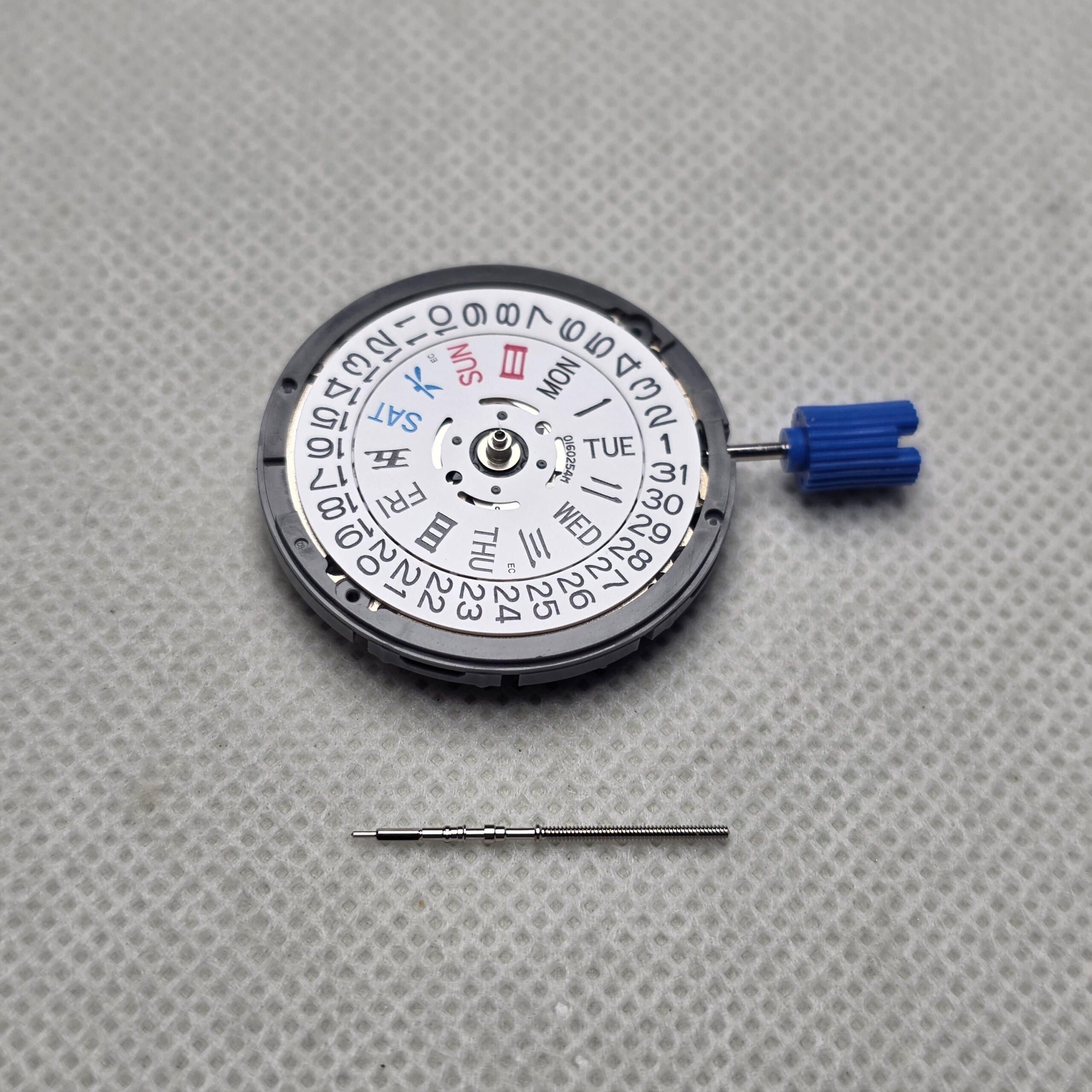
NH36 day wheels are available in different language combinations, and the displayed day must align correctly at the chosen crown position. A movement prepared for one case and dial orientation is not automatically correct for another. This matters especially when moving between 3 o’clock and roughly 4 o’clock crown layouts.
The practical questions are simple:
- Does the dial have the correct day-date window?
- Does the day wheel use the language combination you want?
- Do the dial feet and crown position match the case layout?
- Will both calendar discs align cleanly in the window?
The NH36 is the right choice when day-date is part of the design. It is not automatically better than the NH35; it simply asks the dial to carry more information.
3. NH34 Is a GMT Build, Not Just an NH35 With Another Hand
The NH34 adds a central 24-hour hand. It allows a second time reference to be read against a 24-hour scale on the dial, chapter ring or bezel. The 24-hour hand can be adjusted separately, while the main time is set through the regular hour and minute hands.
The NH34 is a caller-style GMT movement: its 24-hour hand is adjusted independently, while the main local-time display is set conventionally. Our caller GMT vs traveller GMT guide explains how that differs from a movement with an independently jumping local hour hand and why the distinction matters in use.
The extra hand changes the build in several places. The dial centre opening must clear the GMT post. The hand set must include the correct fourth hand. The case and crystal must provide enough space above the taller assembled hand stack. A flat crystal or a case sold only for an NH35 can become a problem even though the movements share much of their underlying architecture.
A GMT watch also needs a readable 24-hour reference. A fourth hand with no coherent scale may look technical while communicating very little. The bezel, chapter ring and dial should make the complication usable rather than merely decorative.
This is why “NH34 compatible” should be verified at the case level, not inferred from an NH35 listing. Look for an explicit statement about NH34 hand clearance and confirm the recommended crystal profile.
4. The Hand Stack Is the Biggest Physical Difference
NH35 and NH36 use the familiar hour, minute and seconds arrangement. NH34 inserts a 24-hour hand into the stack. That additional layer affects installation order and the vertical space required beneath the crystal.
Hand installation is already one of the easiest stages to damage. Hands must sit level, remain parallel and clear one another through a full rotation. The NH34 adds another opportunity for contact. A GMT hand that is not seated evenly can touch the dial, the hour hand above it, or reveal a clearance problem only after the watch has been cased.
Do not buy a generic “NH hand set” without reading the specification. NH34 needs the correct GMT hand in addition to the regular hands, and the visual lengths should suit the dial’s hour markers and 24-hour track.
5. Dial Compatibility Is More Than Diameter
A common 28.5mm dial diameter does not prove that a dial is correct for all three movements. Diameter is only the outer measurement. The centre opening, calendar window, dial feet and printed scales still matter.
For NH35, verify the date window and crown orientation. For NH36, verify both calendar windows or the combined day-date opening, plus the day-wheel alignment. For NH34, verify that the centre hole clears the additional GMT post and that the dial provides a useful 24-hour reference if the bezel or chapter ring does not.
Some builders remove incompatible dial feet and use dial dots. That can solve one mounting problem, but it does not fix a misplaced date window, an incorrect day wheel, or insufficient hand clearance. Adhesive is not a substitute for planning the movement, dial and case as one system.
6. Crown Position Can Decide the Movement Variant
Seiko-style mod cases commonly place the crown at 3 o’clock, 3.8 o’clock or near 4 o’clock. The case opening may accept the movement, yet the calendar and dial feet can still be wrong for the chosen orientation.
This is most obvious with the NH36 because the day text has to sit level in the window. It also affects date alignment and where the dial feet land. When a supplier offers several movement or day-wheel variants, the crown position is not a cosmetic dropdown. It is a build specification.
Before ordering, write the complete combination in one line: movement, crown position, dial diameter, calendar layout and case reference. If any part of that line is unknown, the build is not ready to purchase.
7. Case Compatibility Must Be Explicit
Cases are often marketed as NH35/NH36 compatible because those two movements are close enough for many shared case systems. NH34 requires more caution. Even when the movement holder and stem position work, the additional hand height may require a taller crystal or more internal space.
Also check the movement spacer, crown and stem supplied with the case. Water resistance depends on the complete case system and the quality of assembly, not on the movement name. Gaskets, crown sealing, crystal installation and pressure testing all matter.
Our broader Seiko modding parts guide explains how the case, dial, hands, chapter ring, crystal and movement interact. If you are planning a first complete assembly, use the step-by-step Seiko mod build guide as the companion piece.
8. The Best Movement Depends on the Design
Choose NH35 when:
- You want a clean three-hand watch with a date.
- You want the simplest parts search and assembly path.
- The dial does not benefit from a day window or GMT hand.
- You are building a first Seiko mod and want fewer compatibility traps.
Choose NH36 when:
- Day-date is useful and visually suits the watch.
- You have confirmed the crown orientation and day-wheel language.
- The dial is designed for the correct calendar layout.
- You want a practical everyday or sport-watch display.
Choose NH34 when:
- A second time reference is central to the watch concept.
- The case and crystal are explicitly compatible with the GMT hand stack.
- The dial, chapter ring or bezel provides a legible 24-hour scale.
- You are comfortable installing and aligning four central hands.
9. Common Ordering Mistakes
- Buying by diameter alone. A dial can be the right width and still have the wrong centre hole, feet or calendar window.
- Assuming every NH case accepts NH34. The fourth hand can create a crystal-clearance problem.
- Ignoring crown orientation. This can misalign dial feet, date and especially the NH36 day display.
- Using a GMT hand without a 24-hour scale. The watch gains visual noise but little useful information.
- Ordering an NH36 without checking day language. The language pair is part of the visible design.
- Mixing random supplier claims. “NH compatible” is too vague; confirm compatibility for the exact movement and case reference.
The strongest builds begin with a compatibility map, not a shopping cart. Our guide to choosing Seiko mod parts goes deeper into that process.
Workshop Verdict
For most straightforward custom builds, the NH35 is the sensible default. It is not glamorous, but it gives the design room to breathe and reduces avoidable assembly problems.
Choose the NH36 because you want day-date, not because the extra text makes the specification sound richer. Choose the NH34 because the watch is designed around a useful GMT display, not because four hands look more expensive than three.
That is the real NH35 vs NH36 vs NH34 decision: start with the function, then prove every surrounding part is compatible. When the movement, dial, hands, case and crystal agree, all three can produce excellent watches.
For a workshop-led custom build, Rexx Timepieces can help plan the movement and surrounding parts as one watch rather than a collection of listings. The Rexx Timepieces YouTube channel shows the hands-on build and dial work behind that approach.
Frequently Asked Questions
Is NH36 better than NH35?
No. NH36 adds a day display, while NH35 is date-only. NH36 is better only when the watch is designed for day-date and the calendar orientation matches the dial and case.
Can I put an NH34 in an NH35 case?
Sometimes, but never assume it. The holder and stem position may be compatible while the taller four-hand stack lacks crystal clearance. Use a case explicitly sold and documented for NH34.
Can NH35 and NH36 use the same dial?
They can share some no-date dials or purpose-made compatible dials, but a date-only NH35 dial does not provide the day display required for a normal NH36 day-date build. Dial feet, crown position and calendar alignment also need verification.
Does NH34 have a true GMT function?
NH34 provides a separately adjustable central 24-hour hand for a second time reference. It does not provide the independently jumping local-hour hand associated with traveller-style GMT movements.
Which movement is best for a first Seiko mod?
NH35 is usually the easiest starting point because the three-hand date layout has broad aftermarket support and fewer clearance and calendar-alignment decisions than NH34 or NH36.