A custom milestone watch can mark a wedding, graduation, new business, recovery, anniversary, family story, or personal turning point. The appeal is not difficult to understand. A watch stays close, gets used, and continues collecting meaning after the event itself has passed.
But personal does not have to mean crowded. The strongest milestone watches rarely place the entire story on the dial. They choose a few details that can live comfortably inside a real watch: a color, a texture, a symbol, a monogram, a date, a short engraving, or a material connected to the person.
That distinction matters. A milestone watch should not look like a scrapbook compressed into a dial. It should feel like a real watch that quietly knows why it exists.
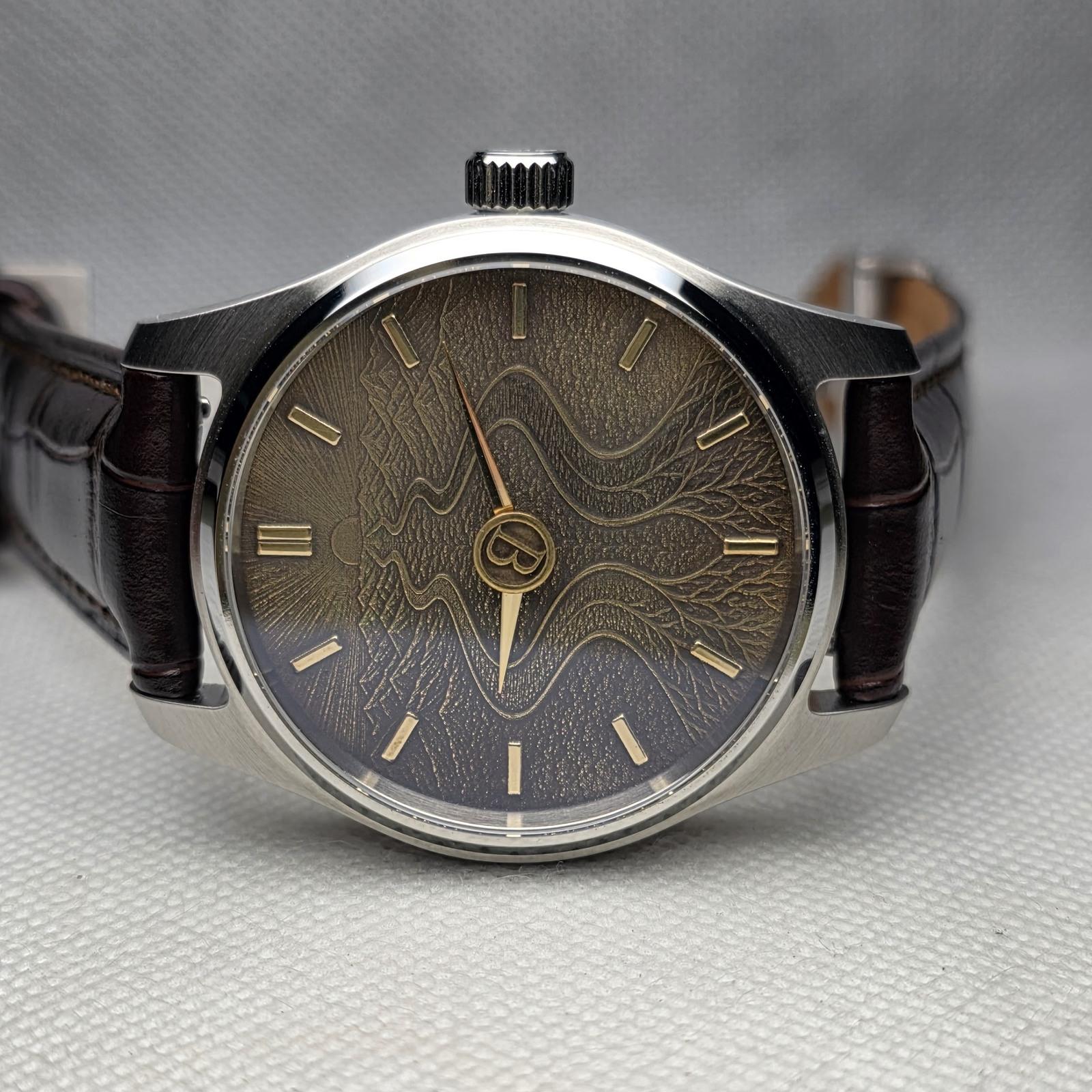
The Root of Our Legacy: A Son’s Gift to His Father
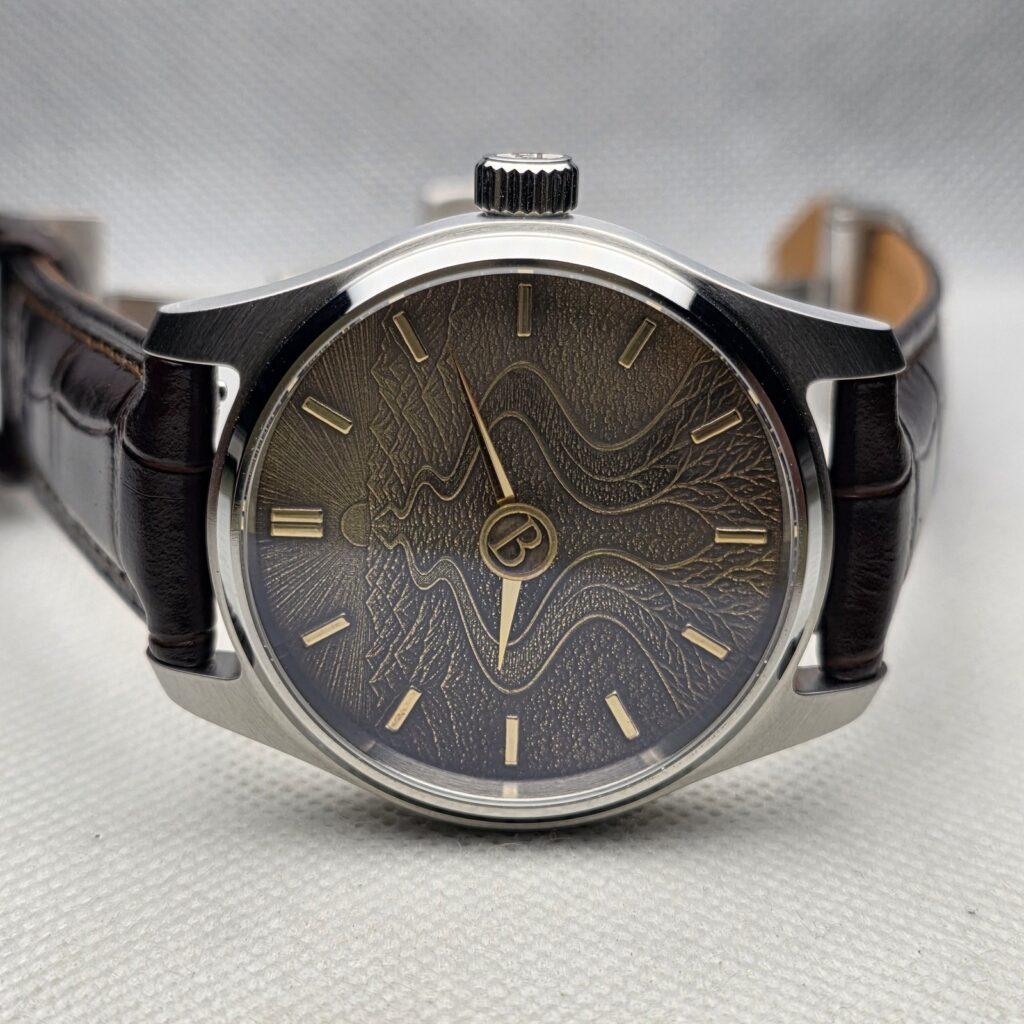
This Rexx commission began with a family idea: everything we become grows from our roots. On the dial, two paths travel alongside each other toward a sun, branching into roots below. The image carries the relationship without putting a written dedication across the face.
The brass dial was laser engraved, chemically darkened, then gently sanded and polished to reveal the artwork against the darker surface. Its 33.5mm diameter sits inside a 39mm case, giving the composition a substantial part of the watch’s face. Dial diameter and the visible opening are different measurements; the former does not establish the latter.
Meidan also made the custom seconds hand by laser, incorporating the client’s initial B. It is a moving detail rather than a fixed dial logo. The crown carries a matching reverse-etched B. Through the back, the engraved rotor shows two brothers walking a path, while the caseback carries the fuller legacy message shown below.
The useful design lesson is the division of the story: roots and paths on the dial, a personal initial in motion, and the family image and words on the back. Each detail has its own place.
See the photographs and join the original Legacy workshop discussion on Reddit. For a personal commission, the Rexx project inquiry is the place to describe the recipient, story and practical requirements.
Workshop disclosure: The Watcher HQ, Rexx Timepieces, Meshberg Watches and Rexx StudioWorks are part of the same maker-owned ecosystem. This is a Rexx commission, not a Meshberg production model.
Why a Custom Milestone Watch Works
Watches are unusually good at carrying memory because they connect an event to an ongoing ritual. You do not simply place the object on a shelf. You wind it, set it, fasten it, check it, and notice how it changes in different light. The milestone becomes part of ordinary life.
This is one reason graduation watches, wedding watches, retirement watches, and inherited watches appear so often in collector stories. In one Hodinkee reader-story collection, watches are tied to graduation, family values, travel, and years of later milestones. The important part is not the logo on the dial. It is the continuity between the day the watch entered a life and everything that happened afterward.
The same idea appears in the ritual of wearing a watch. A watch is functional, but it is also repetitive and physical. That repeated contact gives a personal build time to become more meaningful rather than less.
A Watch Can Hold a Story Without Explaining Everything
The first mistake in many custom projects is trying to make every detail visible at once. A couple wants two names, the wedding date, a location, a flower from the invitation, a line from a song, and the colors of the venue. A business founder wants the logo, launch date, product outline, coordinates, slogan, and company colors. Each detail matters on its own, but the dial has very little space.
The solution is hierarchy. Decide what the watch should communicate from across the room, what it should reveal at wrist distance, and what should remain private.
- From a distance: case shape, overall color, strap, and visual mood.
- At wrist distance: dial texture, marker style, hands, and one meaningful symbol or monogram.
- In private: dates, names, phrases, coordinates, or a fuller message on the caseback, clasp, or strap.
This approach gives the story layers. It also keeps the watch wearable. The owner can explain the meaning when they want to, but the design does not depend on a long explanation to look resolved.
The Best Personal Details Are Often Small
A personal watch does not need a portrait, a large logo, or a paragraph of text. Small signals often age better because they can survive changing taste.
- Initials or a monogram: especially effective when integrated into the hand stack, marker system, or dial pattern.
- A date: useful on a caseback, clasp, or the underside of a strap where it remains precise without dominating the dial.
- Coordinates: meaningful for a birthplace, studio, wedding location, or important journey, but usually better kept off the main display.
- A symbol: a branch, star, wave, architectural line, animal, tool, or abstract form can carry a story without spelling it out.
- A color: a family color, uniform tone, landscape reference, or material finish can establish the emotional direction quietly.
- A texture: engraving, brushing, chemical darkening, paint, or exposed metal can create character without adding more text.
- A strap or bracelet: often the easiest part to change later, and a good place for color, stitching, or private engraving.
The key word is one. One strong symbol usually has more authority than five weak ones. Our guide to how custom watches reflect personal style explores the broader design choices; a milestone build asks those same questions with a specific memory or achievement behind them.
Dial Color, Texture, and Layout Carry the Mood
The dial does most of the emotional work because it is the part the owner sees most often. Color can make the watch feel formal, hopeful, calm, technical, warm, or deliberately understated. Texture changes how that color behaves. A matte surface absorbs light. A radial finish moves with the wrist. An engraved surface reveals depth at an angle. Chemically darkened metal can make polished or exposed details stand forward.
Layout controls whether those ideas feel mature. Markers need room. Hands need contrast. A date window creates a visual weight that has to be balanced. A symbol placed near the center behaves differently from one replacing an hour marker. Even a beautiful artwork can fail as a watch dial if it interferes with time reading or looks cramped once reduced to roughly 28 to 32 millimeters.
This is why independent art dials are interesting when they are done well. They do not merely add decoration. They work with depth, material, contrast, and scale. If you want the practical workshop side, see how custom watch dials are made.
Put the Most Private Detail Where It Belongs
The caseback is valuable space. It can carry a longer message, a date, an image, a family phrase, or a dedication without compromising the front. A clasp or strap underside can hold another layer that only the owner normally sees.
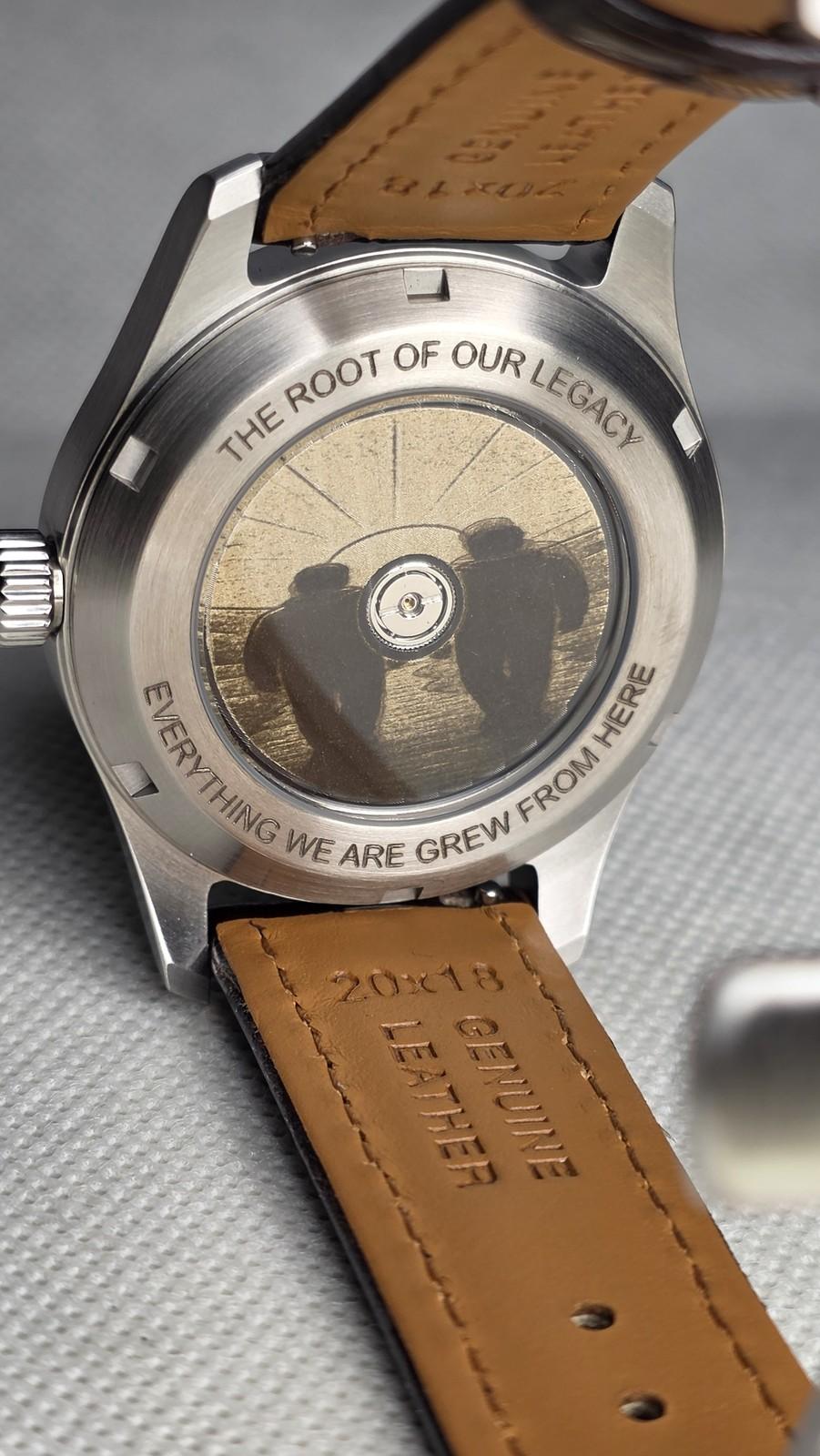
This separation is one of the most useful custom-watch principles. The dial handles daily legibility and identity. The back carries detail. Neither side has to do every job.
Engraving also has practical advantages. It is durable, does not change the hand stack, and can often be added without redesigning the entire watch. But the available surface, metal, coating, depth, and case construction still matter. A display back offers different possibilities from a solid back, and text has to remain large enough to engrave cleanly.
Technical Limits Make the Design Stronger
A workshop cannot treat a custom watch as a flat graphic. The design has to survive assembly. Dial diameter, dial feet, movement layout, center-hole size, date-window position, hand height, marker thickness, crystal clearance, case depth, crown alignment, and movement holder all affect what can be built.
Those limits are useful. They force the design to become clearer.
- A thick applied symbol may collide with the hands.
- A deep engraved surface can weaken thin areas of the dial.
- A dark-on-dark color scheme may disappear once the watch is under a crystal.
- A date window cannot move freely if the movement fixes its position.
- A large logo may leave the hour markers without enough breathing room.
- A dial made for one movement or case may not fit another.
This is where workshop review matters. The Rexx custom dial route lets a customer establish color, exposed metal, markers, movement layout, logo text, and surface pattern, but Rexx reviews the design for movement fit, case clearance, legibility, and production quality before it is made.
That review is not a compromise to the idea. It is the step that turns the idea into a watch.
Existing Watch or Full Custom Build?
There are two sensible ways to approach a milestone project.
Start With an Existing Watch
Choose a Rexx watch whose case, movement, size, and general character already suit the person. Then change the dial, hands, strap, bracelet, or engraving direction. This reduces uncertainty because the underlying watch platform is already known.
A custom dial can be ordered by itself or installed in any compatible Rexx watch. Compatibility still has to be confirmed. A dial that fits one movement, date layout, or case opening should not be assumed to fit every watch on the site.
Begin With a Broader Custom Idea
If the case style, movement, dial layout, hands, finishing, and engraving all need to change together, start with the Rexx custom-watch workshop. The project can then be evaluated as one system rather than as separate parts chosen in isolation.
For small workshop objects, loose dials, engraved pieces, and one-off craft, Rexx StudioWorks is the commerce layer. For real build and dial-making footage, the Rexx Timepieces YouTube channel provides the process proof behind the finished work.
Workshop Proof: A Hebrew Heritage Watch
The Rexx Timepieces Short Hebrew Heritage Watch | A Fully Custom Limited Edition Timepiece shows how a cultural reference can become a complete watch rather than a slogan placed on a dial. The project is explicitly credited as designed by Patriel and brought to life by Rexx Timepieces. That division of credit matters: it identifies the designer and the workshop role without guessing at movement specifications, edition size, or production methods that have not been publicly documented.
How to Brief a Maker Without Overdesigning
A good brief does not need to be technical. It needs priorities. Before contacting a builder, answer five questions:
- What is the milestone? State it in one sentence.
- Who will wear the watch? Include wrist size, normal clothing, and whether the watch should feel quiet or expressive.
- Which detail is essential? Choose the one element the finished watch must preserve.
- Which details can remain private? Move dates, messages, and names away from the dial when possible.
- What is flexible? Let the maker know which colors, materials, hands, or layouts can change for legibility and fit.
References help, but explain what you like about them. Saying “I like the warmth of this brown” is more useful than sending a full watch and asking for a copy. A sketch, photograph, family object, architectural pattern, or even a rough mood can be enough to begin.
What Usually Makes a Milestone Watch Weaker?
The common failures are not a lack of meaning. They are a lack of editing.
- Too many symbols compete for attention.
- Text becomes too small to read or engrave cleanly.
- The design copies a photograph literally instead of translating its idea.
- Low contrast makes the hands disappear.
- A large logo turns a personal watch into a promotional object.
- The brief ignores movement and case compatibility.
- The design follows the event theme so closely that it becomes difficult to wear afterward.
The best question is not “How much can we add?” It is “What can we remove without losing the reason for the watch?”
A Careful Note About Memorial Watches
Not every milestone is celebratory. A memorial watch can carry grief, family history, or public memory, and it deserves more care than an ordinary personalization exercise. Symbolism should be specific, respectful, and approved by the people connected to the story. It should never be used as generic decoration.
Rexx’s Frozen in Time – October 7th is an art piece rather than a conventional running watch. Its hands are fixed at 06:29, and its layered imagery was built around a defined memorial subject. It is useful here only as a reminder that serious meaning changes the design brief: the object must serve the memory, not the marketing around it.
The Watcher HQ Verdict
A custom milestone watch succeeds when it remains wearable after the occasion is over. The event gives the project a reason, but proportion, legibility, material, and restraint give it a future.
Choose one visible idea. Put private detail on the back. Let technical limits improve the composition. Most importantly, build a watch the owner would still choose even if nobody else knew the story.
That is the balance worth chasing: a real mechanical object first, and a personal record quietly built into it.
Frequently Asked Questions
What milestones can a custom watch mark?
Common examples include weddings, anniversaries, graduations, retirement, a new business, recovery, citizenship, a major journey, parenthood, family heritage, and memorials. The event matters less than whether the design choices are specific and durable.
Is engraving better than a custom dial?
Neither is automatically better. A custom dial changes the public character of the watch. Engraving is better for precise private information such as dates, names, coordinates, or a longer phrase. Many strong projects use both, with the dial kept simpler.
Can a custom dial be installed in any watch?
No. Dial diameter, movement layout, dial feet, date position, center opening, marker height, hand clearance, and case geometry all matter. Rexx can install a custom dial in any compatible Rexx watch, but compatibility must be checked for the specific model.
How long does a custom milestone watch take?
Timing depends on the case, movement, dial process, engraving, finishing, parts availability, revisions, and testing. A dial change on an established platform is usually simpler than a one-off build, but the workshop should confirm timing only after reviewing the actual brief.