Watch building vs watchmaking is best understood as a difference in scope, not a contest over who is allowed to care about watches. A watch builder usually assembles a watch from compatible cases, movements, dials, hands, crowns, crystals, and straps. A watchmaker may do that too, but the professional scope normally extends into diagnosis, servicing, adjustment, repair, testing, refinishing, and sometimes making or modifying components.
Both kinds of work can require patience, dexterity, cleanliness, and mechanical judgment. The confusion begins when a neatly assembled custom watch is described as proof of every skill involved in professional watchmaking, or when assembly is dismissed as if it requires no skill at all. Neither position is useful.
The short answer: building proves that someone can select, fit, and assemble a working combination of parts. Watchmaking covers the deeper responsibility of understanding why the watch works, finding why it does not, correcting faults, measuring the result, and returning the watch in a condition suitable for use.
Watch Building vs Watchmaking: Why the Terms Get Blurred
For the company and supply-chain view behind those bench roles, see who really makes a watch. It distinguishes ownership, design, movement and component production, assembly, testing, warranty, and service without using one label for every task.
Modern watch culture brings several worlds together. There are hobbyists assembling their first watch from a kit, Seiko modders combining compatible aftermarket parts, small brands developing watches with manufacturing partners, restoration specialists working on discontinued calibres, and trained watchmakers servicing watches at a bench. Social media often compresses all of that into the word “watchmaking.â€
There is no universal law that assigns every watch-related activity one protected English title in every country. “Watch builder†is especially informal. It is useful because it describes a real activity without pretending that all builders have the same training or perform the same work. Professional standards, however, show that watchmaking is much broader than installing a dial and hands.
The American Watchmakers-Clockmakers Institute CW21 standard covers quality repair, timing, water resistance, refinishing, micromechanics, and the ability to make or modify basic components. WOSTEP’s full watchmaker program adds advanced regulation, escapement work, chronographs, material science, turning, milling, and high-end finishing. The British Horological Institute diploma pathway progresses from servicing technician work to skilled watchmaking and then repair, restoration, and conservation.
Those programs do not mean that every competent watchmaker performs every advanced task every day. They show the range of knowledge behind the profession.
What Watch Building Usually Means
Watch building usually begins with parts that were designed to work within an established system. A builder may select a movement, case, dial, hands, chapter ring, bezel, crown, crystal, and strap, then assemble them into a complete watch. In a good build, the choices are not random. Dimensions, tolerances, hand stack, dial opening, stem height, movement holder, crown position, crystal clearance, and gasket condition all have to agree.
That is why a careful build is more than decorative customization. Installing hands without marking the dial, cutting a stem to the correct length, keeping dust away from the finished dial, aligning a chapter ring, closing the case without trapping a gasket, and confirming that the hands clear each other all require practical skill.
Beginner training recognizes this value. AWCI’s distance-learning Basic Assembly course, for example, uses disassembly and reassembly to teach movement components and their functions. Assembly is a legitimate way into the subject. It simply is not the whole subject.
For a closer look at the custom-watch side, see our guide to what watch modding is, the practical sequence for building a Seiko mod, and the compatibility issues covered in Seiko modding parts explained.
What Professional Watchmaking Adds
A watchmaker has to work beyond the assumption that all the supplied parts are clean, correct, and compatible. The watch may arrive running badly, stopping intermittently, winding roughly, leaking, or showing damage from a previous repair. The first task is often diagnosis.
That may involve documenting the watch, opening the case correctly, checking the movement under magnification, evaluating amplitude and beat error, tracing faults through the gear train or automatic winding system, testing electrical components in a quartz watch, and deciding what can be cleaned, adjusted, repaired, or replaced.
A full mechanical service normally requires controlled disassembly, cleaning, inspection, correct lubrication, reassembly, regulation, and testing. The work has to remain traceable: a good result is not merely “it ticks.†The watch should wind, set, change date where applicable, retain appropriate power, run within an agreed standard, and pass the relevant functional checks.
Water resistance is another dividing line. Replacing a caseback gasket does not prove that a watch is water resistant. The case, crystal, tube, crown, pushers, seals, and closure all form part of the system, and the result should be tested with suitable equipment. Our guide to watch accuracy and regulation explains the same principle on the movement side: a single seconds-per-day claim is not a complete diagnosis.
How the Work Compares at the Bench
| Area | Watch Building or Modding | Professional Watchmaking |
|---|---|---|
| Starting point | Known, compatible parts or a planned custom configuration | A complete watch that may have unknown faults, wear, contamination, or past repairs |
| Core task | Select, fit, align, and assemble parts cleanly | Diagnose, service, repair, adjust, test, and document the watch |
| Movement work | Often installs a complete working movement | May fully disassemble, clean, inspect, lubricate, repair, and regulate the movement |
| Compatibility | Checks dimensions, stem position, hand sizes, dial fit, and clearances | Must also recognize wear, damage, wrong parts, poor previous work, and hidden faults |
| Testing | Basic function, hand clearance, crown action, timing, and visual inspection | Position-dependent timing, power reserve, functions, automatic winding, water resistance, and service-specific checks |
| Fabrication | Usually limited or outsourced | Advanced work can include making or modifying components and tools |
The table describes typical scope, not a rigid hierarchy of people. An experienced builder may learn regulation, pressure testing, refinishing, or movement service. A service watchmaker may specialize and rarely fabricate a balance staff. The honest description depends on the work actually performed.
The Skills That Overlap
Good builders and watchmakers share several habits. They protect finished surfaces, control dust, use the correct screwdriver, understand that force is usually a warning, and inspect their work under magnification. Both need steady hand control and a willingness to stop when a part does not behave as expected.
They also need visual judgment. Dial spacing, hand length, case proportion, finish transitions, and strap choice determine whether a watch feels resolved. A watchmaker may encounter those questions during restoration or refinishing; a custom builder meets them while creating the watch’s final identity.
Rexx Timepieces is useful workshop evidence here because the work crosses several layers: custom-watch assembly, Seiko mods, dial design, laser engraving, finishing, and practical experimentation. The Rexx Timepieces YouTube channel shows the hands-on process rather than asking readers to accept a generic craft claim. The important wording is still specific: a custom build demonstrates building and finishing decisions; it does not automatically claim every discipline in restoration or traditional component manufacture.
Tools Reveal the Difference in Scope
Assembly Tools
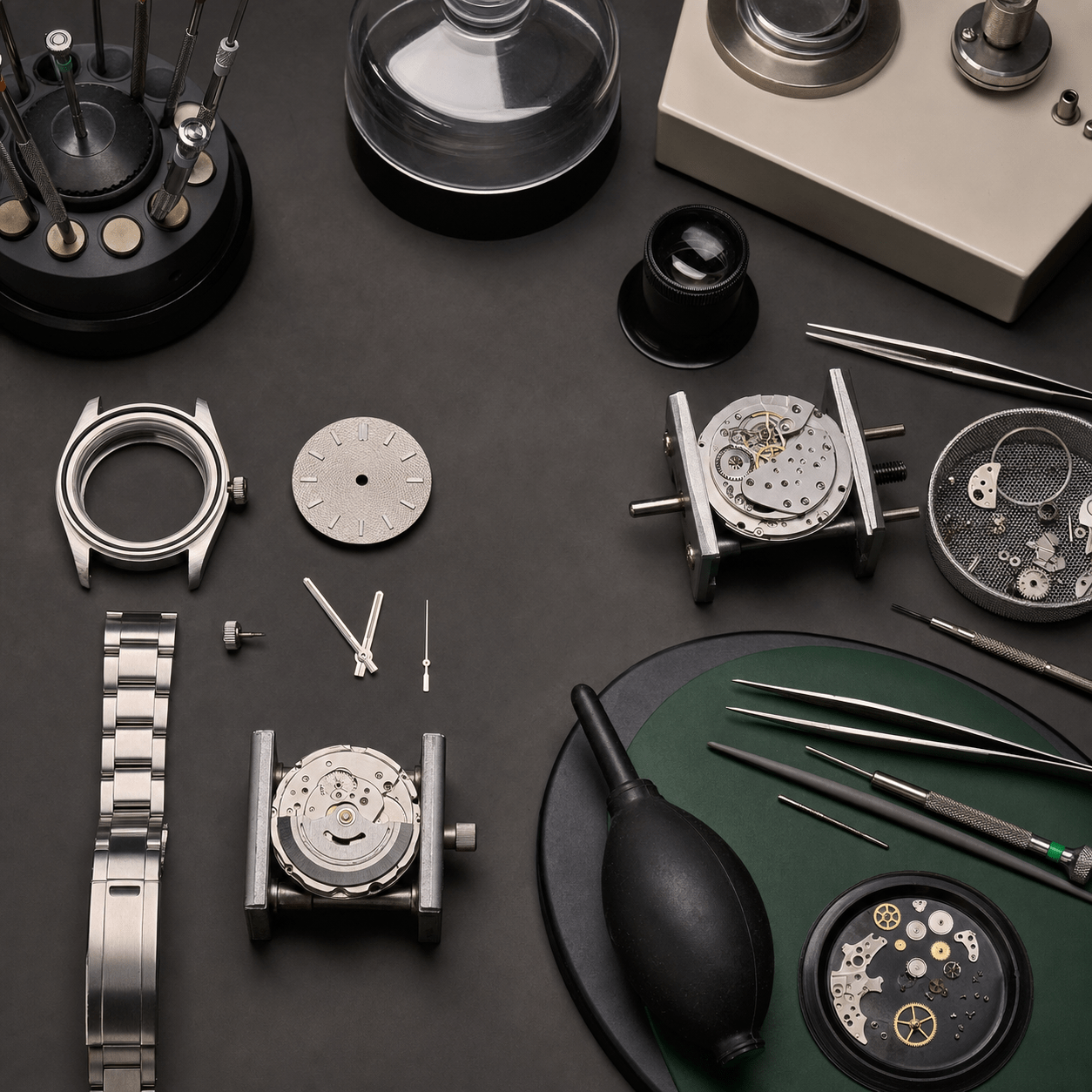
Movement holder, case cushion, quality screwdrivers, non-magnetic tweezers, hand-setting tools, hand removers, loupe, blower, dust cover, stem cutter, files, caseback tools, and suitable finger protection.
Service and Test Tools
Cleaning equipment, oilers and lubricants, timing machine, demagnetizer, mainspring tools, movement-specific holders, pressure tester, electrical test equipment for quartz, and controlled inspection equipment.
Advanced Workshop Tools
Lathe, staking set, jewelling tools, milling or drilling equipment, refinishing machinery, measuring instruments, heat-treatment equipment, and specialist tools made for a calibre or repair.
Owning the tools does not create the skill. It creates the ability to practise the skill and, in careless hands, the ability to damage a watch more efficiently. Beginners should build their tool set around the task in front of them. Our beginner guide to Seiko modding tools covers the assembly layer without pretending that it replaces watchmaker training.
Where Dial Making and Case Work Fit
Dial work is its own field with several possible levels. Applying a ready-made logo, printing a dial, laser engraving a metal blank, hand finishing a surface, setting markers, and creating a dial from raw material are different processes. A workshop may perform some stages in-house and work with specialists for others.
The same applies to cases and finishing. Brushing a scratched clasp, restoring a defined case geometry, coating a case, machining a new case, and engineering a water-resistant case system are not interchangeable claims. Precise language makes the work more interesting because the reader can understand what was actually solved.
For that deeper material layer, read how custom watch dials are made, our guide to watch dial materials and texture, and watch case materials explained.
Three Honest Ways to Describe the Work
1. “I assembled a custom watch from compatible parts.†This is clear and respectable. It tells the owner that the movement, case, dial, and hands were selected and fitted as a complete design.
2. “I built the watch and regulated and pressure-tested it.†This adds specific evidence. It tells the owner that timing and water-resistance checks were part of the delivered work, assuming the workshop can document those results.
3. “I serviced or repaired the movement.†This should mean movement-level work, not simply installing a new movement. The description should identify what was diagnosed, serviced, adjusted, repaired, or replaced.
Specific language builds more trust than the broadest possible title. It also helps customers compare quotes correctly. A low-cost assembly, a full movement service, and a one-off dial development project should not be expected to carry the same labour, equipment, or risk.
What Customers Should Ask Before Commissioning Work
A Practical Commission Checklist
- Which parts are made, modified, finished, or purchased?
- Who supplies the movement, case, dial, hands, and bracelet?
- What movement-level work is included?
- Will the watch be regulated, and how will the result be reported?
- Will water resistance be tested, and to what stated standard?
- What happens if a supplied part is defective or incompatible?
- Which work is performed in-house and which is outsourced?
- What warranty, return, and future-service terms apply?
These questions are not an accusation. A serious builder or watchmaker should welcome a chance to define the job. The answers also protect the workshop from expectations that were never part of the commission.
So, Is a Watch Builder a Watchmaker?
Sometimes the same person is both. Many watchmakers build custom watches, and many builders continue training until they can diagnose and service movements properly. But one completed assembly does not demonstrate the full professional scope of watchmaking, just as replacing a strap does not demonstrate case restoration.
The fairest conclusion is not to police enthusiasm. It is to respect the depth of each task. Clean custom assembly deserves credit. Good design judgment deserves credit. Dial making and finishing deserve accurate credit. Professional diagnosis, service, repair, testing, and fabrication deserve credit too.
For a beginner deciding where to start, should you build your own watch? gives the practical trade-offs. If the movement itself is still unfamiliar, begin with our beginner’s guide to mechanical watches. The more clearly you understand the layers, the easier it becomes to learn the next one without overstating the last.